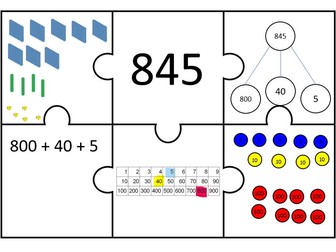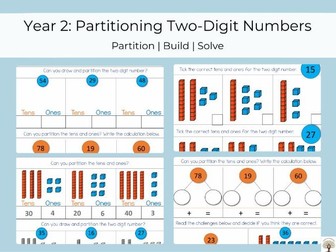
10 x 2, 3 and 4 digit place value jigsaws (30 in total)
Get children to match up the correct pieces of the jigsaw by using their knowledge of place value. Also includes 4 blank jigsaws so children can make their own.
I recommend printing on card for durability as these will need to be cut up.
Perfect for an introduction into place value.
Fully editable in Microsoft PowerPoint. Configured to print on A4. Download also includes a PDF copy should you wish to print from that.
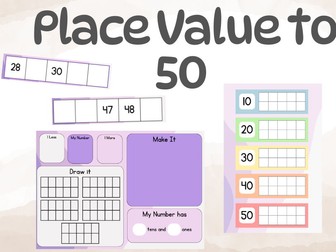
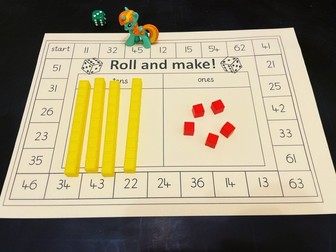
Practise place value to 100 by rolling a dice and building the number you land on, using base ten equipment.
Included:
PPT of baord game for editing numbers
PDF for easy printing
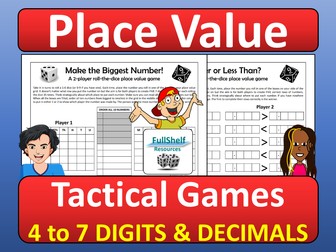
Key Stage 2 (KS2) Year 3, 4, 5 and 6 maths dice games for place value up to millions and decimals to 3 places. Includes games for 4, 5, 6 and 7 digit numbers (thousands, ten thousands, hundred thousands and millions) and 1, 2 and 3 decimal places (tenths, hundredths and thousandths). A fun, more challenging and strategic twist on an old idea, these 19 games will make students think carefully about where to place digits, practise their ordering skills, develop interesting tactics and prolong the uncertainty until the final moments. 24 pages, PDF format.
Great for starters, early finishers, revision or as a fun homework task
Many levels of challenge - ideal for differentiation or for use across year groups
Use as printed worksheets or else laminate (or use in dry-wipe sleeves) and complete with whiteboard pens
Instead of playing in pairs, you might form small groups - pairs could play against pairs instead of one-versus-one and you might appoint a checker who can adjudicate (and then swap roles for the next game). Consider enlarging to A3 for larger groups.
There is a mixture of Make the Biggest Number, Make the Smallest Number and Greater or Less Than games
Every turn, players can place the digit they throw on any row or column, until there are no vacant boxes remaining, prolonging the uncertainty! Keeping an eye on each other’s numbers as they form, players will begin to spot new tactics; for instance they might notice that a 1 placed in a thousands place might not be so costly if there’s a 9 in the ten thousands place, depending on what their opponent is doing on their grid. They can also practise saying their completed numbers aloud at the end.
If you don’t have a 0-9 dice, the games still work with a 1-6 dice. Alternatively:
Use 0-9 spinners (I have included black and white and colour templates for your convenience) if you wish to make some
Use digit cards (basic digit cards included in the file)
Use a pack of playing cards (use Aces as 1 and Jacks as 0, put aside the Kings and Queens; shuffle the pack and take one card in turn)
Instructions are printed on the boards.
Thank you very much for supporting my store.
YOU MIGHT ALSO LIKE…
Multiplication and Division Activities BUNDLE
Maths Puzzles Worksheets HUGE BUNDLE
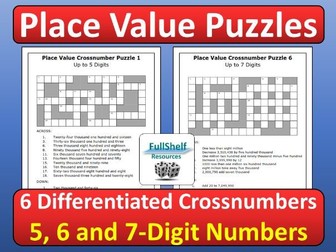
Place Value CrossNumber Puzzles
Area and Perimeter Activities BUNDLE
Explore more at FullShelf Resources
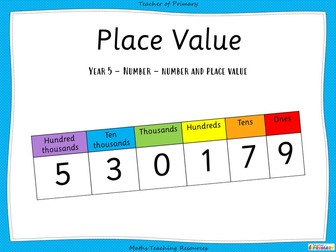
Place Value - Year 5
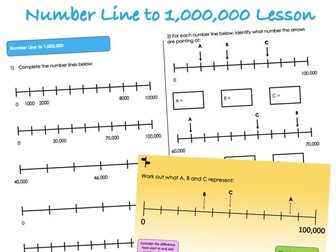
This KS2 mathematics teaching resource is an aid to delivering a lesson on numbers up to 1,000,000 and place value, covering the curriculum objectives of the year 5 maths programme of study (Number - number and place value). Content includes:
Four-digit number recap
What is a five-digit number
What is a six-digit number
Place value explanation
Place value activity and worksheet
Further place value activity and worksheet
Partitioning six-digit numbers activity and worksheet
Make the highest and lowest six-digit number activity and worksheet
Two power of 10 multiplication and division class activities
Link to a place value game
Further worksheet and answers
‘Place Value - Year 5’ is editable so teachers can adapt the resource, if needed, to suit their individual teaching requirements.
Not quite what you’re looking for? Click below to see similar Year 5 place value resources:
Number and Place Value - Year 5
This is set 1 of the worksheets I created for children working below Key Stage in my Year 6 class.
Lesson 1 and 2 work with 2 digit place value.
Lesson 3 and 4 are beginning to look at 3 digit.
The resource would also be suitable for KS1 use.
There are references to the Birmingham Toolkit Banding in the learning intentions for reference.
This lesson takes learners through a series of assessments to ensure they have met all their place value objectives. It has a series of tasks and discussions about the meaning of place value, reading and writing numbers and it follows a graduated release with I do, We do, You do format. The independent task is linked with Year 5, Year 4 and Year 3 place value skills so it can be differentiated for the learner, depending on their gaps and where they are in the phases. The sheets can be adapted easily to change numbers or volumes of digits.
I am using this resource to consolidate after picking up a new class. I want to ensure they have met their objectives but I have also used it at the beginning of the year as an assessment to create flexible groups for my first place value lesson and adapt my unit of teaching to emphasis key gaps for the class, groups and individuals.
Enjoy!
Place Value Grid with 4 different layout options available.
Layout 1 - Ones to Millions, including 3 decimal places (no border)
Layout 2 - Ones to Millions, including 3 decimal places (border)
Layout 3 - Ones to millions - no decimal places (no border)
Layout 4 - Ones to millions - no decimal places (border)
A fantastic resource that can be printed and laminated on A4 or A3 and used in any KS2 class to support number work.
The PDF can also be uploaded to online learning platforms (e.g. Seesaw) to be used electronically.
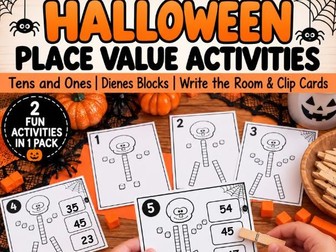
You will need dienes for this. Children to make a monster representing the value on the card. These are numbers between 100 and 1000. Suitable especially for children in Year 3 and 4. Can be used for a unit on place value or a game at any other time in the maths year.
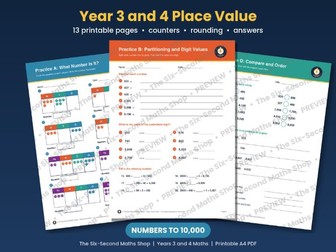
I have designed these place value charts to use with my Year 4 students - one chart simply shows Thousands, Hundreds, Tens and Ones, the other shows Tenths and Hundredths as well.
The simpler chart I use in the Autumn Term, before we cover decimal numbers. I use the more complicated one in the Spring and Summer Terms. These are in colour - I laminate these charts to use throughout the year.
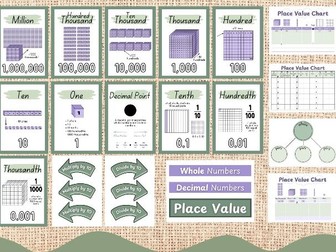
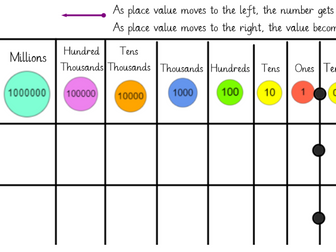
Place value display from thousands to thousandths.
Primary display resource. Colours match standard place value counters.
Perfect for KS2 maths or KS1 without the decimal section.
Number
Place Value
Decimal
Place Value - Hundreds, Tens and Ones - Year 3
In this year 3 teaching resource pupils are taught to recognise the value of each digit in a three-digit number (hundreds, tens, ones) as per the curriculum objectives of the year 3 maths programme of study (Number - number and place value). Content includes:
1. One, two and three-digit number explanations
2. A tens and ones activity with accompanying worksheet
3. 3 hundreds, tens and ones activities with accompanying worksheets
4. A place value explanation
5. A link to a place value educational video
6. 1 further worksheet with answers
‘Place Value - Hundreds, Tens and Ones - Year 3’ can be edited giving teachers the freedom to adapt the resource to suit their individual teaching requirements.
Download this GCSE Maths Place Value & Ordering worksheet with answers. Printable 5 page PDF worksheet for teachers. Covers Foundation & Higher content.
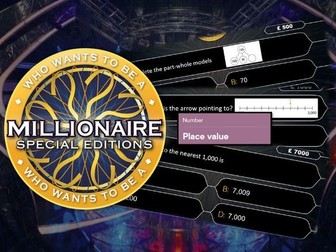
Fun and engaging blockbusters activity for the classroom based on the classic TV show. This particular activity is designed to help pupils consolidate their knowledge of place value.
Split the class into two teams and assign each one to be either blue or white. Each team takes turns to choose a letter that will then reveal a question. If they get the question right make the tile their colour by clicking the blue or white boxes on each tile.
The blue team win if they make a connected row across the screen, and the white team win if they make one going down. Because the blue team have another tile to complete, they should go first.
KS2 Maths Teaching Resources: Place Value Decimals
‘Place Value Decimals’ has been designed to help delivery of a lesson covering many of the curriculum objectives in the KS2 maths programme of study - Number - Fractions (including decimals and percentages). Content includes:
Place value and decimals explanation
Converting fractions into decimals activities
Decimal place value activity
Multiplying and dividing by 10, 100 and 1000 printable worksheet and number cards and activity
Finding decimals on a number line activity
Ordering decimal numbers activity
comparing decimal numbers activity
Decimal loop game worksheet printable
This animated maths PowerPoint presentation can be edited so teachers are able to adapt the resource to suit their individual teaching requirements.
Not quite what you’re looking for? Click below for similar Year 5 decimals resources:
Measurement and Decimal Notation - KS2
Subtracting Decimals Within 1 - Year 5
Decimals - Making 1 - Year 5
Adding Decimals (with the same number of decimal places) - Year 5
Adding Decimals Within 1 - Year 5
Adding Decimals Beyond 1 - Year 5
Colour-coded colouring worksheet to help children recognise the value of zero as a placeholder. Two copies of sheet included so that this can be printed 2 per page and stuck in an A5 book or one per page and used as an A4 worksheet. The final sheet is the answer sheet.
The activity sheet also includes a traffic light outline for self-assessment to allow children to share their confidence level.
This resource contains two worksheets on place value to 100. It has been designed for students working towards the AQA Entry Level Certificate in Maths who are working at Entry Level 2.
You may also be interested in:
Numbers to 100 AQA Entry Level 2 Maths
This resource contains an age-appropriate, 36 page workbook (36 worksheets) with progress check, certificate of achievement and answers for: Component 1: Properties of Number.
Tasks and activities have been designed to help students achieve these learning outcomes:
2.1 Read, write, order and compare numbers up to 100
2.2 Recognise place value in two digit numbers
2.3 Count from 0 in steps of two, three and five
2.4 Round numbers less than 100 to the nearest 10
2.5 Understand and identify odd and even numbers
More AQA Entry Level Maths Resources