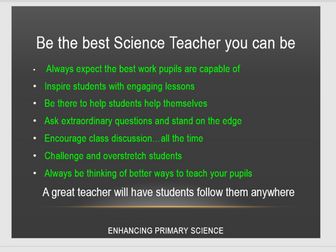
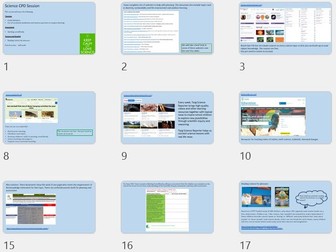
An invaluable science CPD PPT to be used by both science subject leads and classroom teachers. The PPT would be particularly useful to use in a staff meeting. It displays the best websites to use for primary science planning and gives a range of methods for extending children’s learning in the classroom. Also included is a useful websites document and Year 5/6 self-assessment grid.
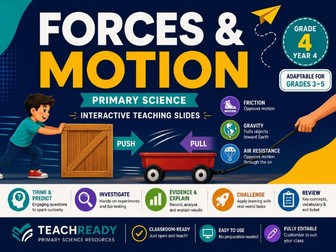
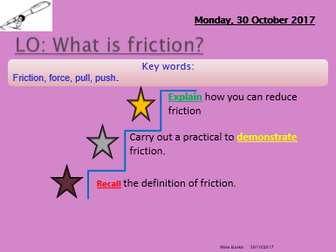
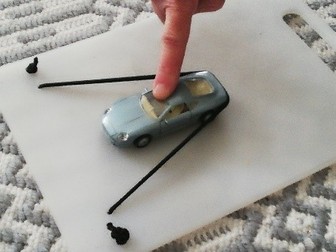
Teach forces and motion with this ready-to-use primary science presentation covering pushes and pulls, friction, gravity, air resistance, balanced and unbalanced forces, and scientific investigation.
This 30-slide presentation combines clear explanations, engaging visuals, prediction questions, practical investigation prompts, challenges and review activities.
Includes:
What is a force?
Pushes and pulls
How forces change motion
Contact and non-contact forces
Friction and friction investigation
Gravity and motion
Air resistance investigation
Balanced and unbalanced forces
Fair testing and evidence
Design challenge
Review and exit ticket
Ideal for: Grade 4 / Year 4 Science and adaptable for Grades 3–5.
Format: Editable PowerPoint presentation (.pptx)
Teacher-friendly. Student-ready. Ready to teach.
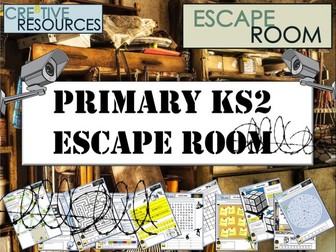
Brand New KS2 PRIMARY ESCAPE ROOM - End of Year Virtual Escape Room by Cre8tive Resources! Students must escape the haunted School. This lasts an hour or under depending on how quick the teams can solve each puzzle! Students love this style of lesson, great as an educational treat for your KS2 class. The Puzzles cover every subject that KS2 students will study (Some English, Maths, Science and Humanities with a sprinkling of PSHE, Citizenship and Art)
This is a completely different escape from any of our other escape rooms (even the keys have been adapted and the final bonus escape is unique as well as our new style of Question Tree Puzzle!)
✰✰✰✰✰✰✰✰✰✰✰✰✰✰✰✰✰✰✰✰✰✰✰✰✰✰✰✰✰✰✰✰✰✰✰✰✰✰✰✰✰
Product Contents:
☞ Escape Room Interactive Tracker PowerPoint - Keeps the competitive nature on display
☞ Escape Room Puzzle Keys (Six Sets for Six Teams)
☞ Escape Room Team sheet - Record codes, answers clues as they progress through the 7 rooms
☞ Escape Room Puzzles (7 Rooms = 7 Different styles of Puzzles involving numeracy, literacy and lateral thinking)
☞ Teacher Answer Sheet - Quickly confirm to teams they have solved the puzzle correctly
☞ Teacher instructions of how to set up the escape room and what to print and top tips and shortcuts.
☞ Successful Escape Certificates for those that complete the entire challenge (There is a difficult bonus escape too :) for any quick teams
☞ The 7 Rooms each have a specific Puzzle that has been adapted to suit the topic of this Escape Room and is suitable to KS3 and KS4 Student
✰✰✰✰✰✰✰✰✰✰✰✰✰✰✰✰✰✰✰✰✰✰✰✰✰✰✰✰✰✰✰✰✰✰✰✰✰✰✰✰✰
Our Philosophy
We aim to help you equip students with the knowledge and skills to take ownership of their own learning. Our Products come ‘Ready-to-Teach’ with everything you need to teach fun and creative lessons. Our products are teacher-designed, classroom tested & student approved.
✰✰✰✰✰✰✰✰✰✰✰✰✰✰✰✰✰✰✰✰✰✰✰✰✰✰✰✰✰✰✰✰✰✰✰✰✰✰✰✰✰
The 7 Rooms include: Secret Bunker, Space Station, Garden Tunnel, The Office, Dungeon, The Island, Skate Park (Each Puzzle has been adapted to suit the topic of this Escape Room and is suitable to KS3 and KS4 Student or even bright KS2 students. C8/ES/46
JUST PRINT AND GO!
They can also be used to encourage a flipped learning environment.
How can this resource be adapted for social distancing?
Upload / send the sheets digitally so students can work independently through them (don’t use the keys or PPT tracker if so)
Could use as part of a Recovery Curriculum
Set the 7 Puzzles for Homework
Pairs instead of groups
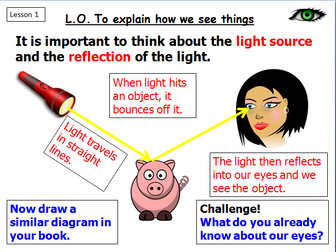
A fully resourced KS2 science lesson about the human eye and how we see. The lesson contains a teaching PowerPoint, full planning and differentiated tasks (challenge and extra support). The resource explores how we see things, then focuses on the different parts of the eye and their functions. The independent tasks for the children also link to these themes.
Please note: some video links are included in the sessions, which should always be assessed for suitability prior to use!
Includes:
*Teacher PowerPoint presentation
*2 differentiated eye labelling task sheets (lower and middle/higher ability)
*3 differentiated eye part functions task sheets (lower, middle & higher ability)
*Full planning, linked to science curriculum
Please see the Goldtopfox shop for more great teaching resources:
https://www.tes.com/teaching-resources/shop/goldtopfox
A set of bright and eye catching headings to set up a science working wall in your classroom. To be printed on card or on paper and laminated to use year after year. Selected images are in line with the NC requirements (in England) for Year 2. The set includes:
Main Working Wall Heading
Key Words - where you will display key science vocabulary that children will be learning and using in the topic
Our Scientific Questions - where you will display children’s questions about their current topic
Our Findings - where you will display examples of data collected through children’s scientific enquiry work
We are working like… - linking children’s learning to scientific careers
What we know to begin with - where you will display children’s prior knowledge about the topic
Superstar Scientists - where you can celebrate successful young scientists by displaying exemplary pieces of work or photos of children working scientifically and displaying excellent skills (scientist of the week)
Key vocabulary cards - sets of key vocabulary cards for animals, humans, uses for materials, living things & their habitats and plants
For a consistent approach across Years 1 to 6 why not consider the bundle.
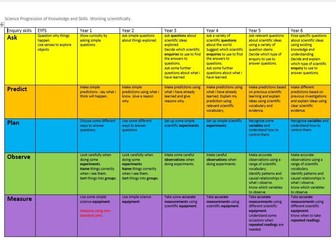
Grids showing progression of knowledge and skills across all areas of primary science. Supports whole school monitoring of curriculum coverage and progression of skills by science lead. All documents show how knowledge and skills from each area of primary science are developed across each year group. Links to different units of work are included to show how knowledge from one year group supports another year groups work in a different area. Progression in working scientifically is colour-coded and broken down into key skills under one-word headings.
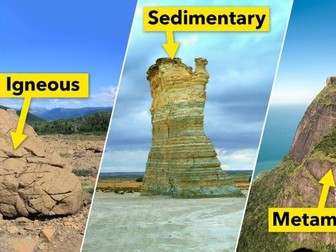
In this exciting unit, Year 3 students dive into the world of geology by exploring different types of rocks and their properties. Through hands-on investigations, students learn to identify and classify rocks, understanding how they’re formed and why they’re important in our everyday lives. From examining fossils to observing soil samples, this unit brings science to life, connecting the natural world to real-world applications and sparking curiosity about the earth beneath our feet. Perfect for budding scientists, this topic encourages observation, classification skills, and a deeper appreciation of nature’s incredible diversity!
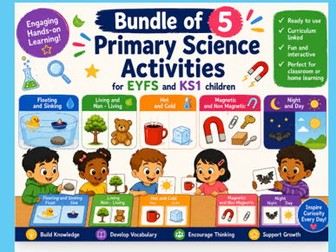
This primary science resource bundle includes five popular topics: Floating and Sinking, Living and Non-Living, Hot and Cold, Magnetic and Non-Magnetic, and Night and Day.
Topic set contains 10 worksheets – 5 colour worksheets and 5 matching black-and-white versions.
The Floating and Sinking has 9 black and white sheets with a blank template included.
Children develop observation, discussion, and classification skills as they sort and match pictures under the correct categories, helping them build early scientific understanding through hands-on learning and visual exploration.
Designed for EYFS, KS1 and SEND learners, these activities encourage curiosity, vocabulary development, and critical thinking.
If your fed up with hunting for decent science assessments for Primary children, or paying well over the odds for them, then look no further. This resource includes twenty-eight different assessments as well as a detailed mark scheme, designed to make marking efficient. Every single Primary science objective (NC 2014) is covered in each of the child friendly tests. Not enough? Well, also included is an excel spreadsheet which has been designed to make tracking progress a breeze. Simply fill in the marks for each child and the spreadsheet will do the rest of the work for you. It will give you a ‘grade’ for each individual objective, a total grade for each science topic and an overall science grade. This method of assessment quickly allows you not just to see individual pupils’ weaknesses, but also weaknesses within the class as a whole and provides the teacher with an excellent evidence base. In this era of tracking without levels, this is an essential resource for all Primary teachers. Please, leave feedback for this amazing resource!
ALSO ADDED: Individual assessments for ALL science objectives for ALL year groups are available for purchase as are individual year group, KS1, KS2 or complete Primary packs. Visit my shop – by clicking on my username – to find these great resources + lots more! And if you like these Science Assessments, you will also like my maths assessments – check them out in my shop!
Primary Science Scheme of Work put together by a Science Lead.
Scheme of work includes;
Lesson objectives/questions
Key questions
Key Vocabulary
National Curriculum reference
This scheme of work has been implemented since September 2019 and has had a very positive impact.
Also includes yearly overview and intent statement.
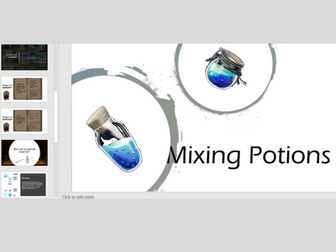
This lesson is appropriate for ages 8-11 years old. It can support children to learn about mixtures and solutions with included videos and tasks. This is a powerpoint which offers a wizard/ magic theme to keep young children engaged. It has been used to teach Year 5 successfully. I recommend preparing resources from your kitchen, a spoon to mix and a bowl of water for the main activity. Can easily be completed from home.
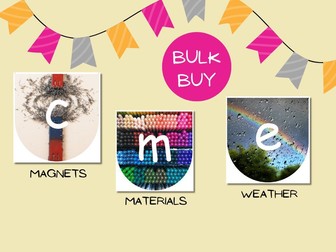
A collection of 3 colourful and engaging science display bunting sets:
forces and magnets
materials
weather
Each of the bunting documents contain the complete alphabet (including a capital W and H and a question mark) so the wording can reflect a question or a phrase that you would like. They contain high quality images so you can be assured they will make any display look professional and engaging. Save money if bought as a bundle!
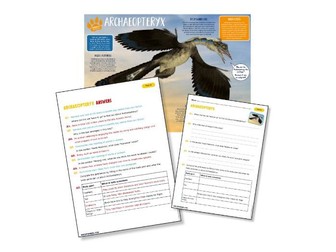
This non-chronological report text for upper KS2, linking to the topics evolution and inheritance and biological systems, tells you all about the Archaeopteryx. The text explains how these ancient dinosaurs were an evolutionary link between the dinosaurs and modern birds and how Charles Darwin used this information to help inform his theory of evolution.
This downloadable reading pack includes:
An A3 reading spread for you to print.
Reading comprehension question and answer sheets.
Here are a collection of fun science experiments, designed for Primary and SEN pupils. Collected and adapted from various sites including the Science Museum. Ideal way to inject a little fun into those end of term lessons. I will continue to add more experiments and investigations when I get the time and after my pupils have proved that they can work.
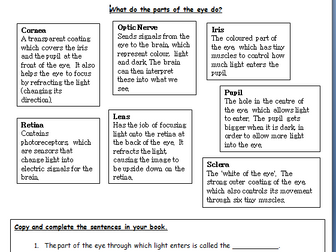
2 worksheets for use in a KS2 lesson about the parts of the human eye:
*Labelling key parts of the eye
*Explaining what different parts of the eye do
These worksheets are a small segment of a full lesson on the human eye, which covers light sources, how we see and the functions of the parts of the eye. The full lesson, which also includes a teaching PowerPoint, differentiated task sheets and full planning, can be found in my TES shop here:
https://www.tes.com/teaching-resource/the-human-eye-a-primary-science-lesson-11516052


 Quick View