All you need to teach Issues and Debates in Psychology. Includes a student work book and Power Point presentation, student tasks. Can be used in the classroom or for flipped learning.
Written by an experienced teacher and examiner.
Deb Gajic
CPsychol
AFBPsS
This lesson was created using the latest AQA A-Level Specification (published June 2019) although content and activities may be useful for other specifications.
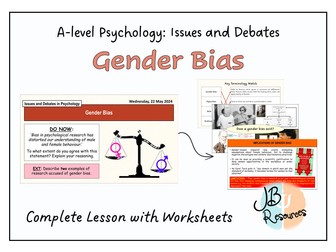
Key content covered in this Lesson:
Key Questions
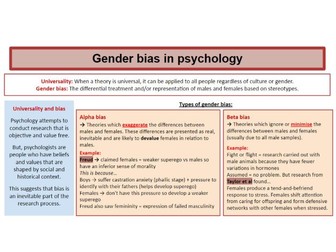
Universality and Bias
Alpha Bias
Beta Bias
Androcentrism
Activity: Key Term Match
Class Discussion: Application to Research
Using Issues and Debates to Enhance Your Evaluation
Exam Practice with Mark Scheme: Short Answer Question
Evaluation worksheet
Evaluation points
Plenary: Consolidation Question
To request lessons, provide feedback or if you have had any issues opening any resources of my resources, please feel free to contact jb_resources@outlook.com.
Reviews and feedback are always welcome.
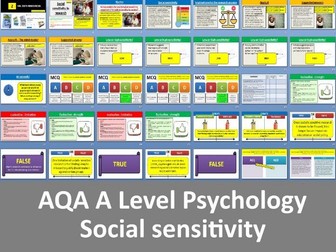
This engaging lesson introduces AQA A Level Psychology students to socially sensitive research as part of the Issues and Debates topic. Students explore what makes research socially sensitive, why it matters, and how psychologists can manage ethical implications responsibly.
The lesson begins with a thought-provoking moral starter question to encourage discussion and link psychology to real-life decision making. Core AO1 knowledge is delivered through clear, concise explanations of social sensitivity and ethical implications, supported by key researchers such as Sieber and Stanley (1988) and real-world examples.
Students then apply their understanding through AO2 scenario-based tasks, including research on gifted children and Adrian Owen’s “mind reader” study, before testing understanding with mini whiteboard activities, low/high sensitivity questions, and MCQs.
AO3 evaluation is developed using model PEEL paragraphs, structured evaluation slides, true/false justification tasks, and class debates that promote higher-order thinking. The lesson includes exam practice, peer assessment (WWW/EBI), a research task on key studies, and optional Kahoot consolidation.
Includes:
Starter discussion & retrieval
AO1 explanations with examples
AO2 application scenarios
AO3 evaluation (strengths & limitations)
Mini whiteboard activities
MCQs & hinge questions
Debate tasks
Exam practice with success criteria
Peer assessment & reflection
Research task and consolidation
Colourful, concise, exam-focused, and highly engaging
This lesson was created using the latest AQA A-Level Specification (published June 2019) although content and activities may be useful for other specifications.
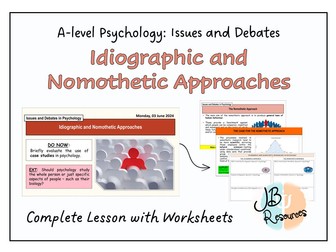
Key content covered in this Lesson:
Key Questions
The Idiographic Approach
The Nomothetic Approach
Examples of the Idiographic Approach: Humanistic Psychology
Examples of the Nomothetic Approach: Behaviourist, Cognitive and Biological Approach
Does the psychodynamic approach take an idiographic or nomothetic approach?
Exam practice with Mark Scheme: Short Answer Question
Evaluation worksheet
Evaluation points
Activity: Lesson Summary Worksheet
Plenary: Consolidation Question
To request lessons, provide feedback or if you have had any issues opening any resources of my resources, please feel free to contact jb_resources@outlook.com.
Reviews and feedback are always welcome.
AQA exam board
A-Level issues and debates revision slides
Great for last minute revision
Condensed AO1 and bullet pointed AO3 paragraphs
Has animations, colours, pictures
Downloaded as a ppt
This bundle was created using the latest AQA A-Level Specification (published June 2019) although content and activities may be useful for other specifications.
This bundle includes a complete lesson and activities for the A-Level Issues and Debates Topic.
The 7 lessons are included in this bundle are:
Gender Bias
Culture Bias
Free Will and Determinism
The Nature-Nurture Debate
Holism and Reductionism
Idiographic and Nomothetic Approaches
Ethical Implications of Research Studies and Theory
Please see individual lessons for further details of the content included.
Socially Sensitive Research debate in line with the OCR A level Psychology Specification. Debate can be referenced in all 3 units of the course.
Powerpoint includes definitions, explanations of where various studies lie in the debate, discussion activities, misconceptions addressed and strengths & weaknesses.
This comprehensive revision bundle covers the full AQA A-Level Psychology Issues and Debates topic, designed to take students from initial revision through to exam-ready practice.
Included in this bundle:
✦ Knowledge Organiser — a full-page visual overview of all six debates, including key terms, definitions, key studies, and exam tips for every debate. Print-ready for A3 or use digitally.
✦ Revision PowerPoint (20 slides) — an engaging slide deck covering all six debates with AO1 key content, key studies, and AO3 evaluation. Each debate includes a ‘Check Your Knowledge’ slide with exam-style questions, followed by a full answers slide.
✦ Practice Question Booklet — 30 exam-style questions across all six debates, ranging from 1-mark definitions to extended response questions. Write-on lines included.
✦ Mark Scheme & Model Answers — full model answers for every question, with examiner tips and common mistakes highlighted for each.
Covering: Gender & Culture • Nature vs Nurture • Holism vs Reductionism • Idiographic vs Nomothetic • Ethical Implications of Research • Free Will vs Determinism
Created by an AQA Psychology examiner.
Suitable for A-Level Year 13 students and their teachers. Ideal for independent revision, classroom use, or homework.
This lesson was created using the latest AQA A-Level Specification (published June 2019) although content and activities may be useful for other specifications.
Key content covered in this Lesson:
Key Questions
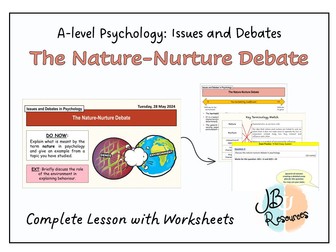
The Nature-Nurture Debate in Psychology
The Heritability Coefficient
Nurture
Reliance on Heredity and Environment
The Interactionist Approach
Example: Phenylketonuria (PKU)
The Diathesis-Stress Model
Epigenetics
Video: What is Epigenetics?
Activity: Key Term Define
Exam Practice with Mark Scheme: Short Answer Question
Evaluation worksheet
Evaluation points
Exam Practice with Mark Scheme: Evaluation Question
Plenary: Consolidation Question
To request lessons, provide feedback or if you have had any issues opening any resources of my resources, please feel free to contact jb_resources@outlook.com.
Reviews and feedback are always welcome.
Psychology as a Science debate in line with the OCR A level Psychology Specification. Debate can be referenced in all 3 units of the course.
Powerpoint includes definitions, explanations of where various studies lie in the debate, discussion activities and strengths & weaknesses.
The following file includes all content required for the 8 psychological debates:
Nature/Nurture
Freewill/Determinism
Reductionism/Holism
Individual/Situational
Psychology as a science
Usefulness of research
Socially sensitive research
Ethical considerations
It includes detailed explanations of each debate, in addition to real life examples, practice exam questions and activities for students to work through.
This PowerPoint can be printed as a 50 page workbooklet.
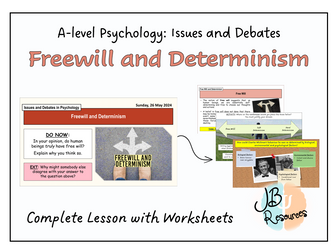
This lesson was created using the latest AQA A-Level Specification (published June 2019) although content and activities may be useful for other specifications.
Key content covered in this Lesson:
Key Questions
Video: Did Charles Whitman really have free will?
Free Will
Hard Determinism
Soft Determinism
Activity: Continuum Activity
Biological Determinism
Environmental Determinism
Psychic Determinism
Activity: Charles Whitman Case Deterministic Factors
The Scientific Emphasis on Causal Explanation
Evaluation worksheet
Evaluation points
Exam practice with Mark Scheme: Short Answer Questions
Plenary: Consolidation question
To request lessons, provide feedback or if you have had any issues opening any resources of my resources, please feel free to contact jb_resources@outlook.com.
Reviews and feedback are always welcome.
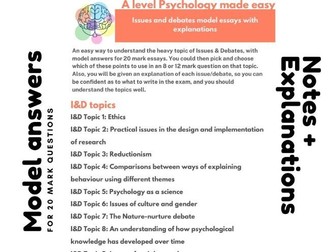
Master the Issues & Debates Section of Edexcel A Level Psychology with Confidence. Packed with expertly crafted 20-mark model answers for every possible question, this book offers invaluable insights into exam technique and provides comprehensive notes to simplify even the trickiest concepts. Written by an experienced Edexcel Examiner with over 16 years of teaching expertise, it delivers practical hints and tips designed to help you approach the Issues & Debates questions in Papers 1 and 3 with clarity and precision.
Part of a groundbreaking series designed to demystify challenging psychology topics and exam skills, this resource empowers your students to achieve A* results while building confidence and understanding along the way.
Issues and Debates – AQA A-level Psychology Topic Overview
The Issues and Debates topic challenges students to think critically about how psychological knowledge is developed and applied. It examines the assumptions, biases, and values that underpin psychological theories, and how these impact research and real-world applications.
Key areas include:
Gender Bias – Understanding androcentrism and alpha vs. beta bias in psychological research.
Cultural Bias – The impact of ethnocentrism and cultural relativism in the development of psychological theories.
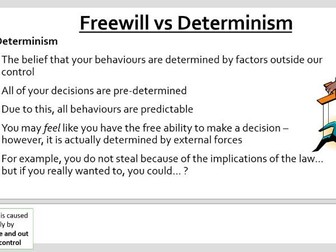
Free Will and Determinism – The debate over whether behaviour is freely chosen or shaped by internal/external forces.
Nature vs. Nurture – Exploring the influence of genetics and environment on human behaviour.
Holism and Reductionism – Whether human behaviour is best understood by breaking it down or looking at it as a whole.
Idiographic vs. Nomothetic Approaches – Differences between studying individuals in-depth vs. establishing general laws.
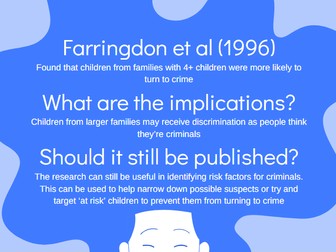
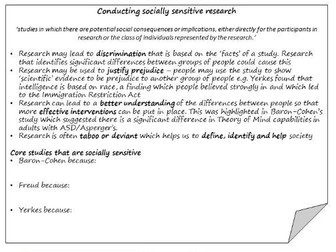
Ethical Implications of Research – How psychological findings may influence societal views and policy, especially in socially sensitive research.
This topic deepens students’ understanding of psychology as a science and encourages reflection on how values, assumptions, and ethics influence both research and theory.
Psychological Debates Summary - Powerpoints and Packs. In line with the OCR A level Specification - can be used as content in all 3 units but mainly unit 2 (core studies).
Powerpoint runs through what you need to know for each debate, example debates unit 2 questions and set up for flashcards for each debate for students to complete. There are answers within the teacher version. I’ve also made this into a pdf pack for ease of use.
Resources included:
Powerpoint (student version)
Powerpoint (teacher version)
Pack (student version)
Pack (answer version)
Psychological Debates Poster in line with the OCR A level Psychology Specification. Primarily to be used in unit 2 (core studies), but also can be referenced in unit 3 (applied psychology) and unit 1 (research methods).
Poster outlines the 8 debates and the key question for each.
PowerPoint for CAIE Research methods - A Level.
Includes the extra information that candidates will need for the A Level assessment.
Cultural differences
Reductionism vs holism
Determinism vs free will
Idiographic vs nomothetic
CAIE A-Level Psychology (9990) for examination 2024 - 2026.
A five-slide knowledge organiser for the debates and issues unit for OCR A Level psychology. Fully editable for alternative specs and needs.
Includes:
Nature - nurture debate
individual - situational debate
reductionism - holism debate
determinism - free will debate
socially sensitive research
usefulness
psychology as a science
AQA Psychology
Paper 3 - Issues & Debates
Personalised Learning Checklist for Paper 2 Biopsychology Module which includes:
Lesson by lesson breakdown for 7 topics
Learning objectives linked to AQA assessment objectives
Student grading system


 Quick View