The perfect blend of Understanding the World, Maths and Writing!
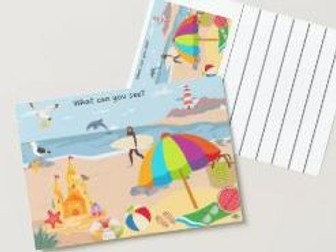
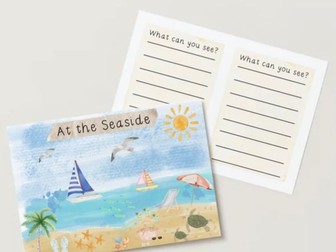
What can you see at the seaside? Variety of objects (some more than 1). The children cab subitise & write what they can see… e.g. I can see 2 turtles
Sheets to write on & table sign included
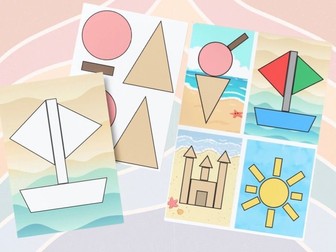
4 seaside themed tangrams.
Come with themed backgrounds and an eco print version with no background.
Cut and manipulate the shapes to build the picture.
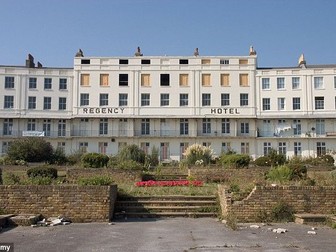
A lesson and activities exploring the reasons for UK seaside town tourism decline through YouTube and Text comprehnsions followed by a creative activity where students create a plan to rejuvenate a town. This lesson has Morecambe town related information (map & key facts) but can easily e adapted to other similar towns.
Thank you for looking at my resource.
This resource includes a fully comprehensive powerpoint ,worksheets/resources catering to a wide range of abilities, preparation list and a lesson plan.
This is the first lesson in a sequence .The lesson can be taught independently without the need for the future lessons. This lesson can be picked up and taught straight from however is fully editable.
Children will start by a rewind task (recapping prior learning). Children will recap on the four countries and capital cities of the UK. Children will actively engage in this by discussing which of the four capital cities they have visited they would most like to visit and why.
Children will be introduced to the new learning by thinking about their own experiences of day trips/holidays. This will lead into the seaside being introduced.
Children will think about the qualities a seaside through discussion and watching a video. This will bring about thinking about the importance of seaside locations.
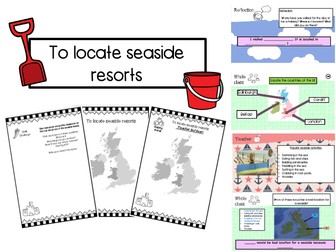
Children will be built up to using an atlas to identify the locations of 10 UK seaside locations.
A helping hands task (supported task) is provided.
A chilli challenge is provided to extend learning. This should be given to all children. The ‘differentiation’ will be based on how children access the task.
Past/current vocabulary is explicitly taught and children are reminded of this at suitable and regular opportunities.
Stem sentences are provided throughout to promote oracy and allow children to focus on the geography rather than formation of a sentence.
This lesson is part of The Seaside, a Geography unit designed for students in KS1 and lower KS2, but can also be taught as a stand alone lesson.
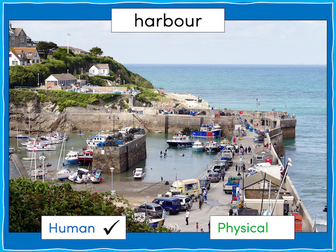
The presentation first explains the difference between human and physical geographical features. It then challenges students to identify a range of seaside features (e.g. cliffs, lighthouse, river mouth) and classify them as human or physical.
In the activity, students identify a range of seaside features and classify them as human or physical.
Easier - Students classify seaside features as human or physical.
Medium - Students label seaside features (with initial letter clues) and classify them as human or physical.
Harder - Students label seaside features (no clues) and classify them as human or physical.
Extension - Students unscramble sentences about the seaside.
If you like this resource, we would appreciate a review! We will happily send you a free resource in return for a review or useful suggestions/feedback. Contact us at ed@teachitforward.co.uk.
Beach scene to prompt writing of simple sentences.
A4 sheet for children to use to look and describe things they see. Perfect to use as a Communication & language resource to prompt interesting sentence ideas and adjectives. Additional sheet for writing could be done independently as an enhanced CP activity or a teacher led/supported writing task.
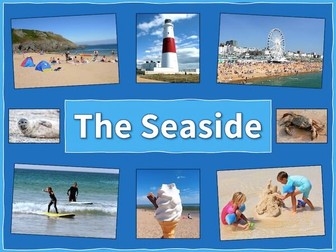
The Seaside is a Geography unit designed for students in upper KS1 and lower KS2 (Y2-Y3).
The planning overview, topic title page and vocabulary page can be downloaded for free here. Lessons include:
L1 – Identifying features of the seaside
L2 – Identifying human and physical features of the seaside
L3 – Locating seaside towns and cities of the UK
L4 – Investigating a seaside town - Lyme Regis
L5 – Identifying islands of the United Kingdom
L6 – Investigating what life is like on a small island
L7 - Packing for a seaside holiday
Each lesson includes a presentation and differentiated activities/worksheets.
If you like this resource, we would appreciate a review! We will happily send you a free resource in return for a review or useful suggestions/feedback. Contact us at ed@teachitforward.co.uk.
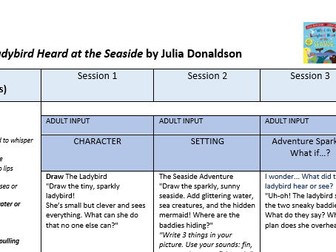
English planning for Foundation aged children. Focus text: What the Ladybird Heard at The Seaside by Julia Donaldson. Three days of planning in the style of Drawing Club. Suggested vocabulary and actions. Suggested daily input and model daily phrases/sentences.
This lesson is part of The Seaside, a Geography unit designed for students in KS1 and lower KS2, but can also be taught as a stand alone lesson.
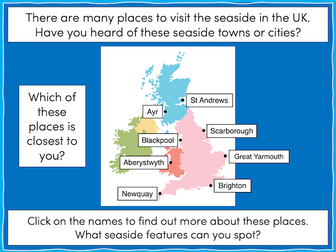
The presentation takes students on a tour of eight seaside towns and cities around the United Kingdom including: Ayr and St Andrews in Scotland; Aberystwyth in Wales; Blackpool and Newquay in England.
The activity then challenges students to use their map skills to locate these towns and cities on a map of the UK. This can be done using an atlas or the prompt maps included.
Easier - Students label 8 seaside towns and cities using a prompt map.
Medium - Students label 12 seaside towns and cities using a prompt map.
Harder - Students label 12 seaside towns and cities using an atlas.
Extension - Students locate and label 2 further seaside towns and cities from each country of the UK.
If you like this resource, we would appreciate a review! We will happily send you a free resource in return for a review or useful suggestions/feedback. Contact us at ed@teachitforward.co.uk.
PPT was prepared for online E-Learning and was used alongside the Oxford International Geography Textbook for the Unit At the Seaside
You do not need the textbook.
Areas of learning covered include defining the seaside, seaside resorts and holiday resorts.
This resource was created for Year 2 (ELL Learners).
Powerpoint is fully editable.
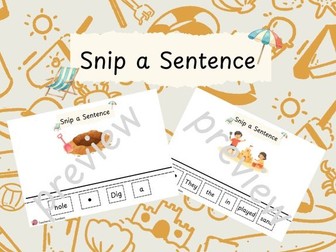
In this activity children will cut up, reorder, and create simple sentences.
This resource includes:
15 sentences,ranging in complexity
Table sign
Blank table sign
This resource particularly supports:
Understanding of sentence structures
Reading of sentences
Word order in sentences
Vocabulary
Builds awareness of full stops,capital letters and finger spaces
Reading of high frequency words
Develop scissor control
Hand-eye coordination
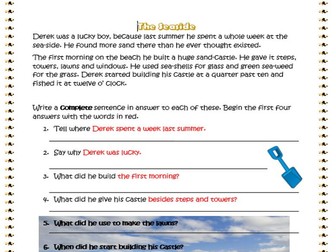
This worksheet provides the student with a short story. Then they must answer the questions. This resource guides students on how to answer questions in full sentences - highlighting the part of the sentence which is important and should be used in the answer.
Seaside – History of the seaside 1930
This lesson is part of the year 7 humanities curriculum that combines elements of History, Geography and Literacy. I have uploaded several lessons with the theme of seaside. They can all be taught together, alongside each other, or independently, as each is a standalone lesson on a different topic. This lesson covers the popularity of the seaside in the 1930s
Seaside Powerpoint and worksheet to go with it. (Comic Sans Font) An interactive powerpoint about seaside places in the British Isles, set out as a non-fiction text and linked using hyperlinks. Can be used as an exploratory activity or with the worksheet for children to identify geographical features at…


 Quick View