

 Quick ViewQuick View
The Day , the Year and the Seasons
Comprehension and additional task exercises pages 190 and 191 from Next Page Science KS3 Complete. Accompanying PowerPoint and word searches available for free from the website.
This exercise covers:
• What causes a day and a year: 24 hrs and 365.25 days
• A leap year
• Earth’s orbit having an elliptical shape
• Earth’s tilt as the cause of the seasons
• A pictorial illustrating summer (solstice), winter (solstice), spring (equinox) and autumn (equinox)
• An explanation explaining why light intensity changes from winter to summer using torches to represent how the same amount of light from the sun can be more or less intense
• Earth’s path across the sky (northern hemisphere)
• How earth’s spin causes the sun to rise in the east and set in the west
• An exercise on plotting the average hours of daylight for each month
• A matching the statements exercise
• An exercise on what it would be like in the summer (continual daylight) and winter (continual night time) at the north pole
• Amazing WHAT? facts
 Quick View
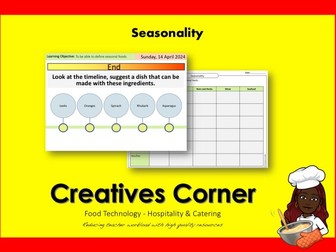
Seasonality
This is a 1 hour lesson based on students exploring seasonal foods.
Could be used as part of the NEW WJEC Hospitality and Catering course as well as any other food preparation and nutrition course.
**Learning Objective: **
To be able to define seasonal foods
To be able to explain the benefits of seasonal foods
To be able to produce a recipe for each season, that includes seasonal ingredients
Included:
Starter, mini plenary (based on the keyword) and Plenary
Automated Dates Embedded to PPT
3 Activities
Challenge Task
PDF Resources
Timers
 Quick View
Seasons - KS3 Physics
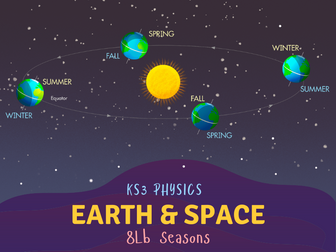
Earth and Space - The Science behind Seasons - 8Lb KS3 Physics
PLEASE READ BEFORE PURCHASING
My lessons follow the learning objectives of Exploring Science: Working Scientifically Student Book Year 8 by Pearson. This powerpoint is working towards Edexcel national curriculum but follows the overall English national curriculum suitable for schools that teach towards AQA & OCR curriculum also.
✰✰✰✰✰✰✰✰✰✰✰✰✰✰✰✰✰✰✰✰✰✰✰✰✰✰✰✰✰✰✰✰✰✰✰✰✰
My Lessons include:
Visually appealing graphics that encourage engagement throughout a lesson.
‘Do now/Starter’ activities with music to encourage fast and easy settling as the pupils arrive to lesson.
Progress steps: By having the student’s track their own progress, it creates ownership of goal achievement. The graphic representation of the students’ progress can be highly motivating. If improvements are not achieved, students can reflect on what changes need to be made to the intervention plan.
Peer and self-assessments (AfL) encouraging use of green pen self-assessment and purple pen peer assessment . This can be edited to meet the expectations of your school policy
Formative assessments to consolidate learning throughout (exam-style questioning, linking questions)
Plenary activities.
Extensions and challenge questions to reach higher ability students.
On screen timers to aid lesson plan and pupil focus.
Implementing subject specific key words throughout to encourage literacy
✰✰✰✰✰✰✰✰✰✰✰✰✰✰✰✰✰✰✰✰✰✰✰✰✰✰✰✰✰✰✰✰✰✰✰✰✰
I owe no rights to the music or images used in this PowerPoint
music credit to: Summer Adventure by DPmusic
Range of used icons credit to: Flaticon
Seasonal Changes
Activities:
Draw Clothes throughout seasons
Draw the seasons (Suggested activity- listen to Vivaldi’s 4 seasons and draw)
Illustrate trees throughout the seasons
Stickman outline - Suggested activity: Draw clothes for stickman throughout the seasons.
 Quick View
Traitors Season 2 School Edition
Did you enjoy the popular TV series ‘The Traitors’?
Did you play the original TES School edition and want Season 2 ready for your school? New exciting challenges and with the all new ‘Seer’ card introduced!
Why not play the game with your staff in school? This could be just the resource to improve staff wellbeing, encourage teamwork or simply a focus to get you through to that next half -term.
This resource has been cleverly designed and adapted from the TV series by the same Headteacher as Season 1-which had over 450 downloads. Including the orginal rules, traitor and faithful cards and secret missions, as well as murder and recruitment cards.
Enjoy :)
undefined
 Quick View
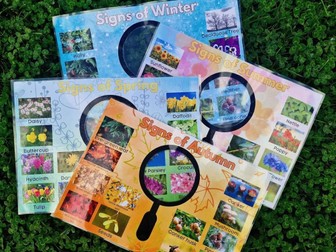
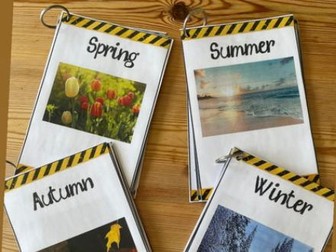
Seasons Construction Area Cards
A set of construction area cards for each season!
I have put mine onto keyrings and laminated as shown in the pictures and will put them into the construction area depending on the season.
The download is in a4 size per page but they can easily be reduced to a5 or increased to a3 dependent upon your classroom needs.
The cards contain different objects e.g. Santa’s sleigh, pumpkin, combine harvester, as well as objects linked to events e.g. a field of poppies for Remebrance/ a bee hive for World Bee Day.
They are matched in style to my other construction card resources in my TES shop.
 Quick View
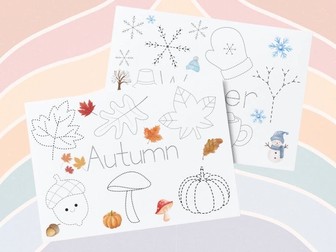
Seasons - Trace and Colour Pencil Control
Autumn
Winter
Spring
Summer
Perfect for pencil control work while learning about each season
 Quick View
Bubble Writing - Days/Months/Seasons **NON-CURSIVE**
Bubble writing - non-cursive word bank
Like many primary school teachers I have tried a variety of handwriting schemes with varying degrees of success. Having thought through many common problems with handwriting I have developed a simple scaffold that places a bubble either side of the line to support letter formation. This simple scaffold provides a guide to consistently form printed letters and ensure each letter is uniform in both height and width. Children are able to leave equal spaces between words and see clearly whether or not there is enough space at the end of each line for the next word they intend to write. There has been a huge impact within my class in a very short space of time and I hope you will see similar benefits within your own setting.
Included is a PowerPoint presentation including the days of the week, months of the year and the seasons.
It is suggested that this resource is used alongside the ‘Bubble Writing Starter Pack’ available from my TES store.
 Quick View
Spanish Weather in Months and Seasons
Spanish Weather in Months and Seasons Presentations, Display Cards, Activity Sheets & Playing Cards
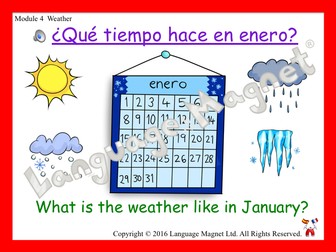
This Spanish weather resource combines Spanish weather phrases with the months of the year and seasons to enable pupils to extend their conversation about the weather. It can be used as a stand alone resource, but it is also designed to follow on from the basic Spanish Weather and Spanish Months of the Year resources that can be found in the Language Magnet shop.
The first slide revises 12 weather phrases, followed by a slide for each month of the year showing a different weather phrase. For example, “En enero hace frío”. Once pupils are confident with the months of the year, they can apply the same structure to the seasons, for example, “En invierno hace frío”. The presentations provide full audio support for non-specialist language teachers and the teacher can click on the sentence structures either before or after the pupils speak, to assess learning.
The presentations are accompanied by two differentiated versions of a writing activity sheet to support different stages of learning.
There are two sets of weather, months and season cards for students to practise speaking and listening. One set of cards has the visual prompts only and the other set provides the key words and phrases, to enable pupils to create their own sentences.
A colourful set of 9 display cards for the seasons and weather is also provided with this resource to remind pupils of the language structures that they are learning.
Format
Instant Powerpoint downloads in ppsx format
Instant printable downloads A4 size (210 x 297mm)(8.26 x 11.69 inches) in PDF format
The audio is Castilian Spanish, the standard form of European Spanish.
Includes
1 ppsx download Spanish Months and Weather presentation 26.7MB, including sound files
1 ppsx download Spanish Seasons and Weather presentation 14.3MB, including sound files
1 printable set of Seasons and the Weather colour display cards (9 cards)
2 printable activity writing sheets (differentiated versions)
1 printable set of Weather, Months and Seasons speaking and listening cards
I hope you enjoy using this resource with your pupils and appreciate the quality and uniqueness of my work. If you like this resource, please leave a review for other teachers and visit my shop for more weather or months of the year products. You will find complete modules and a full scheme of work available on the Language Magnet website.
Many thanks for your support.
Terms of Use
These Powerpoint presentations and printable downloads are for use with the teacher’s own classes only and cannot be used by other teachers for other classes unless a multiple licence has been purchased with this product.
The original downloads and photocopied sheets may not be resold commercially or redistributed.
 Quick View
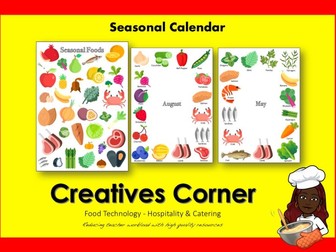
Seasonal Calendar - Booklet
This seasonal calendar booklet can be used alongside Seasonality Lesson. It can be kept in the classroom as a resource for students to use for independent learning tasks as well as other seasonality lessons.
It includes, images of the different foods available in each month along with the names of the foods included.
Explaining the Seasons
Aimed towards KS3 (Yrs 11-14), a fun animated lesson explaining the Seasons. Slide by slide animations shows clearly why the Earth experiences Summer and Winter.
By the end of the lesson learners should be able to:
Identify what causes summer and winter.
Describe how the Sun radiates light.
Explain the link between the tilting of the Earth and the seasons.
 Quick View
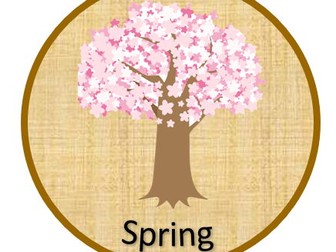
The Seasons Natural resource
This resource consists of the four seasons: ‘spring, summer, autumn and winter’. This resource can be used for a display, within a tuff tray or within an area of continuous provision. This resource just needs to be printed and laminated for longevity.
 Quick View
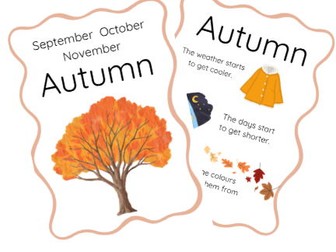
Seasons Fact Cards
A set of engaging, child-friendly information cards designed to support learning about the four seasons in line with the Year 1 science curriculum.
Each card is double-sided:
Front: The name of the season with the corresponding months of the year
Back: Key facts about the season, including typical weather, changes in nature, and daylight patterns
These cards support children to:
Observe and describe seasonal changes
Understand typical weather for each season
Explore how day length varies across the year
Build and use seasonal vocabulary
Perfect for continuous provision, these cards can be used in a variety of ways:
Reading and discussion prompts
Matching and sorting activities
Independent research and fact finding
Supporting drawing and writing tasks
Enhancing small world, investigation, or outdoor learning areas
Designed with early readers in mind, the cards use simple language and clear visuals to promote independence, curiosity, and talk.
Bundle
 Quick View
Season TEACCH Bundle - Independent Autism and SEND Activities
Save 25% with this Seasonal Bundle.
Activities and tasks for your pupils with Autism!
Includes early reading, writing and maths activities to help achieve those early targets and build on working independently!
These are the individual resources included:
Spring TEACCH Tasks £3
Summer TEACCH Tasks £3
Autumn TEACCH Tasks £3
Winter TEACCH Tasks £3
When using TEACCH tasks the task that is to be completed should be placed on the left hand side of the desk/workstation. The pupil then completes this task and places it on the right when completed. Having a clear visual for the pupil to identify where the finished tasks go is preferable. This clear structure allows the pupils to focus on the task they are completing and not be distracted by the work process. It is important to remember that when completing these tasks it is also about creating and building independence as well as success at the task, this is why the consistent work approach (working from left to right is so important)
When using these tasks I would recommend using them for at least 4-6 weeks. For some children it may take up to a term for them to master the skill and be able to complete this independently.
 Quick View
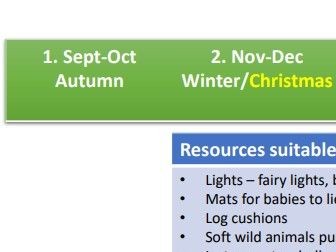
Sensory Play - seasons yearly plan
An overview of sensory play linked to natural resources and seasonal items. Links to celebrations such as easter, christmas, bonfire night etc. Using natural and real resources for sensory play. Includes every season and month to cover the whole year.
Seasons
Seasons, why they happen, northern hemisphere, sun’s height in the sky, day and night etc. Complete lesson. Seasons is number 3 in a series of 6 high quality lessons that fully and expertly delivers all the points within BOTH the NEW KS3 Department for Education ‘Space Physics’ National Curriculum and the AQA KS3 specification / syllabus sections ‘3.7.2 Universe’ and ‘3.1.2 Gravity’.
NO PREPARATION REUIRED ! Simply submit the equipment list to your technicians and then the PPT will lead you step by step through the entire lesson.
Recall why we have day and night.
* Explain the seasons and the importance of the sun’s angle.
* Explain why if it is summer in the UK, it is winter in Australia.
* Compare the shadows and the suns positions in winter and summer.
* Use new literacy words such as sphere, hemisphere, equator etc
* Successfully complete a simple practical to explain summer and winter.
STARTER
Pupils will start the lessons by thinking and working in pairs in a race to solve a picture puzzle and work out what today’s lesson is about. After discussion that leads to revealing the title and lesson outcomes, students then self assess against their current understanding of this lesson.
MAIN and MAIN and MAIN…
This lesson is chunked into discrete sections to support learning and engender positive behaviour by keeping students interested and focused. All points of the specification are addressed.
There are various student activities such as: demo, practical, gap fills, matching, paired work, literacy activities, focused questions with answers and differentiation, picture puzzle, mini test, homework, carefully selected video, self-assessment opportunities, peer assessment opportunities etc. This good variety of activities keeps pupils focused and happily learning.
PLENARY:
In the plenary activity pupils complete a matching activity and then peer assess it to uncover how much they have learnt during the lesson. They then self-assess themselves against the lesson outcomes. Students who need further support set themselves additional homework to enhance learning of today’s lesson.
EXTENSION ACTIVITIES:
These are provided just in case any group requires them.
All resources are included in this excellent lesson, there is nothing for you to do but deliver it.
Thank you for looking, your positive feedback would be very much appreciated :)
This lesson is one of a series of 6:
1. Solar system, stars and galaxies and the universe.
2. Geocentric and heliocentric solar system models
3. Seasons.
4. Gravity, weight and mass.
5. Exploring and observing the universe.
6. The moon’s phases.
For more lessons that meet the new KS3 and KS4 specifications please type Barclayfox into the tes resources search engine to see all my lessons.
Happy teaching !
Barclayfox.
 Quick View
Seasons song - 'Seasons come Seasons Go'
This song goes through each season describing what happens to the weather, the animals, etc.
Johnny, the male singer, says grumpy things about each season.
Sarah, the female singer, is upbeat and says positive things.