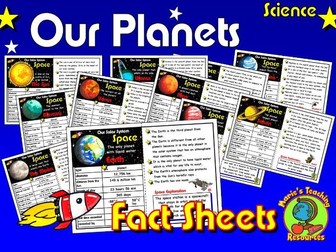
Fact sheets about the planets in our solar system, the Sun and our Moon.
A5 fact sheets (once A4 folded back to back) for a Reading Corner, Topic Board, Writing Corner, Science Resources – or alternatively used as A4 posters.
A lot of useful information!
Each fact sheet includes information about the planet, its size, distance from the Sun, how many hours in a day, how many days in a year, temperature on the surface, number of moons, when and who first recorded it. Each one has the space craft which was used to explore the planet.
For more useful Space activities and resources, please check my shop Marie’s Teaching Resources.
Thanks for looking :)
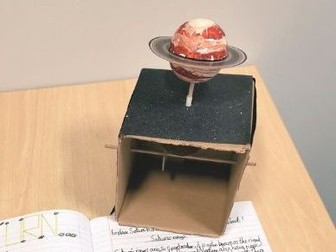
You are purchasing a step-by-step PPT on how to build a spectacular rotating planet cam toy aimed at children in UKS2.
It is aimed to be the end piece for a Earth and Space topic and corresponds with the National Curriculum for Design and Technology for KS2.
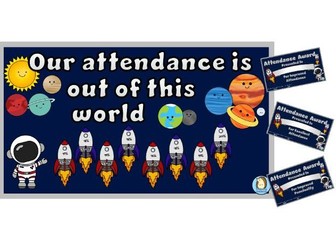
This “Our Attendance is Out of This World” display pack, featuring a vibrant space theme with rockets, astronauts, and planets, is designed to inspire and improve whole-school attendance in your primary school. The pack includes engaging display materials that bring the theme to life, making it easy to create a visually striking attendance board. Also included are matching certificates to reward students for excellent attendance, improved attendance, and punctuality. Perfect for setting a school-wide focus on attendance, this display pack makes an impactful, year-round addition to your corridor or school hall.
This class assembly is all about Space. It discusses the Sun and the 8 planets within, then moves on to the earth and its rotation and orbit of the sun. It talks about Constellations and ends with a dramatic entrance from a spacecraft with a ‘mini’ Neil Armstrong emerging and discuss about the 1st landing on the moon. You would need to build a make-shift space craft for a child to fit into. We used 4 large bit of card-board and stuck tin foil all around it and made an American flag. The children loved it. We also found a kid’s spacesuit for our mini Neil Armstrong. You will also need the Sun and Planets blow ups, easily and cheaply purchased from Amazon. It doesn’t come with a Space song, but again songs with lyrics are easily found through a simple youtube search.
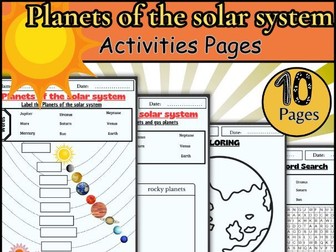
Explore the solar system with this engaging and interactive printable activity pack!
This Planets of the Solar System resource is perfect for introducing young learners to the 8 planets and the Sun. Students will label planets, identify gas vs. rocky planets, complete a fun space-themed word search, and color each celestial body for visual reinforcement.
Use it for science lessons, review, centers, early finishers, or sub plans!
What’s Included:
Labeling Worksheet – Identify and name the planets
Answer Key – For self-checking or guided instruction
Gas Planets vs. Rocky Planets Sorting Page
Space-Themed Word Search Puzzle
2 Coloring Pages – For creativity and memory retention
Maze Activity – Critical thinking and problem-solving
All pages in black-and-white PDF format for easy printing
Skills Covered:
Planet identification
Vocabulary building in astronomy
Sorting planets by type (gas vs. rocky)
Visual recognition and labeling
Fine motor skills and creativity
Perfect For:
Grades 1–4
Science Centers
Space Unit Studies
Earth & Space Science Curriculum
Homeschool Lessons
Sub Plans
Early Finishers
Format:
PDF – Print and Go!
Are you exploring Astronomy with your students? This set of 10 fully illustrated worksheets will be very useful. The themes covered are…
Life beyond Earth
Mission to Mars
The Solar System
The Sun
The Moon
Planet Earth
Lifecycle of a medium star
Lifecycle of a large star
Eclipses
Big Bang Theory.
Great as starters or extension activities. Easy to print and very student friendly. Ideal for 10 to 14 yr olds.
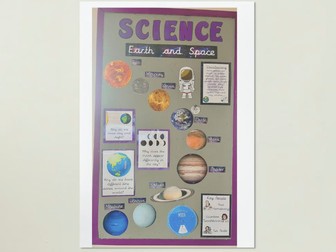
Earth & Space Year 5 Science Display Printable Resources
PDF format
Includes:
Key vocabulary
Key people
Planet pictures
Planet labels
Key questions posters X3
Earth and Space lettering
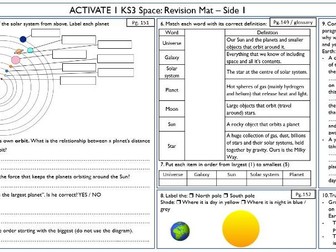
A double sided revision mat worksheet with answers. Page number references given for Collins Activate 1 Textbook.
Suitable for mixed ability groups - a variety of tasks including short answers, gap-fills and match-up activities.
Includes questions about:
Planets: Order, size and orbits
Key vocab definitions about objects in space
Days, years and seasons
Eclipses
Phases of the moon
Satellites
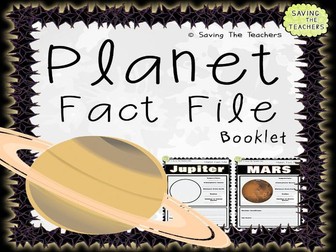
This Planet Fact File is the perfect activity for your children to learn all about the planets in our solar system by completing their own personal booklet. They are required to research key information about the planets in order to complete the booklet. This pack contains two sets, one set where they can draw the planets, and the other where an image is already on the information sheets.
You can use this activity in class, however lots of my class loved taking it home as a home learning project!
Contents:
- Fact File Front Cover
- Differentiated Fact File Templates For: Mercury, Venus, Earth, Mars, Jupiter, Saturn, Uranus, and Neptune.
Symbols (c) Widgit Software 2010. Something for everyone. 6 pages can be printed 2-up on A4 (but easier to manage full A4 size for some children). Names of the planets with attempt to show their approximate relative sizes; Spot the Difference; symbol reading and counting; Odd One Out to talk about; symbol reading-for-meaning (and follow instructions); copy words into the blanks in a story with symbol support. Suggestions included.
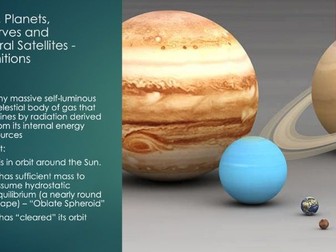
In this complete lesson resource, there is an Hour lesson (Or 2 lessons if you wish to stretch and add extra activity), on the definition of planets, stars and dwarf Planets, as well as informative video links and exercises to help students understand the effect of a body’s mass on the weight of an object.
Animated with stunning visuals


 Quick View
 Quick View
 Quick View
 Quick View
 Quick View
 Quick View
 Quick View
 Quick View
 Quick View
 Quick View
 Quick View
 Quick View
 Quick View