Particle Model: States of MatterQuick View
BrainJar

Particle Model: States of Matter

(1)
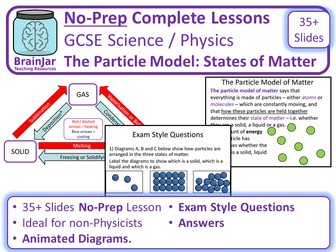
Complete No-Prep lesson with exam questions, tasks and answers on States of Matter, Particle Model (Kinetic Theory), and Changes of State for AQA GCSE (9-1) Science / Physics. This was updated 31st Jan 2022 as I realised that I had not included answers to a couple of questions, and then I made some mainly cosmetic changes 3rd April 2022 - please download again if you are one of the many people who purchased before then. As a Secondary Science teacher and Deputy Headteacher for many years I make high quality no-prep lessons so busy teachers can teach outstanding lessons without spending hours planning. This high quality lesson includes explanations, different types of in-lesson assessment (all with answers) and unique exam questions. My lessons are ideal for non-Physicists - as a Biologist who retrained as a Physics teacher I know how to take learners on a journey that builds up their understanding step by step, while still going into a lot of depth. The preview video shows a representative sample of slides from the resource so that you get a good idea of what it includes before you buy. What’s Included: • Two Starter / Do Now activities so you can extend this over two lessons if needs be. • Explanation slides in “chunked” sections with animated diagrams. • Multiple questions in different question styles and difficulties - no need for worksheets. Each “chunked” explanation section typically includes a set of “learning check / quick questions” followed by a set of in-depth questions on the learning from that “chunk” of the lesson. All questions have answers. • Exam-style questions on the whole lesson at the end of the lesson- these are unique, based on real exam questions but not just copied from exam boards. • Answers for all questions • All easily editable to adapt to your teaching or to use in existing lessons. • Slightly humorous, at points, if you like that sort of thing. Learning objectives: Describe the states of matter – the properties of solids, liquids and gases. Describe the changes of state between the different states of matter. Describe kinetic theory - how the particles are arranged and move in solids, liquids and gases. Link the forces between particles to the arrangement and movement of the particles and to the properties of solids, liquids and gases. Explain why mass is conserved when a change of state occurs. Written for AQA GCSE Science and Physics but likely to be applicable to other exam specifications and certainly adaptable for a more able KS3 class. Please leave a rating / review and all other feedback gratefully received!
States of Matter KS3 Activate ScienceQuick View
ychebbout

States of Matter KS3 Activate Science

(1)
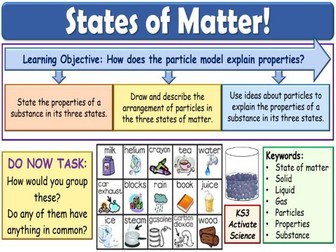
Perfect lesson resource for KS3 Chemistry! A fully differentiated and resourced lesson that assists students in learning about how the particle model explains the properties of the three states of matter. Students will state the properties of a substance in its three states, draw and describe the arrangement of particles in the three states of matter, and use ideas about particles to explain the properties of a substance in its three states. The resource includes a detailed and engaging lesson PowerPoint with differentiated activities, quizzes and class practical activities for students to complete. This resource is part of the Particles and their behaviour topic and has been created for the delivery of the Activate KS3 Science course. Also great for KS2 Science. 32 slides in total for the lesson PPT
States of MatterQuick View
OuttheBoxScience

States of Matter

(0)
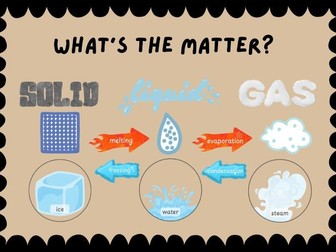
KS3 new for the Activate 1 unit ‘Particles and their Behaviour’. Full lesson ready to use straight ‘out of the box’. Similar structure to my other power points following the input - activity - review phasing plenary sections for progress checking Clear learning objectives and outcomes Modern and engaging layout Little adaptation needed Covers an hour lesson of content matched to the specification 31 ppt slides Please give constructive feedback :D
States of Matter and Changes of State - GCSE Physics WorksheetsQuick View
cal-w11

States of Matter and Changes of State - GCSE Physics Worksheets

(1)
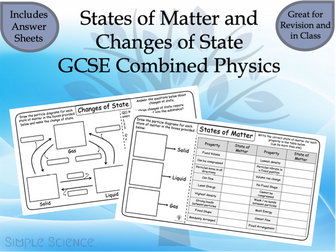
This resource contains 2 worksheets that can be used in class or as homework to enable your students to practice what they have learnt in the classroom. This pack includes: States of Matter Changes of State We have worksheets for the following topics in Physics Paper 1: Energy Energy (Kinetic, Elastic and G.P.E) Change in Thermal Energy and Power National and Global Energy Resources Electricity Circuit Symbols, Current, P.d. and resistance Series Circuits Domestic Electricity and The National Grid Static Charge – Triple Particle Model of Matter Density of Regular Objects States of Matter and Changes of State Atomic Structure The Atom, Ions, and Isotopes Radioactive Decay and Nuclear Equations Half-lives and Radioactive Contamination More worksheets will be added in the future. Please rate and review this resource. Thank you!
States of matterQuick View
slking24_sk

States of matter

(0)
A PowerPoint with information and tasks designed for recapping the features and properties of solids, liquids and gases and changes of state. I created this as a revision resource for entrance exams but it could easily be adapted for introducing the topic too.
Edexcel CC1a States of MatterQuick View
fosterpaul

Edexcel CC1a States of Matter

(5)
CC1 lesson for the new Edexcel Science GCSE, looking at states of matter. Including: what the states of matter are, properties of the states of matter, particle theory, changes of state, predicting states of matter, cooling curve practical and heating curves.
Changing States of Matter - Worksheet | Printable and Distance LearningQuick View
Ayse_Unk

Changing States of Matter - Worksheet | Printable and Distance Learning

(2)
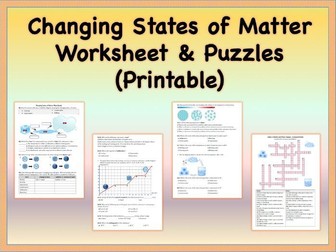
This worksheet contains various questions to help your students learn (or review) basic concepts about Changing States of Matter (Solids, Liquids, and gases). This engaging worksheet can easily be used for science class practice, test prep, morning work, early finisher work, homework assignments, quizzes, or assessments. In this worksheet, students will answer questions about the following terms: States of Matter Change of state Phase change Solids Liquids Gases Melting Freezing Vaporization Condensation Sublimation Deposition Melting point Boiling point Freezing point What is included in this resource? ✓ Printable and editable Student Worksheet (PDF and Word document) ✓ Paperless digital version for use in Google Drive (Prepared with Google Slides) ✓ States of Matter and Phase Changes - Crossword Puzzle Activity (Printable) ✓ Complete Answer Key
PhET Simulation: States of MatterQuick View
brianswarthout

PhET Simulation: States of Matter

(0)
In this guided inquiry online lab your students will investigate the three states of matter: solids, liquids and gases. By the end of this online lab they will be able to (1) describe the characteristics of the three states of matter, (2) compare the motion of the particles in the three different phases, (3) explain how to change the state of a material and be able to name the six different phase changes (4) understand that different substances have different melting and boiling temperatures and (5) state the relationship between the pressure, temperature, volume and amount of gas in a container. You will use one of the simulations from PhET Interactive Simulations. The simulation is called States of Matter: Basics (HTML5). The link for the simulation can be found inside the resource. All of our PhET Online Labs can be purchased as a money saving bundle. PhET Interactive Simulations incorporate research based, student centered activities that are fun and easy to use. All of the PhET simulations are available from their website: PhET Interactive Simulations. This PhET online simulation can be done in the classroom or during distance learning. This product includes: (1) The lab activity worksheets. (2) An answer key for the worksheets. (3) Notes presenting a full explanation states of matter.
States of matter (Physics) Distance learningQuick View
CMGsSciencelessons

States of matter (Physics) Distance learning

(0)
During this distance learning lesson (P6.2 States of matter) GCSE students work through the digital worksheet activities to develop their understanding of the different properties of solids, liquids and gases using the particle model. Based on the 2nd lesson from the AQA 9-1 GCSE (OUP) Physics P6: Molecules and matter chapter. Ideal for independent & distance learning / home-school / covering missed content after absence / non-specialist cover lesson Aimed at a mixed ability class covering content 1-8 This resource includes (4 pages): Teacher guidance and answers Engage- Self-assessed vocabulary task using Google Sheets (Fact of the day). Explore- Links to articles, video clips, virtual labs, and simulations for students to explore. Explain- Embedded Google Slides™ presentation (includes lesson objectives, information slides, self-assessed questions). Apply- Resources and task in which students apply their knowledge gained during the lesson. Extend- Resources and task for students to extend their learning. Important: Students must have access to PC with internet to use this worksheet This resource works best as a Google Doc™. with Google Classroom™ some tasks will be unavailable in other formats (Word/Excel). If you require more assistance, please contact me at- cmgeducationresources@gmail.com
States of Matter Cut and Paste ActivityQuick View
PROJECT_science

States of Matter Cut and Paste Activity

(0)
A cut and paste activity designed for students to study the states of matter. Includes images and facts about the three main states of matter [solid, liquid, gas] and the characteristics of each. Included in this kit: ➸ Cut out grid of images and facts about solids, liquids and gases. ➸ Sheet with headings to paste the images and facts on. ➸ Teacher answer key. ➸ Instructions on how to use the resource. Great accompaniments to this resource: States of Matter Task Cards States of Matter Cootie Catcher Clipart by: Ron Leishman ToonClipart
States of Matter – Solid, Liquid and GasQuick View
raj98me

States of Matter – Solid, Liquid and Gas

(0)
States of Matter – Solid, Liquid and Gas .................................................................. This is a complete unit on States of matter. It includes lessons (to act as the unit plan), activities, and printable worksheets. Show your students that solids, liquids and gases really do "matter" with these States of Matter unit plan! It will be a great addition to your States of Matter curriculum and will add discovery and excitement to your Science class! Activities and Resources Include: o What is matter? o What are solid, liquid and gas? o Phase change diagram of matter. o Phase change diagram of water. o Cut and paste activity. o Measuring methodology. o 36 task cards. Kids have to choose correct answer for given picture. o 12 vocabulary tags. Kids have to describe each tag in their science note book. o Worksheet – fill in the blanks by using given words. o Question sheet. o True or false. o Complete phase change diagram for matter. o Match section A and B. • Simple & lucid language makes the understanding of concept easier. • Child-friendly layout with illustrations and photographs holds the interest of the child and reinforces learning through visual impact. CHECK OUT THE PREVIEW TO SEE THIS PACKET UP CLOSE! Other resources you may be interested in- 1 – Earth day 2 - Heat Transfer - Interactive Notebook with KEY 3 - Light and Shadow - Comprehension Questions and Assessment Pack 4 - States of Matter “Doodle Notes” 5 - Light – worksheets 6 - Force, Work and Energy – Unit plan with worksheets 7 - Reading Comprehension Checks – Sloppy Science-1 8 - Reading Comprehension Checks – Sloppy Science-2 9 - Reading Comprehension Checks – Golden Rules to Save Electricity, Paper, Water & Fuel 10 – Safety and First Aid Happy Learning….!!!
states of matter worksheet particle modelQuick View
lewistull

states of matter worksheet particle model

(19)
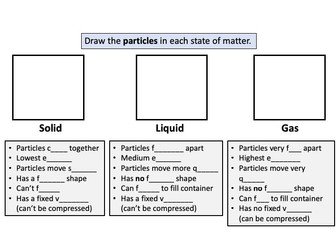
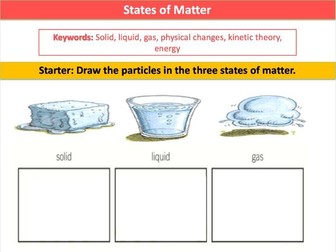
Students to draw what solid/liquid/gas states of water look like in the beaker. Then they are to 'zoom in&' to the particles and draw what they would look like for each state. Students to then complete a short extended writing activity using as many keywords as they can to describe the process of ice melting and water boiling. Higher ability students should be able to refer to the movement and arrangement of particles in this piece.
States of Matter Venn DiagramQuick View
Bluebell78

States of Matter Venn Diagram

(2)
Simple Venn diagram worksheet. Students have to place the statements in the correct place on the Venn diagram. Another plenary I find works really well with this topic is to arrange pupils into groups of two or three and provide each group with a petri dish lid or base and a lump of plastacine. Get the students to make particles out of the plastacine, then arrange them in the petri dish as you would find them in solids, liquids etc. The nice thing about making the partcles in the petri dishes is that you can put them on the projector and get the rest of the class to assess them.
States of Matter ~ KS3 ~ Year 7Quick View
Dr_Troilo

States of Matter ~ KS3 ~ Year 7

(1)
Key stage 3 ~ year 7 ~ complete lesson on states of matter. In this lesson students will learn how to describe the properties of solids, liquids and gases. They will use the particle model to explain the properties of substances in each of the three states. These slides can be used as a stand-alone or incorporated into a practical lesson. Extension questions are included on the slides and there is a pick and mix of different tasks to select from for your students. This lesson includes: -Title slide with learning objectives -A starter activity -A group reading task (literacy) -Keywords sorting task (vocabulary: compress, flow, matter, vibrate and state of matter) -A handout sheet task defining solids, liquids and gases and creating a factfile. -Questions and challenge questions -Answer slides included -Next lesson Melting and Freezing https://www.tes.com/teaching-resource/resource-12977344 … All content, diagrams and photos © Troilo Science / Febo Learning unless otherwise stated. We also have lessons for KS3 Particles on the following topics: Particle Model States of Matter Melting and Freezing Boiling and Condensing Evaporation and Sublimation States of Matter (SEND Supplementary Lesson) Diffusion Gas Pressure Particles End of Topic Revision
States of MatterQuick View
isabell2

States of Matter

(0)
Lesson on states of matter. Knowledge retrieval Questions and Answers. Plenary Questions and Answers. Suitable for Year 9 and up.
States of Matter KS3 Science BundleQuick View
ychebbout

States of Matter KS3 Science Bundle

3 Resources
The perfect resource specially designed for KS3 Science lessons! This bundle includes five fully differentiated and resourced lessons, created to captivate students curiosity through creative and practical learning. These lessons provide fun and interactive ways for students to learn about particles! This bundle comes complete with the following fully differentiated and resourced lessons for the topic: Lesson 1: The particle model - Students will state what materials are made up of, describe simply what the particle model of matter is, and explain why different materials have different properties. Lesson 2: States of matter - Students will state the properties of a substance in its three states, draw and describe the arrangement of particles in the three states of matter, and use ideas about particles to explain the properties of a substance in its three states. Lesson 3-5: Changes of state Lesson 3: Melting and freezing Students will recognise the state of a substance in relation to its melting and boiling point, explain changes of state in terms of changes to the energy of the particles, and draw before and after diagrams to explain observations about changes of state. Lesson 4: Boiling Students will describe simply how changes of temperature or state can be described in terms of particles transferring energy, recognise the state of a substance in relation to its melting and boiling point, and explain changes of state in terms of changes to the energy of the particles. Lesson 5: More changes of state Students will describe the difference between boiling and evaporation, explain changes of state in terms of changes to the energy of the particles, and draw before and after diagrams of particles to explain observations about changes of state. Lessons include engaging and detailed PowerPoint Presentations with differentiated activities, worksheets, quizzes and class practical activities for students to complete. Also great for KS2 Science. Enjoy the resource and feel free to leave a comment. Thank you.
States of Matter KS2 Class Assembly ScriptQuick View
TaylorResources

States of Matter KS2 Class Assembly Script

(1)
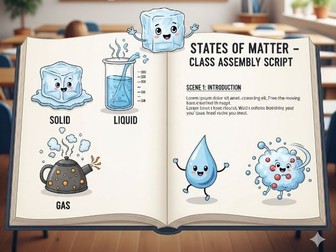
Transport your students into the world of science with our States of Matter Class Assembly Script! This engaging assembly pack features 32 speaking parts, making it ideal for the whole class to get involved in a fun, educational performance. Benefits: 32 Speaking Parts: Every student gets a role to play, ensuring full participation and engagement. Easy to Perform: Clear stage directions and simple dialogue make it easy for teachers and students alike to prepare. Creative Add-ons: Includes prop ideas and a catchy song to enhance the performance and make it even more memorable. Educational & Fun: Students will learn key facts about healthy living while developing confidence and teamwork through performance. Sample Excerpt: What Is Matter? Child 1: Matter is everything you can touch, see, or feel. Child 2: All matter is made of tiny particles. Child 3: Some matter is solid — like a rock or a chair. Child 4: Some is liquid — like water or juice. Child 5: And some is gas — like the air we breathe! Child 6: Let’s meet the states of matter now… Perfect for school events, this script makes learning about the past an exciting adventure!
States of matterQuick View
CDSEducation

States of matter

(0)
A selection of worksheets that can be used as a revision or during the teaching of the states of matter. Also ideal material to be left with a substitute as all answers are provided. Included are: A starter activity listing solids, liquids and gases A wordsearch comprising a literacy comprehension with underlined key terms A properties sorting worksheet A key word match up A home learning worksheet that recaps students learning during the lesson on the particle diagram of a solid, liquid and gas as well as the properties. Answer are included. Have you also seen my festive Christmas comprehension https://www.tes.com/teaching-resource/resource-12602253