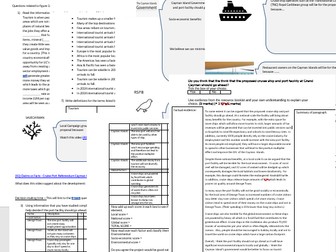
AQA GCSE Geography paper 3 pre-release support for 2024.
Tudeley Village development.
This document contains 12 pages of resources that can be set as homework to run along the pre-release booklet or taught in class.
Includes:
Exemplar answer to a question that could possibly be similar to the 9 mark question this summer. Last year’s prediction was correct as well as for 2022.
Task sheet to help student to examine the pre-release booklet.
Additional suggested questions to practice.
Now updated due to the change in the map provided by AQA.
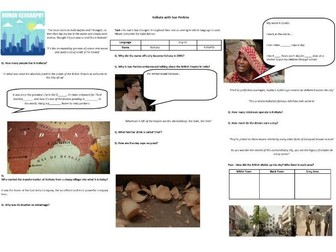
BBC - Kolkata with Sue Perkins - Worksheet to support the BBC Documentary
Sue Perkins immerses herself in the complex life of Kolkata. She sees first-hand how it has evolved from a place notorious for its fabled ‘Black Hole’ dungeon and the dreadful poverty of its street people to a place reinventing itself as a vibrant new megacity, with a booming property sector and a reputation for eccentricity, culture and tolerance.
In this intricate human habitat, Sue explores the lives of its people, from the 250,000 homeless street kids hustling for a living to the wealthy young entrepreneurs who race their Ferraris and Lamborghinis down the streets of the New Town.
She joins the rickshaw wallahs navigating the chaotic city streets and narrow lanes, thronged with people, and descends into Kolkata’s Victorian sewers as part of an epic clean-up. She limbers up with the ladies of the Laughing Club and makes an offering to the goddess in the sacred Kalighat Temple.
No other city tells the remarkable story of India more clearly than the beautiful, crazy, colourful city of Kolkata. Through encounters with people from every strata of society, from the richest to the poorest, Sue paints a picture of contemporary India emerging from a brutal colonial past to take its place among the most powerful nations on earth.
Written in Publisher and formatted to A3 the resource can be saved as a PDF for A4 printing
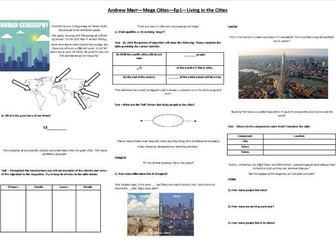
Andrew Marr - Mega Cities - Ep1 - Living in the Cities - Worksheet to support the BBC documentary
‘For the first time in history, more people live in cities than the countryside. Across the globe, we have 21 cities with more than 10 million people, and these numbers are set to increase - busy, noisy, crowded megacities are the future. In a fascinating three-part series, Andrew Marr finds out how these heaving mega-metropolises feed, protect and move their citizens.
In the first episode, Andrew looks at how people live in five of the world’s biggest megacities: London, one of the world’s oldest megacities; Dhaka, the world’s fastest-growing megacity; Tokyo, the largest megacity on Earth; Mexico City, one of the most dangerous cities in the world; and Shanghai, arguably the financial capital of the world.’
The worksheet is written to provide independent learning and enrichment opportunities through a variety data collection and analytical tasks.
The worksheet has been written in Publisher to an A3 format but can be amended and printed as a PDF to accomodate A4 printing. I have included an A4 Word document version to allow for use in Google Classroom
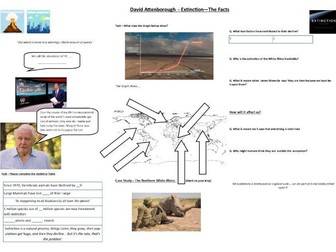
BBC - Extinction - David Attenborough - Worksheet to support the BBC Documentary
With a million species at risk of extinction, Sir David Attenborough explores how this crisis of biodiversity has consequences for us all, threatening food and water security, undermining our ability to control our climate and even putting us at greater risk of pandemic diseases.
Extinction is now happening up to 100 times faster than the natural evolutionary rate, but the issue is about more than the loss of individual species. Everything in the natural world is connected in networks that support the whole of life on earth, including us, and we are losing many of the benefits that nature provides to us. The loss of insects is threatening the pollination of crops, while the loss of biodiversity in the soil also threatens plants growth. Plants underpin many of the things that we need, and yet one in four is now threatened with extinction.
Last year, a UN report identified the key drivers of biodiversity loss, including overfishing, climate change and pollution. But the single biggest driver of biodiversity loss is the destruction of natural habitats. Seventy-five per cent of Earth’s land surface (where not covered by ice) has been changed by humans, much of it for agriculture, and as consumers we may unwittingly be contributing towards the loss of species through what we buy in the supermarket.
Our destructive relationship with the natural world isn’t just putting the ecosystems that we rely on at risk. Human activities like the trade in animals and the destruction of habitats drive the emergence of diseases. Disease ecologists believe that if we continue on this pathway, this year’s pandemic will not be a one-off event.
Written in Publisher and formatted for A3 printing, the resource can be saved as a PDF for A4 printing
The worksheet is a 3 page resource
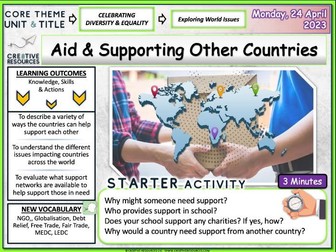
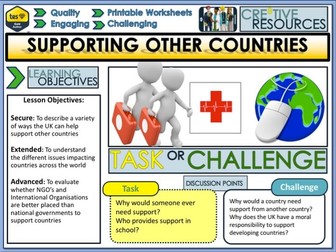
Aid and Supporting Other Countries. (Diversity and Equality) Lesson Pack includes: Editable PowerPoint, lesson assessment, student resources and signposting to extra support services. One of our 40 different bonus mindfulness activities also included and much more.
Learning Outcomes:
To describe a variety of ways the UK can help support other countries
To understand the different issues impacting countries across the world
To evaluate what support networks are available to help support those in need
Some Key Terms Covered
Free Trade, Fair Trade, Aid, NGO, Developing, Globalisation, Debt relief
PSHE and Citizenship Confidence (Assessment) Objectives
I know the difference between Free trade and Fair trade I understand how one country can help another I know the differences between developing countries and developed countries
Each Lesson Pack Contains:
1 Fully Editable PowerPoint (Learning Outcomes, Confidence Checkers, Assessment of Learning, Variety of Tasks, Video Embedded URL Clips, Engaging Premium Quality Slides, Extra Support Websites, Challenging & Thoughtful Questioning)
Student Worksheet(s)
Mindfulness Extension Activities
Assessment Opportunity (Confidence Checker)
Teacher Notes (On some slides)
Mapped against Latest DfE Guidance, PSHE Association Core themes and Requirements
The Cre8tive Curriculum way!
Our shared vision at Cre8tive Curriculum is to help teachers to equip students with the knowledge and skills to take ownership of their own learning and become independent critical thinkers. Products come ‘Ready-to-Teach’ with everything you need for educational, fun and creative lessons.
Be Ofsted and DfE PSHE ready with our resources! Product Code: RSE/C8/LS/56
We sell Complete PSHE and Citizenship Units - Take a look at some of them here:
Gangs Drugs and Alcohol Unit
Politics, Parliament and Me Unit
KS4 Careers and Gatsby Benchmarks Unit
Extremism and Terrorism PREVENT Unit
Exploring British Values Unit
LGBTQAI+ PSHE Unit of Work
Celebrating Diversity in the UK
A detailed lesson about how the UK can support other developing countries across the globe. PowerPoint Lesson for Citizenship Studies. (60-120 Minutes worth of Material) suitable for KS3 or KS4 students.
Learning Outcomes:
Secure: To describe a variety of ways the UK can help support other countries
Extended: To understand the different issues impacting countries across the world
Advanced: To evaluate whether NGO’s and International Organisations are better placed than national governments to support countries
Made by a team of Specialist Practicing Humanities Teachers as part of one of the leading PSHE & Citizenship Resource Providers in the UK - Cre8tive Resources .
What is included in this product?
Fully editable 21 slide PowerPoint Lesson 60-120 minutes
Student Revision Rubix Cube
Student Assessment Sheets
Brand New Revision Tree Handout + More
Answer Keys:
Student input creates some of the answers. Product Code CIT/C8/LS/117
Description of Product
Ready-to-Use pack of classroom activities will enthuse and engage students! This lesson material is designed to be used for between one and two teaching periods and includes; activities, challenging and thoughtful questions, student hand-out (for use during lesson or as a homework), embedded URL links (where appropriate), differentiated tasks and, all relevant information to help students learn about issues relating to the topic.
N.B This lesson can be taught with no printing (For those on tight budgets :)
Our Philosophy
We aim to help you equip students with the knowledge and skills to take ownership of their own learning. Products come ‘Ready-to-Teach’ with everything you need to teach fun and creative lessons. Our products are teacher-designed, classroom tested & student approved.
With over 600 Citizenship and PSHE Products to pick from why not try looking at one of these:
British Values Quiz
Comparing electoral systems
Voting systems and electoral reform
GCSE CItizenship UNIT
What is Identity
These resources consist of a number of different folders intended to support teachers in the delivery of the WJEC specification. There are lesson plans and teaching strategies developed to encourage good practice among teachers of geology.
Revision resources for the Earth’s Life Support Systems part of OCR Geography A Level.
Including:
Revision notes on all topics
Essay plans
Example essays
I received an A* at A Level for Geography - Including 100% for my coursework piece.
ELSS Case study on the water and carbon cycles within the Arctic Tundra. This useful revision resource gives an in depth guide including information surrounding all specification points:
• water and carbon cycles specific to Arctic tundra, including the rates of
flow and distinct stores
• physical factors affecting the flows and stores in the cycles, including
temperature, rock permeability and porosity and relief
• physical factors affecting the flows and stores in the carbon cycle,
including temperature, vegetation, organic matter in soil and the
mineral composition of rocks
• seasonal changes in the water and carbon cycles in the Arctic tundra
• the impact of the developing oil and gas industry on the water and
carbon cycles
• management strategies used to moderate the impacts of the oil and
gas industry
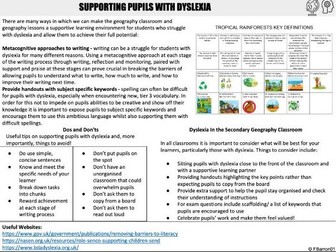
A how to guide on supporting pupils with dyslexia in a secondary geography classroom
Ideal resource for ITT trainees or those who want a few extra tips and tricks!
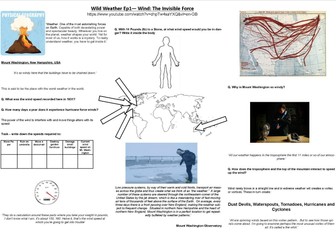
Richard Hammond - Wild Weather - Worksheets to support the BBC TV Documentary Series
Episodes include
Ep1 - Wind
Ep2 - Water
Ep3 - Temperature
All worksheets are written in Publisher and formatted to A3 printing. They can howevevr, be edited and saved as PDF files for A4 printing. All have word versions for uploading to Google Classroom
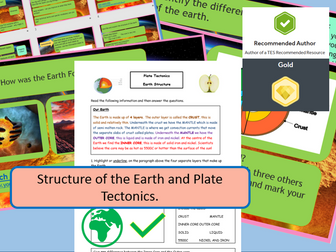
A complete lesson with activity sheets designed for KS3 but suitable for KS4, that include identifying the inner core, outer core, mantle and crust. Convection currents are then covered before the last activity moves onto the differences between continental and oceanic crust. Suitable for Geography tectonic units as well as science courses.
Summarised / concise notes of the theory / general information required for the Earth’s Life Support Systems topic for OCR A Level Geography.
Key sub-topics included:
Characteristics that make up the Identity of a Place
Carbon Cycle
Hydrological Cycle
Catchment Hydrology
Land Use Changes Impact Water Cycle
Water Extraction
Fossil Fuels & Carbon Cycle
Positive & Negative Feedback Loops - Carbon & Water Cycles
Monitoring Changes to Global Water & Carbon Cycles
Interlinkages of Water & Carbon Cycles
Impact on Long-Term Climate Change
Management Strategies - Water & Carbon Cycles
Please note: the major case studies are not included in this document (see the case study resource in my shop), however, smaller case studies have been included throughout this document to help understanding.
Key words have been highlighted. These words and their definitions are included in the definitions resource in my shop.
This engaging set of world symbols has been thoughtfully designed to support learners of all ages in exploring global geography through clear and accessible visuals. Each symbol is simple, inclusive, and easy to recognise, making it suitable for a wide range of abilities and learning styles.
Ideal for both primary and secondary classrooms, as well as SEND and EAL learners, these visuals support the development of geographical awareness, cultural understanding, and key vocabulary in an accessible and meaningful way.
What is included:
A range of world-related symbols Clear, highly visual designs to support understanding for all learners Easy-to-print format for flexible classroom use
Ways to use:
Geography lessons and global topic displays
Labelling maps and identifying key features
Supporting discussions about the world and different places
Matching, sorting, and categorisation activities
Revision tools and visual prompts
This engaging set of river symbols has been thoughtfully designed to support learners of all ages in understanding key features of rivers through clear, visual representations. Each symbol is simple, accessible, and easy to interpret, making it ideal for a wide range of learning needs and abilities.
Perfect for primary and secondary classrooms, as well as SEND and EAL learners, these visuals help to build understanding of geographical vocabulary and concepts in an inclusive and meaningful way.
What is included:
A range of river feature symbols Clear, highly visual designs to support comprehension for all learners Easy-to-print format for flexible classroom use
Ways to use:
Geography lessons and topic displays
Labelling river diagrams or maps
Vocabulary support for new concepts
Matching and sequencing activities
Revision aids and visual prompts
Complete lesson - Linked to AQA 2016 Geography syllabus
All resources required for lesson attached.
PowerPoint is simple enough for a non geography specialist to teach
LOs
Identify the types of aid Nigeria receives.
Describe the different aspects of aid.
Explain how aid benefits Nigeria.
AQA GCSE Geography paper 3 pre-release support.
This document contains 7 pages of resources that can be set as homework to run along the pre-release booklet or taught in class.
Includes:
Exemplar answer to a question that could possibly be similar to the 9 mark question this summer.
Task sheet to help student to examine the pre-release booklet.
Additional suggested questions to practice.
You can download the link for free.
You can also join my special class at google class
Link https://www.tes.com/my-resources/lessons/LgmpIirbfhRW8Q
Class code : z9bqm7s
A PowerPoint that breaks the issue down.
A booklet of questions and suggested practice questions to aid understanding.
Includes geo and maths skills too.


 Quick View