A fantastic Maths Challenge! ANSWERS provided!
Learning Intention: To investigate time zones and to calculate flight times.
Activity: Students have to calculate the arrival time (UK and local time at destination) for each flight.
For the highest achieving students, they have to use the 2 websites provided to calculate flight times and time zone differences as well as generating their own flights!
Almost every parent commented on how exciting and challenging this homework challenge was and the students loved it!
PDF and Word formats available so fully editable.
Please note: Depending on the time of year, the flight times on the activity sheets may vary by 1 HOUR. This is because of daylight saving times (when the UK clocks move forwards/backwards by 1 hour ). You don’t need to worry about this, just use the times written on the activity.
PLEASE NOTE: This is the UK version. If you require the US version, please visit our store.
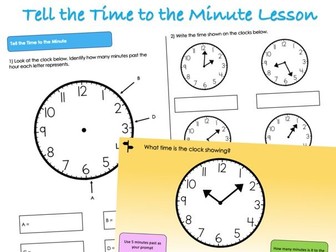
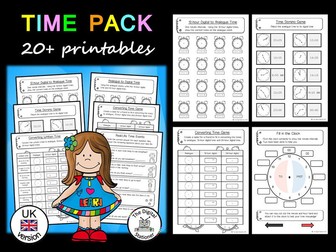
24 Printable worksheets - Telling the time. There are also templates included so that you can create your own written worksheets or alternatively, children can create their own questions for a partner to solve.
Contains:
* Telling the time booklet name page (b&w)
* Telling the time booklet name page (colour)
* Create your own clock (with numbers)
* Create your own clock (without numbers)
* 12-hour digital to analogue (1 minute intervals)
* 12-hour digital to analogue (5 minute intervals)
* 24-hour digital to analogue (1 minute intervals)
* 24-hour digital to analogue (5 minute intervals)
* 12-hour digital to analogue (1 minute intervals)
* Analogue to digital time
* Time domino game
* Create your own time domino game (template)
* Time in real life (reasoning)
* Create your own converting time grid (template)
* Converting time grid
* Match the time
* Create your own match the time (template)
* Converting written time
* Create your own converting written time (template)
* Real-life time events (reasoning)
* Convert your own time- analogue and digital (template)
* Fill in the clock - with minute intervals
* Time elapsed
* Create your own time elapses (template)
* Time terminology word search
PDF format (when printing please set the size option to actual size).
Your feedback is really important to us. We provide quality products at affordable prices and really would appreciate your feedback. With that in mind, please be kind enough to spare a minute or two to leave feedback on this product as it will help us improve our service to you the customer.
Thanks,
Primary Stars Education
Primary school visual timetable.
This is bespoke to my school/classroom, but uploaded as PPT so it can be edited.
Clocks added through https://onlinetools.com/time/draw-analog-clock so they are correctly presented.
Duplicated pages to keep formatting and delete what isn’t needed.
Enjoy :)
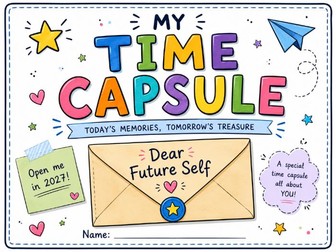
PDF booklet of 10 activities:
Cover page and introduction
Self Portrait
School Memories
Letter to My Future Self
Handprint
Footprint
Height Strip
Maths Time Capsule Challenge
Finish the Picture
Story Time Capsule
Open Me in 2027 Reflection
A quick transition day activity for children to celebrate their achievements, reflect on the year they have had and create lasting memories to look back on in the future. Through a series of fun tasks, including letters to their future selves, drawings, challenges and personal reflections, children will create a time capsule that captures who they are today. The capsule can then be reopened in a year’s time, allowing children to see how much they have grown, changed and achieved.
Put all the activites in an envelope for the child to open at the end of the next academic year.
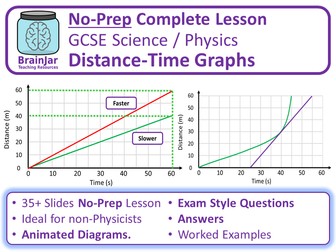
Complete No-Prep lesson with exam questions, tasks and answers on Distance-Time Graphs for AQA GCSE (9-1) Science / Physics. This lesson covers all of AQA GCSE Physics 4.5.6.1.4 / Combined Science 6.5.4.1.4.
As a Secondary Science teacher, Deputy Headteacher, writer and examiner for many years I make high quality no-prep lessons so busy teachers can teach outstanding lessons without spending hours planning. This high quality lesson includes explanations, different types of in-lesson assessment (all with answers) and unique exam questions.
My lessons are ideal for non-Physicists - as a Biologist who retrained as a Physics teacher I know how to take learners on a journey that builds up their understanding step by step, while still going into a lot of depth. The preview video shows a representative sample of slides from the resource so that you get a good idea of what it includes before you buy.
What’s Included:
• Teaching notes
• Starter / Do Now Activity
• Explanation slides in “chunked” sections with animated diagrams.
• Worked examples of calculations / questions.
• Multiple questions in different question styles and difficulties - no need for worksheets. Each “chunked” explanation section typically includes a set of “learning check / quick questions” followed by a set of in-depth questions on the learning from that “chunk” of the lesson. All questions have answers.
• Exam-style questions on the whole lesson at the end of the lesson- these are unique, based on real exam questions but not just copied from exam boards.
• Answers for all questions
• All easily editable to adapt to your teaching or to use in existing lessons.
• Slightly humorous, at points, if you like that sort of thing.
The lesson was written for AQA GCSE Science / Physics but is very likely to be applicable to other exam specifications.
Please leave a rating / review and all other feedback gratefully received!
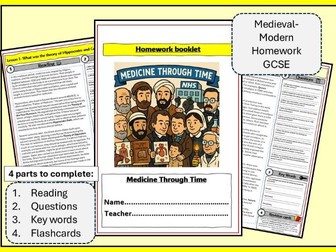
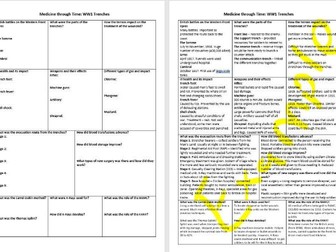
This booklet contains a series of guided reading activities for the GCSE History: Medicine Through Time topic. It covers the full Edexcel course from 1250 to the present day, including a focus study on Medicine on the Western Front.
The booklet is divided into four main periods:
Medieval Medicine (c.1250–1500)
Renaissance Medicine (c.1500–1750)
Industrial Medicine (c.1750–1900)
Modern Medicine (c.1900–present)
Plus a depth study on Medicine on the Western Front (1914–1918)
There is a guided reading and question set for every lesson, with 19 lessons in total. Each reading explains key events, discoveries, individuals, and changes in medicine, followed by 10 guided reading questions to check understanding.
Students should:
Read each passage carefully before answering the questions.
Use the dotted lines provided to write full-sentence answers.
Define the key words listed for each lesson.
Create revision flashcards using the key information and vocabulary from each topic.
This booklet is designed to help them build knowledg and create strong revision notes for their GCSE Medicine Through Time exam.
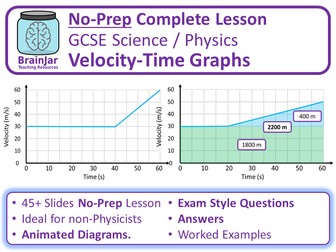
Complete No-Prep lesson with exam questions, tasks and answers on velocity time graphs for AQA GCSE (9-1) Science / Physics. This lesson covers part of AQA GCSE Physics 4.5.6.1.5 / Combined Science 6.5.4.1.5.
As a Secondary Science teacher, Deputy Headteacher, writer and examiner for many years I make high quality no-prep lessons so busy teachers can teach outstanding lessons without spending hours planning. This high quality lesson includes explanations, different types of in-lesson assessment (all with answers) and unique exam questions.
My lessons are ideal for non-Physicists - as a Biologist who retrained as a Physics teacher I know how to take learners on a journey that builds up their understanding step by step, while still going into a lot of depth. The preview video shows a representative sample of slides from the resource so that you get a good idea of what it includes before you buy.
What’s Included:
• Teaching notes
• Starter / Do Now Activity
• Explanation slides in “chunked” sections with animated diagrams.
• Worked examples of calculations / questions.
• Multiple questions in different question styles and difficulties - no need for worksheets. Each “chunked” explanation section typically includes a set of “learning check / quick questions” followed by a set of in-depth questions on the learning from that “chunk” of the lesson. All questions have answers.
• Exam-style questions on the whole lesson at the end of the lesson- these are unique, based on real exam questions but not just copied from exam boards.
• Answers for all questions
• All easily editable to adapt to your teaching or to use in existing lessons.
• Slightly humorous, at points, if you like that sort of thing.
The lesson was written for AQA GCSE Science / Physics but is very likely to be applicable to other exam specifications.
Please leave a rating / review and all other feedback gratefully received!
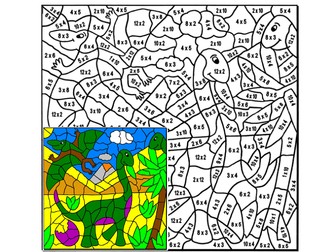
Arithmetints colouring puzzles are an ideal way for students to develop and practise their mathematical skills. This unique dinosaur puzzle aims to embed children’s understanding of 2x, 3x, 4x, 5x and 10x tables facts. Arithmetints puzzles are a flexible resource which can be used for a variety of purposes including assessment. Each puzzle comes with an answer sheet for easy marking. These puzzles also really brighten up pupils’ workbooks or make a great display.
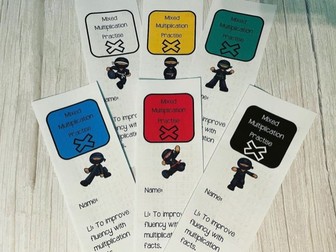
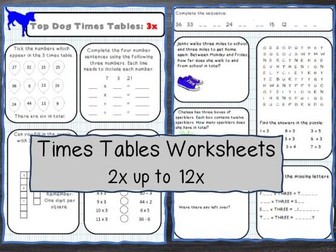
Times table daily activity book themed as ninjas.
The order for completion as follows:
-white belt (x2, x5, x10)
-yellow belt (x2, x4, x5, x8, x10)
-green belt (x2, x3, x4, x5, x6, x8, x10)
-blue belt (x2, x3, x4, x5, x6, x8, x9, x10)
-red belt (all tables to x11)
-black belt (all tables to x12)
This 20 slide PowerPoint presentation can be used for an assembly, for form time, tutor time or PSHE on the first day or week of school. The aim is to help students to consider how lucky they are to have an education and to be inspired to set themselves goals and targets for the academic year. It is full of colourful pictures and animations to hopefully grab the attention of the sleepiest of students! It can be simply shown with very little commentary or can be used for detailed discussion as you wish.
The first slide says Welcome to Year *! (you need to fill in the year group!)
The second slide asks How were you feeling this morning? And gives various options:
Sleepy, sad, scared, lucky, inspired, happy, fed up, grumpy, excited, nervous, positive. Or maybe something else? This can be used as an opportunity for pair, group or class discussion.
Slide 3 says: Here are some other classes starting the school year around the world….
Slides 4 – 8 show classes around the world such as: “Nguyen Thi Phuong teaches a class in Van Chai, Vietnam without books or electricity”, and “Syrian refugee students at one of the Unicef schools at Zaatari refugee camp in Jordan, near the border with Syria.” These slides can be used to elicit the student’s observations about the lives and education of these students and as an opportunity for pair, group or class discussion.
Slide 9 then repeats slide 2: Asking How do you feel now? And gives various options:
Sleepy, sad, scared, lucky, inspired, happy, fed up, grumpy, excited, nervous, positive. Or maybe something else?
Slide 10 asks What was the best thing you did this summer?
Slide 11 states Maybe you did something extraordinary….. and shows pictures of various Olympians from the Rio 2016 Olympic Games.
Slide 11 continues the theme of doing something extraordinary and shows a picture and brief description of the amazing Malala Yousafzai who was targeted by Taliban gunmen in 2012 for expressing her views on education.
Slide 13 asks: Will you do something extraordinary this year?
What goals will you aim for?
Slide 14 – 17 give suggestions e.g Maybe a physical challenge? Make the football team, Run 5K, Learn a new sport, Start training for Tokyo 2020! Beat my swimming PB & Exercise every day. The other challenges are Creative, Academic and Something Else e.g. volunteer, raise money for charity…
Slide 18 says Picture yourself achieving your goal. How does it make you feel? And gives various options: Sleepy, sad, scared, lucky, inspired, happy, fed up, grumpy, excited, nervous, positive. Or maybe something else?
Slide 19 has the brilliant Nelson Mandela quotation: “Education is the most powerful weapon which you can use to change the world.”
Finally slide 20 says Have a great school year!
Enjoy!
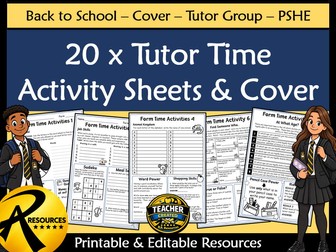
This pack contains x20 A4 printable activity sheets which have been created to keep students busy during tutor/form time and great for cover lessons. If used once a week, this pack will last over half a year! They are also ideal for homeschooling!
Each activity sheet contains a set of tasks which can be given to students to complete independently as part of quiet time or in pairs/small groups for a more interactive session.
Each activity sheet is designed to last between 15-20 minutes. Answers are given where needed in the notes section of each slide.
Activity Sheet Details:
Activity Sheet 1: Word wheel, riddle solving, questioning famous quotations.
Activity Sheet 2: Flags of the world, odd one out
Activity Sheet 3: Job skills, basic sudoku, favourite meal
Activity Sheet 4: Animal A-Z, vocab power, maths and shopping skills.
Activity Sheet 5: Sleepy solutions. sequencing problem solving
Activity Sheet 6: Find some who, true of false quiz, today’s events
Activity Sheet 7: What makes you angry and peaceful? How can you manage yoir feelings?
Activity Sheet 8: Animal alphabet quiz, countries alphabet quiz, famous person choice.
Activity Sheet 9: Class debate about the influence of social media
Activity Sheet 10: Friendship qualities, times tables, choco-lists
Activity Sheet 11: Sports match up quiz, logo memory
Activity Sheet 12: At what age?, pencil case construction, riddle time
Activity Sheet 13: Opposite words, holiday heaven
Activity Sheet 14: My positivity page
Activity Sheet 15: Capital cities, sentence builder, pizza plan
Activity Sheet 16: Relaxation time, genie in a lamp, dog breeds
Activity Sheet 17: Know your nutrition, periodic table, time travel
Activity Sheet 18: Overcoming fear, public speaking
Activity Sheet 19: European map, noughts and crosses, pencil case tower
Activity Sheet 20: Pick your superpower, personal strengths and weaknesses, animal instinct.
Please note that the images you see in have been uploaded to help you preview the resources. All the activity sheets are included within one Power Point resource.
Please be kind enough to leave a positive review if you like these activity sheets. I am more than happy to create another pack if the demand is there.
This resource bundle contains all of the ‘Curious Incident of the Dog in the Night-time’ lessons, the comprehension activities booklet and the knowledge organiser!
The engaging and thought-provoking series of lessons has been devised to provide students with a well-rounded, secure understanding of the text. The entire novel is broken down in to 7 double lesson packs, meaning that there is a total of 14 individual activity sets here.
The Opening Chapters (2-19);
Chapters 23 to 47
Chapters 53 to 83
Chapters 89 to 113
Chapters 127 to 157
Chapters 163 to 197
The End of the Novel (199 to 233).
The comprehensive and colourful PowerPoint presentations guide students through a wide range of activities, including those designed to enhance the following skills: retrieval, understanding vocabulary, inference, explanation, summarising, sequencing, analaysis and deeper thinking activities.
The resources are suitable for students in either KS3 or KS4, depending upon the individual context of the school and students.
Each booklet is has been carefully designed to support students in their reading development. The texts match the reading age for each year group, are extract based and designed for a 20 minute tutor time. The texts are chunked and have discussion questions included. The texts should be teacher read and teacher led, allow for discussion and engangement with students.
Arithmetints colouring puzzles are an ideal way for students to develop and practise their mathematical skills. This unique puzzle aims to embed children’s understanding of 2x, 3x, 4x, 5x and 10x table facts. Arithmetints puzzles are a flexible resource which can be used for a variety of purposes, including assessment. Each puzzle comes with an answer sheet for easy marking. These puzzles also really brighten up pupils’ workbooks or make a great display.
A 2-sided, attractively presented, fun worksheet for tutor time students to guess the logos and brands. Part 1 has 45 fairly well-known logos that the students have to guess and Part 2 has the alphabet created with the first letter from famous UK, American and international brands for the students to guess.
I gave a time limit of 20 minutes for this activity with my form group and it worked quite well.
Answers for both sides included!
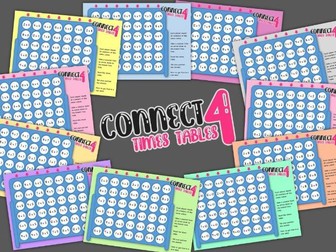
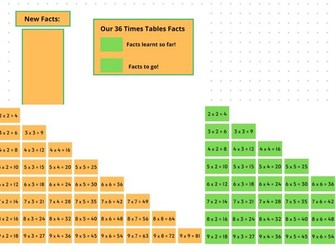
Need a quick and easy intervention to support student to learn tables - This booklet is designed to support a student to develop recall of tables through a focused daily minute of recall. The booklet has a pre and post assessment as well as record space to track daily progress.
Some students need to use a structured approach to get number facts into their long-term memory – they do not seem to keep them there just by regular use in maths lessons. This booklet can be used to support this process.
On each page is a grid with items to prompt the student to say a tables fact. Each day they should count how many oral responses they can give in a minute – and record that on the sheet. The aim is to be able to recall a few more each day.
The precision teaching approach works best if the student can do an activity using the content of the page they are currently working on for a few minutes ( 5 to 10) before they do the one-minute timed activity. There are lots of interactive maths sites online e.g. Topmarks: teaching resources, interactive resources, worksheets, homework, exam and revision help – and this is a great way to give student this opportunity in a way that they can do independently.
At the end of the booklet is a tables square for reference and some ideas for extension activities.
I created a time capsule a few years ago.
I used it with my Year 7 form at the end of the school year. They wrote down their responses to questions such as favourite subject, worst subject, favourite food from the canteen, the job I want in the future is, the best thing about being in year 7, funniest thing that has happened in year 7, height, shoe size and others. I also leave a space for them in the middle where they can put a picture of themselves. I have kept it in a safe box at the back of my cupboard.
It will be a lovely (and embarrassing) memory for them.
this is a quiz on time and converting units of time can be used to recap on time unit conversion - good as a starter or a plenary activity it can be a timed activity to challenge learners
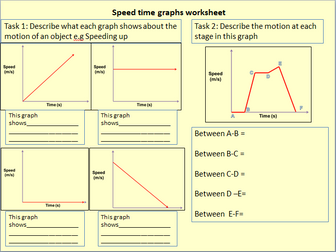
A (long!) worksheet that I produced when I was getting exasperated at my group’s inability to differentiate between distance-time and velocity-time graphs that focuses on the idea of calculating gradients to work out speed/ acceleration.
I gave it to a second-bottom set. They found it difficult and a little confusing (so model it first), but I really wanted to get them to reflect on their mistakes. The results in the assessment did improve a lot. Probably more suitable for a middle ability set in hindsight.
There are a couple of harder sections at the end.