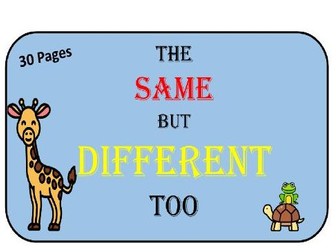
A 30-page printable resource pack inspired by The Same but Different Too, designed for early years learners.
Activities include identifying differences, matching opposites, spotting the odd one out, drawing patterns, ordering by height, counting with 10 frames, describing animals, and 20 sorting colourful pictures. Perfect for encouraging observation and early maths skills.
#EarlyYears #PrintableResources #TheSameButDifferentToo #EYFS #MathsForKids #SortingActivities #HandsOnLearning #CountingFun #MatchingGame
This educational 30 slide assembly focuses on the importance of empathy in secondary school, exploring how to develop empathy skills and its impact within the school community. Students will discover the value of understanding others’ perspectives, fostering positive peer relationships, resolving conflicts with compassion, and cultivating a culture of kindness. Through reflection and actionable tasks, they will be empowered to embrace empathy, creating a supportive and inclusive environment for a successful academic year.
Included in this assembly
What is empathy?
Why is empathy important?
Active Listening
Perspective Talking
Empathy in action
Conflict Resolution
The Ripple Effect
Informative Video’s
Self Reflection
Follow Up Tutor Time Task
Please also visit my TES Assembly Store where over 100 assemblies are available on a huge range of topics.
EYFS Reception Understanding the World knowledge progression map from basline to ELG across the terms of the academic year. Prior learning links to Development Matters 3-4 Years made as well as links to future learning within the KS1 National Curriculum.
This lesson is designed for KS2 students. It can be taught as a stand alone lesson but is also available as part of three wider units, all of which are available on TES:
-Volcanoes
-Earthquakes
-Volcanoes & Earthquakes
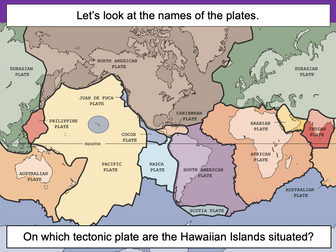
The presentation introduces the idea that the world’s crust is split into tectonic plates and looks at how these are related to volcanoes and earthquakes.
The activity challenges students to identify tectonic plates using a map. It is differentiated two ways:
Easier – Students identify the world’s tectonic plates using a colour-coordinated map.
Harder – Students identify the world’s tectonic plates using a plain map.
Extension – Students use an atlas to find out which tectonic plate countries of the world are located on.
If you like this resource, we would appreciate a review! We will happily send you a free resource in return for a review or useful suggestions/feedback. Contact us at ed@teachitforward.co.uk.
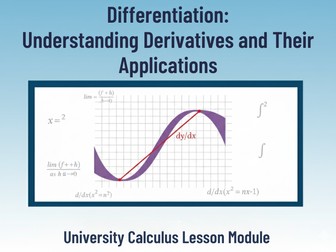
Dive deep into one of the most powerful ideas in mathematics — Differentiation — and help your students master the concept of derivatives as the foundation of Calculus I.
This comprehensive and interactive lesson plan introduces learners to the world of change, motion, and optimization, connecting mathematics to real-world phenomena in physics, economics, and everyday life.
Whether you’re teaching first-year university students or advanced high school learners, this resource is designed to make calculus intuitive, structured, and practical. Students will not only learn how to compute derivatives but also why they matter — understanding the story behind every equation.
**Why This Lesson?
Bridges Theory and Real Life:
Students don’t just memorize formulas — they see how derivatives describe real changes: how fast a car moves, how profits rise or fall, and how nature evolves over time.
Step-by-Step Clarity:
The lesson breaks down every concept with clear explanations, guided examples, and gradual progression, ensuring that learners understand each rule — from the power rule to trigonometric differentiation.
Critical Thinking & Application:
Beyond computation, students tackle optimization problems and rate-of-change applications, gaining the analytical skills they’ll need in physics, engineering, and economics.
Engaging Assessment Structure:
Includes multiple-choice and free-response questions, a guided practice section, and real-world problem-solving tasks to test understanding and boost retention.
Aligned With Academic Standards:
Carefully designed to meet key calculus standards such as HSA-APR.B.3, HSA-APR.C.5, and HSF-IF.B.6, ensuring it fits perfectly into university and advanced secondary curricula.
**What’s Inside This Lesson:
Comprehensive Learning Objective:
Students understand and compute derivatives of polynomial, exponential, and trigonometric functions while exploring their practical uses in optimization and change analysis.
Interactive Opening:
A real-world introduction about speed, motion, and change to connect abstract math to daily experiences.
Detailed Guided Practice:
Includes step-by-step examples (like finding the derivative of 𝑓(𝑥)=𝑥3+2𝑥2−𝑥f(x)=x3+2x2−x) and explanation of common mistakes students make when interpreting derivatives.
Independent Practice & Homework:
A variety of computation and word problems to help students build confidence and fluency.
Assessment Tools:
Ten multiple-choice questions and free-response exercises designed to challenge students’ reasoning and strengthen their problem-solving skills.
Perfect For:
University (Year 1) Calculus I Courses
Advanced 12th Grade Math Classes
STEM programs that integrate mathematics with physics or economics
Tutors & Instructors seeking a ready-to-teach calculus resource
Students preparing for college-level calculus or AP exams
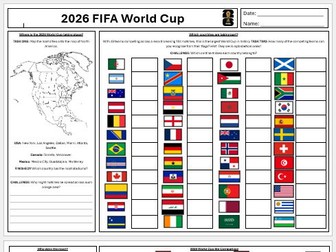
A PPT and A3 double sided word document for students to complete on the 2026 World Cup with a variety of tasks:
Marking on stadium locations.
Identifying flags.
Looking at the advantages and disadvantages of hosting a World Cup.
Comparing country data to decide who should host the 2038 World Cup.
If you’re looking to explore your school’s provision and curriculum in Understanding the World (UW) for your early years children, this audit pack gives you the perfect starting point. Aimed at primary school settings, the audit can be used by both EYFS leads, year 1 leaders & teachers, and curriculum leaders to explore how effectively your school gives children broad and exciting UW learning opportunities and where there are opportunities to develop further. Links are also made between the EYFS and the National Curriculum subjects in Year 1 to provide support for that crucial transition, and is ideal if you’re looking to provide a cohesive curriculum offer.
Further EYFS leadership resources can be found on our website.
Understanding the World audit for Reception and EYFS provisions. Understanding the World audit only.
The comprehensive EYFS deep dive and audit pack can be found on our website Honeyguide SLS for £17.50.
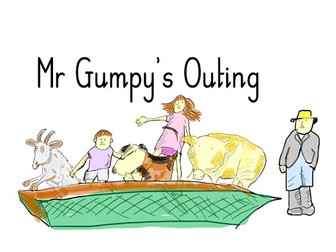
Mr Gumpy’s Outing – 23 Page Literacy & Maths Resource Pack (Hand-Drawn, by myself, EYFS/KS1)
Bring the beloved story Mr Gumpy’s Outing to life with this beautifully hand-drawn resource pack, designed to enhance early maths and literacy skills in a creative, story-based way.
This 23-page pack supports both classroom and home learning and is ideal for EYFS and KS1. The activities help children explore characters, sequencing, numbers, and more through engaging and accessible formats.
Included in this pack:
Two sets of animal flashcards (colour & black and white)
Name the animals
Sequence the characters from the story
Weight sorting activity
General sorting task
Cardinal numbers
Subitising activity
Mr Gumpy’s “Rules” x2
Addition activity
Story-themed maze
All illustrations are original and drawn by me, making this a unique and visually engaging set of resources.
If you find these resources helpful, please consider leaving a positive review – it makes a big difference and helps others discover useful content too.
Take a look at my other story-based resources for more cross-curricular fun!
#MrGumpysOuting #EYFSResources #KS1Learning #EarlyYearsLiteracy #StoryBasedLearning #MathsThroughStories #Flashcards #Subitising #Sequencing #TESResources #HandDrawnResources #EarlyYearsMaths #ReceptionActivities #HomeLearning #PositiveFeedbackAppreciated
This resource contains a fully editable and informative, 115 slide PowerPoint presentation on the 2026 FIFA Football World Cup tournament.
The PowerPoint is divided into the following sections
The history of the World Cup
The structure of the tournament
World Cup Awards
World Cup facts and records
England at the World Cup
2026 World Cup
The presentation contains links to Maradona’s two famous goals, England’s goals in 1966, Englands best football World Cup moments in history, Pele’s goals, the World Cup Willie song, and an interview with the owner of Pickles, the dog, who found the World Cup when it went missing, Roger Milla’s goal - the oldest goal scorer in the World Cup, England’s performance in the World Cup, the 2026 mascots, highlights of the 2022 World Cup and a video about the 2026 tournament.
Please note, the watermark on the preview images is not present on the resource itself.
You may also be interested in:
Football World Cup Quiz 2026 - 100 QuestionPowerPoint Quiz
This is a 100-question PowerPoint quiz on the 2026 FIFA Football World Cup tournament. Each question has three possible answers. The answers can be found by clicking on the ball image on the bottom right-hand corner of each slide. An answer sheet is provided to allow individuals/teams to record their answers. The quiz is divided into 6 categories:
Past World Cups
World Cup Records
Miscellaneous
Picture Round
World Cup 2022
World Cup 2026
Save money and buy both resources at a discounted rate:
Football World Cup 2026 - Presentation and Quiz
Football World Cup 2022 - Fixtures and Results Templates
This resource contains templates of fixtures and results tables for the 2026 Football World Cup tournament for the group stages, the 32 and 16 knockout stages, quarter-finals, semi-finals , third place play-off and final. It also contains a summative results table. Engage your pupils by getting them to fill in the sheets as matches are played.
Football World Cup 2026 - Puzzle Pack - Crosswords - Wordsearches- Anagrams
Thinking of publishing your own resources? Check out this step-by-step guide:
How to Become a Successful TES Author: Step-by-Step Guide
In this engaging and informative lesson, children learn what symbols are, and begin to interpret and reflect on the meaning of symbols. They apply this knowledge in creating their own symbols, considering what the objects/ animals, colours and shapes that they select represent.
I used this as an introductory lesson, before then going into more depth about different religious symbols in the subsequent lessons. Children enjoyed it and it gave them a solid understanding of symbols to build on in the next steps of their learning.
This resource pack contains a comprehensive and colourful 15-slide Powerpoint, which guides teachers and students through the learning activities. A template worksheet is also provided (in Word and PDF) for the students to create and describe their symbol.
In the past, I have used this lesson with children in both Years 1 and 2 - the key learning is aligned with national expectations for RE, and also the content prescribed by most diocese regions. All images are licensed for commercial use, and are cited on the final slide.
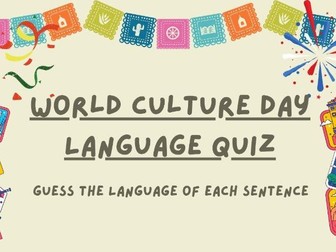
This is a quiz that contains around 37 slides of the best language quiz for world culture day to play with students where they will need to guess the language - it also comes with a hint.
All in all it contains around 14 different languages from around the world that then offers a little bit of information about the country to help promote the countries location and culture!
Enjoy!
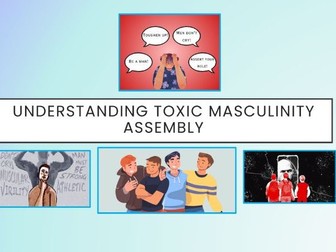
This powerful and thought-provoking 30-slide assembly explores what it means to “be a man” in today’s world — challenging toxic stereotypes and empowering students to embrace healthy masculinity, mutual respect, and critical thinking in the age of online influence.
This Assembly Covers:
What toxic masculinity is — and how toxic masculinity can harm boys, girls, and society
Misogyny, online influencers (e.g. Andrew Tate), and how media shapes attitudes
The impact of harmful messages on mental health
What healthy masculinity looks like — respect, emotional openness, strength without harm
Video discussion task featuring Gillette’s “The Best Men Can Be” campaign
Creative follow-up activity: students design their own anti-toxic masculinity poster campaign
Help your students move beyond outdated stereotypes, recognise harmful messages, and grow into respectful, emotionally intelligent young men and allies.
Please visit my TES Assembly Store where over 100 assemblies are available on a wide range of topics
Activity sheet with a large world map in the centre.
Labels for the continents and oceans at the top and bottom, students can cut and stick or link up with lines. They're then asked to find their home country and label it to understand where it is in the world.
Great to photocopy onto A3 to increase the map size.
Make learning about the world around us fun and exciting with this 43-page EYFS Understanding the World Activity Pack!
This bright, colourful and engaging resource is designed for children in Nursery and Reception, helping young learners develop their curiosity, observation skills and understanding of the natural world through fun, hands-on activities.
What’s Included?
This 43-page printable pack features a variety of child-friendly activities, including:
Animals and Their Homes – Exploring different animals and where they live.
Habitats – Discovering environments such as jungles, deserts and oceans. Weather – Recognising and exploring different weather conditions.
Seasons and Nature – Learning about changes in the world around us.
The Natural World – Encouraging curiosity and observation.
Interactive Worksheets – Opportunities for matching, colouring, identifying, drawing and recording ideas
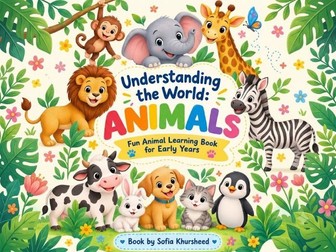
Understand the World – Animals is a fun and engaging preschool activity book designed to help young learners explore the amazing world of animals!
Packed with colourful activities covering animal names, habitats, babies, food, sounds, movement and body parts, this resource makes early learning interactive and enjoyable.
Perfect for Preschool, EYFS, Kindergarten and early years classrooms, with simple, child-friendly activities that support observation, vocabulary, matching, identification and general knowledge.
A ready-to-use animal-themed resource for curious little learners!
a lovely bundle of resources to support the teaching of caterpillars, focussing on Understanding the world. Included is:
watercolour visual discs with vocabulary for the lifecycle of a butterfly
photographic visual discs and frames with vocabulary for the lifecycle of a butterfly
a watercolour life cycle of a butterfly with a blank one and seperate pictures for the children to order themselves
a cut and stick lifecycle that the children can colour and label
visual discs of different types of butterflies
visual discs of different types of caterpillars
EYFS Understanding of the World objectives and Early Learning Goals, split by strand and age. Includes 30-50 months and 40-60+ months. Great for display!
Taken from our PSHE EYFS/KS1 Resource file
One lesson with activities to get the children thinking about key questions.
About the unit in general:
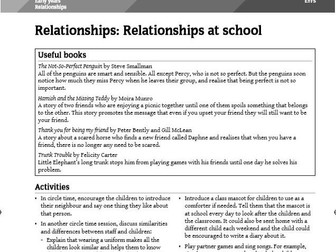
The material in this unit contains ideas on how PSHE and Citizenship can be introduced in the early years. Many of the skills and values that fall within this area of the curriculum are taught throughout each day in an Early Years classroom. The qualities they encourage are illustrated on the following page. Three themes: • Fairness • Relationships • Choices have been covered in depth. Many of the qualities that are developed in PSHE and Citizenship are embraced within these particular subjects. They are fundamental to the Early Years curriculum. Timing In this unit most of the activities would take 10-15 minutes. However, some of the ideas presented are not full activities but suggestions of how to incorporate the topic into the everyday classroom
Find the full unit on TES: https://www.tes.com/teaching-resource/eyfs-pshe-understanding-the-world-back-to-school-unit-of-work-6-lessons-unit-12319666
Leave a review


 Quick View