This worksheet has been designed for gallery visits. There is a space in the middle to make a sketch. It asks the following questions:
Your Name
Title of Artwork
Name of Artist
What have you looked at?
What media has the artist used?
what colours has the artist used?
What kind of marks or techniques has the artist used?
What kind of shapes and forms can you see?
How does the artwork relate to other artworks in the exhibition?
How does the artwork make you feel?
The same worksheet is uploaded as a .jpg and pdf. I'm not sure why you can only see the top part of the pdf. When you download it, it is all there - I have checked!!
Keywords: gallery visit, gallery education, analysing art, visiting galleries, gallery activities.
GCSE Art Gallery Visit Resource for teachers to share with their students.
Created for my Y10 GCSE Art students ahead of our gallery visit to find artist inspiration for their Y11 Personal Portfolios.
The first page gives space for details on arrival/departure times and student/teacher groups.
The second page is a site-specific map of the Tate Modern.
The third page details the Personal Portfolio task to be completed whilst visiting the gallery.
The fourth page, includes guidance and questions to help students consider the art on display and how it may influence, impact their final coursework project.
Editable PDF to help students make the most of their gallery visit.
This version is tailored to the Tate Modern, London but could be adapted to another venue.
This presentation contains 20 slides of resources for Educational Visits for GCSE and A-Level Art and Photography students. I have included help sheets, task sheets and examples for lessons / visits -that I have used to aid my teaching over the last 10 years.
Are you taking students to an art gallery? If so, this resource might help. It explains to students how to behave in a gallery setting and how to really get the best from the experience. A series of tasks ensure that students fully engage with the artwork and collect valuable information through note taking, photography and sketching that can then be expanded upon once back in the classroom. Ideal for Key Stage 3 and GCSE Art students. The resource is print friendly and can be given to students as a work book to use in the gallery. 17 pages.
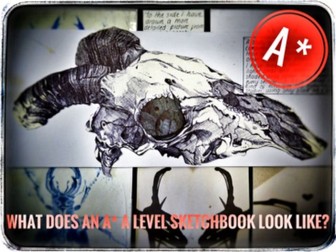
A level Art. If you are struggling to find outstanding exemplar material to show your A level Art students, this might help. Over 30 slides documenting an A* graded sketchbook. The work clearly demonstrates outstanding observational work along with media experimentation, idea development and critical and contextual referencing. This work was awarded A* and was highly praised by the exam board. This work was produced in response to the AQA A level Fine Art title. The theme here is “Growth and Decay”.
Planning an art gallery visit with your students? This resource might just help. A student friendly guide to getting the most out of a gallery visit. A 17 page workbook that guides students through how to behave in a gallery, how to explore and analyse the artwork, how to take notes and sketch details and how to interpret the artwork in order to develop their own art once back in the classroom. Easy to print and ideal for all exam level art students.
Aimed at KS3, great for a series of 3-4 lessons or for cover.
Includes:
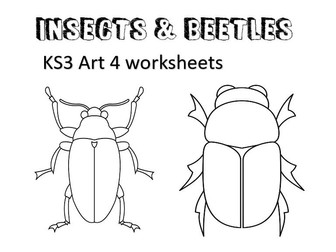
2 worksheets on designing beetles with patterns and collage
1 worksheet on comparing two artists who work with beetles as a theme
1 worksheet getting students to practice their drawing skills by drawing one half of a beetle from a photograph.
Introduce your pupils to the colourful world of Madhubani art, one of India’s best-known folk art traditions. In this engaging art project, children will create a beautifully decorated elephant using bold colours, repeating patterns and their own creative ideas while exploring the distinctive style of traditional Indian art.
This resource is designed to be flexible for different ages and abilities. Pupils can create a highly detailed Madhubani-inspired design or complete a simpler version with fewer decorative patterns, making it ideal for a wide range of year groups, lesson lengths and classroom settings. The project can be completed using watercolours, coloured pencils, felt-tip pens, crayons or mixed media, allowing teachers to use the materials they already have available.
What’s Included
Step-by-step teacher instructions
Supply list with flexible material options
Two completed project examples
Four printable elephant templates
Suggestions for adapting the activity for different ages and lesson times
Ideal For
Primary Art
KS1 & KS2
India Topic
World Cultures
Cross-curricular Learning
Art Clubs
Cover Lessons
Home Education
Through this activity, pupils will explore:
Madhubani folk art
Pattern and repetition
Decorative design
Colour
Creative expression
Looking for a More Complete Lesson?
This resource includes the art project only. If you’re looking for a more comprehensive introduction to Indian art, please visit my shop for the complete Art of India Lesson for Kids. The full lesson includes engaging art history, cultural background, discussion questions, and this Madhubani-inspired elephant project, providing a richer exploration of India’s artistic traditions.
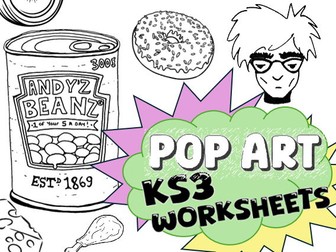
Andy Warhol and Pop Art themed worksheets.
COST EFFECTIVE - Worksheets can be printed in black and white.
Features 4 different design and drawing tasks across 3 worksheets.
Suitable for homeworks, lesson content or cover lessons.
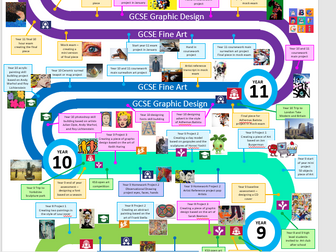
For Art department heads and Art department leads: an example of a visual curriculum road map/pathway for an Art and Design department. OFSTED love it as a visual resource for staff, students and visitors to quickly see the path of the curriculum and how it fits together and builds from one project to another. Use it as a template but make it your own including your own department’s schemes of learning. At my own department we have printed a copy to A1 for each classroom and for the corridor in the department.** If you found this resource useful, please leave a positive review :) Thanks**
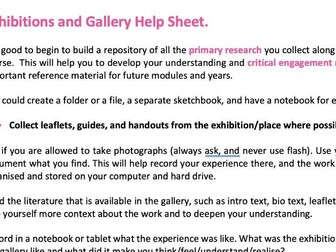
A teaching resource for art/photography teachers and facilitators that can be adapted from school up to university level, that has been developed from my twenty years of knowledge and experience as a photographer and visual arts teacher.
Going to look at artwork is a key part of a creative experience and project, and students may not know how to record this so it is well linked to their own projects, ideas and thinking.
This is a good worksheet/guide to use on a visit and for students going on independent trips. Do let them have access to this resource in plenty of time before you/they go and go through it with them to answer questions they may have. Add/change as you need.
This is drawn from my years of experience as a practicing photographer and visual arts/photography teacher and has been freshly updated in August 2025.
Do not resell or reuse (outside of a teaching scenario) any of the content of this lesson or resource.
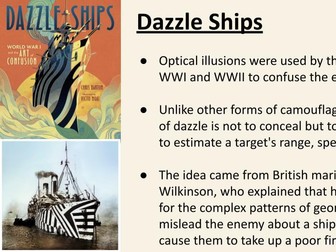
Optical Art lessons where students learn op art techniques and then create their own dazzle ships. Optical illusions.
Includes:
Content for 2 to 4 lessons
Examples
Success Criteria
Do Now Tasks
Printable worksheets
Marksheet
Art of the American Soldier: Stories from the Soldiers encourages students to deepen their appreciation of war art through watching and
listening to veteran war experiences. Students are then asked to point out details in the artwork
they had not previously noticed before listening to the veteran war stories. Art of the American Soldier: Comparing and Contrasting Photography and Painting in War Art encourages students to use photography to analyze artwork for details regarding the historical context of 20th and 21st century wars and conflicts.
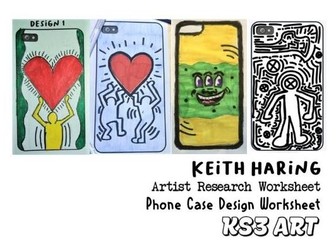
A tried and tested set of 2 worksheets on Keith Haring, great for KS3 art and remote learning.
Worksheet 1 - Design a phone case in the style of Keith Haring, complete with student examples in colour and black & white.
Worksheet 2 - Artist research on Keith Haring complete with information to read and questions to answer.
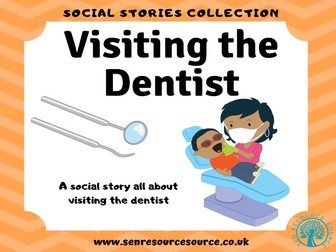
Social story to help children to know what to expect at a visit to the dentist to ease any anxiety prior to their visit.
The point of a social story is to use a patient and reassuring tone to teach children about social situations in a way that can be easily understood. Social stories can be useful for any child who is struggling to understand a situation or concept or needs help to understand a social skill or social cue, expectations, perspectives, common responses or is troubled about an upcoming event but social stories are particularly useful for children on the autistic spectrum for whom social cues can be challenging and who often suffer anxiety if they do not know what to expect from a situation.
These books should be used over and over to reinforce the point so I would suggest either putting the pages into a display book or laminating and binding them.
Clipart images courtesy of Kari Bolt Clip Art
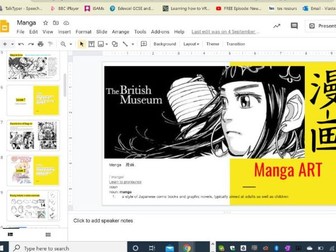
This is a presentation of 34 slides covering 8 lessons. It’s a stylish lesson by lesson guide to creating Manga-style illustration. Assessment criteria are also included in the presentation. The project was originally designed for yr8 student who visited Manga exhibition at British museum. However, it can be taught without the museum visit and can be taught to year 9 and10 . Students have found it very engaging and stimulating.
I taught this lesson, as part of a whole school Art day, to Key Stage 2 pupils (Years 3, 4, 5 and 6). The kids really loved it and added some very creative touches to their walls!
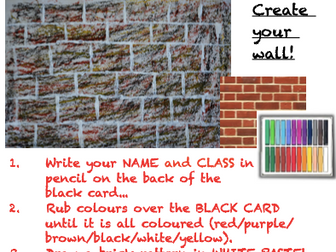
This can be done in a single lesson or extended to cover two lessons. Students do pastel rubbings on black card, then add white pastel lines, to create a brick wall backdrop. Then, they trace over ‘graffiti style’ lettering (on A4 paper), to create their own ‘democratic’ words, to paste onto their brick wall. They will colour these in using the felt tip pens.
I have detailed all the equipment needed in the flipchart and given lots of photos to guide you through each stage of the artwork. I’ve also included templates for the graffiti lettering.
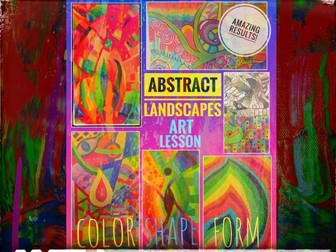
Two linked art lessons that introduce students to abstract landscape art. Clear and straightforward guidance for teachers and students. Includes step by step guide, materials lists, differentiation, cross subject links and links to the artist Hundertwasser. Fully illustrated. Also includes student guidance sheets that can be printed and handed out to support understanding.
Initially, students practice their observational drawing skills relating to landscape forms. They then use their imagination and research into the work of Hundertwasser to develop abstract compositions. They will then complete the work through vibrant use of colour.
This is a really exciting project that allows students to produce striking, vibrant paintings and drawings that look amazing when displayed as group of work. Students will love the results, and so will you when you see how stunning the work looks displayed in your art room.
Two lesson plans. Taking into account work time, this will keep students engaged for at least 4 hour long lessons.
Continuing Barnaby´s trip. This time he will visit China. I have used this resource with my Year 1 class. They really enjoyed it. I hope it is useful for you!
1 Vocabulary Story 931 Visits to Van Gogh
.
Van Gogh seemed vacuous, doing menial tasks in an insane asylum.
His art was reproved and laughed at. However; toward the end of his
life, things started to invert.
A new tier of artists braved the hoarfrost to visit him; it was
a harbinger of things to come. For his part, Van Gogh had charisma
and rapport and was garrulous about his ideas about art.
.
.
.
2 Vocabulary Story 931 Visits to Van Gogh
.
Van Gogh seemed empty headed, doing lowly tasks in an insane asylum.
His art was criticized and laughed at. However; toward the end of his
life, things started to turn around.
A new generation of artists braved the cold to visit him; it was
a sign of things to come. For his part, Van Gogh had charm
and friendliness and was talkative about his ideas about art.
.