Complete course workbook for new specification AQA A Level Philosophy.
26 page workbook of fill-in activities, designed to consolidate and revise key content.
Includes exam technique hints, practice questions and evaluation opportunities.
Great printed off into A3 booklets.
Can be used either in class as a teaching tool, provided as an independent revision resource or set as homework tasks.
Covers whole A Level course including:
Epistemology
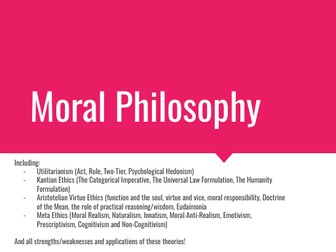
Moral Philosophy
Metaphysics of God
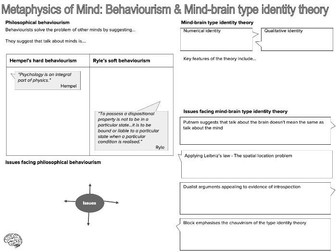
Metaphysics of Mind
This resource contains all lessons for ‘Moral Philosophy’ under AQA’s A-Level Philosophy course. Relevant for either the AS or A-Level, these resources summarise each respective argument/theory, alongside their critiques and any relevant defences. Exam questions are also included routinely.
Unit contains:
An introduction to Moral Philosophy
Utilitarianism (including: Act Utilitarianism, Rule Utilitarianism, Two-Tier Utilitarianism, Psychological Hedonism, strengths/issues of Utilitarianism and application of Utilitarianism to the eight specified scenarios)
Deontological Kantian Ethics (including: The Categorical Imperative, The Universal Law Formulation, The Humanity Formulation, strengths/issues of Deontological Kantian Ethics and application of Kantian Ethics to the eight specified scenarios
Aristotelian Virtue Ethics (including: the function of the soul, Aristotelian virtue/vice, the Doctrine of the Mean, the role of practical wisdom/reasoning, Eudaimonia, strengths/issues of Aristotelian Virtue Ethics and application of Virtue Ethics to the eight specified scenarios
Meta-Ethics (including: Moral Realism, Naturalism, Innatism, Moral Anti-Realism, Emotivism, Prescriptivism and Cognitivism/Non-Cognitivism)
Whilst this contains all relevant theoretical materials, and poses questions to probe understanding, please use the approved AQA textbook for relevant activities.
Note: any extra materials/resources or videos used herewithin are not owned by me, and I take no credit for these. Please refer to their URL links for the original designer/creator.
This is a revision bundle on Kantian Ethics from the AQA A Level Philosophy Specification. It includes 4 lessons, covering Categorical and Hypothetical Imperatives; Kant and Duty; Applied Kantian Ethics; and Weaknesses of Kantian Ethics.
The sessions be used as either standard lessons or extra-curricular revision sessions. The lessons cover the content that students need to know for the exams and then has activities designed to consolidate learning.
Exercises include Tweet the Definition (where students examine key terms); Newsround (a mind map activity); The Weakest Link (a quiz); Thought for the Day (a blogpost writing activity); and the Big Questions (a debating exercise). There is also a homework assignment which you can use to assess learners’ progress.
These resources should make learning interactive, productive, and enjoyable, giving your students the chance to get the grades they deserve.
This is a revision session on Preference Utilitarianism from the AQA A Level Philosophy Specification. It be used as either a standard lesson or extra-curricular revision session. The lesson covers the content that students need to know for the exams and then has activities designed to consolidate learning.
Exercises include Tweet the Definition (where students examine key terms); Newsround (a mind map activity); The Weakest Link (a quiz); Thought for the Day (a blogpost writing activity); and the Big Questions (a debating exercise). There is also a homework assignment which you can use to assess learners’ progress.
This resource should make learning interactive, productive, and enjoyable, giving your students the chance to get the grades they deserve.
Included are a complete set of notes detailing the key concepts and criticisms within the Philosophy of Religion module of the current specification for AQA A-Level Philosophy. I passed A-Level Philosophy with an A* and these notes helped me do it, so I have published them to help the next generation of A-Level Philosophy Students! If there are any omissions please do let me know and I will send an updated copy free of charge.
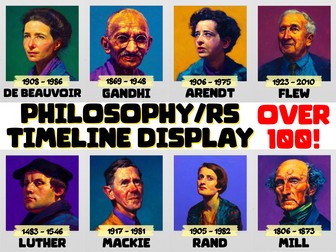
Some of you may have my original Philosopher Timeline in your classrooms. Thank you for your support and I hope it’s been useful throughout that time. Ten years later I’m unveiling a brand new timeline display.
After taking the time to reflect on the previous timeline, I’ve made some modifications in order to:
Support cognitive load and reduce distraction by removing description text.
Foster student interest through eye-catching, coherent and clear pictures.
Improve representation across the board (fewer dead white men as a proportion).
Refine and broaden the thinkers referenced in line with current RS/Philosophy qualifications.
Thinkers now pop with a new art-style that is consistent, clear and memorable.
Names and dates take centre-stage and unnecessary clutter is gone. The timeline is intrinsic to my practice and it’s referred to multiple times a lesson, from Y7 to Y13. Students repeatedly report how useful it is to be able to visually grasp the chronology and how this lowers cognitive load.
There are now over 100 thinkers available each with an optional quote bubble. I’m also more than happy to create additions as you request them, if your particular course requires someone who is missing. I’ve taught both the OCR Religious Studies and, more recently, the AQA Philosophy A-Level course and I’ve combined both sets of thinkers here along with others who might be useful at GCSE and KS3.
I recommend they are printed at A4 on ‘actual size’ print setting. I’ve laminated mine and then cut to the edge with a guillotine.
The base pack includes:
A J Ayer
Alasdair MacIntyre
Alister McGrath
Alvin Plantinga
Angela Davis
Anselm
Anthony Flew
Aristotle
Augustine
Ayn Rand
Basil Mitchell
Bernard Williams
Bertrand Russell
Boethius
C L Stevenson
Carl Jung
Charles Darwin
Copernicus
Daniel Dennett
Daphne Hampson
David Chalmers
David Hume
Dietrich Bonhoeffer
Edmund Gettier
Elizabeth Anscombe
Emil Brunner
Ernest Sosa
Frank Jackson
Fredrick Copleston
Friedrich Nietzsche
G E Moore
Gandhi
George Berkeley
Germaine Greer
Gilbert Ryle
Gottfried Leibniz
Greta Thunberg
Guru Nanak
Gustavo Gutierrez
Hannah Arendt
Harriet Mill
Henry Sidgwick
Heraclitus
Immanuel Kant
Irenaeus
Iris Murdoch
Jean-Paul Sartre
Jesus
Jeremy Bentham
Jo Marchant
John Calvin
John Hick
John Locke
John Mackie
John Stuart Mill
Joseph Fletcher
Julia Annas
Julia Galef
Karl Barth
Karl Marx
Karl Popper
Karl Rahner
Kieth Ward
Lewis Carroll
Linda Zagzebski
Ludwig Wittgenstein
Martha Nussbaum
Martin Luther
Martin Luther King Jr
Mary Daly
Mary Warnock
Noam Chomsky
Norman Malcolm
Paul
Pelagius
Peter Geach
Peter Singer
Philippa Foot
Plato
Rene Descartes
Richard Dawkins
Richard Hare
Richard Swinburne
Robert Nozick
Rosalind Hursthouse
Rosemary Ruether
Siddharta Gautama
Sigmund Freud
Simone De Beauvoir
Soren Kierkegaard
Steven Law
Teresa of Avila
Thomas Aquinas
Thomas Hobbes
Thomas Nagel
Vandana Shiva
W E B Du Bois
William James
William Paley
A revision work booklet ideal for classnotes, homework and revision.
Covers the six units on the AQA Religious Studies A-Level examination (Philosophy only)
The Existence of God
Evil and Suffering
Religious Experiences
Religious Language
Miracles
Self, Death and Afterlife
Contains:
a) Specification checklists for students to complete
b) Key terms tasks for students to complete
c) Revision grids for students to complete
d) Sample exam questions for students to complete
Teacher made.
This resource is to be used with the AQA Philosophy A Level. This covers one of the sections from the Philosophy of Mind unit of the course. It includes all the necessary arguments from the specification.
This bundle contains four double-sided learning checklist and DIRT worksheets: ideal for revision sessions and for students starting the course.
They are for the 2017 (onwards) AQA Philosophy spec, The Personal Learning Checklists (PLCs):
-Allows the student to see clearly what they need to know for the exam.
-Allows the student to communicate to their teacher how they can be best helped.
-Gets the student to analyse their progress in relation to their target grade.
-Encourages students to reflect in a structured manner on their necessary revision focusses.
-Gets students to establish both a revision and an exam technique focus.
Buy them individually for £2.99 or save 50% buying them all together.
Positive reviews greatly appreciated!
.
Check-out some of our most popular resources on TES!
GCSE Religious Studies
Buddhism (20 Lesson Unit)
Buddhism (Thematic Studies Units)
Christianity (Thematic Studies Units)
Hinduism (20 Lesson Unit)
Hinduism (Thematic Studies Units)
Islam (Thematic Studies Units)
.
.
GCSE Sociology Resources
Complete Units (Whole Course)
.
.
AS/A2 Revision Sessions
OCR Religious Studies
AQA Philosophy
AQA Sociology
.
Philosophy for Children (P4C)
The Ultimate P4C Resource Pack
The Debating Society Toolkit
Philosophy Boxes
.
.
.
Other Tools
A3 DIRT Worksheet (15+ 5-star ratings!)
KS3 RE Units
Complete set of revision checklists based on the new AQA A Level Philosophy specification.
Suitable for KS5 Philosophy students.
Helps self-check level of understanding of students, then direct them to weaker areas.
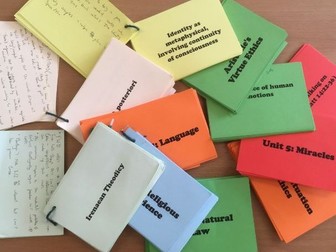
This is an excel file which contains a tab for each unit relevant for Paper 1 of the John Frye Hodder textbook. Each tab contains flashcard templates for each unit. The flashcards are arranged in order so that your students can use the flashcards as a revision resource - they work through the book, chapter by chapter, completing the back of the flashcards with notes. There are over 650 flashcard templates so enough to keep them going!
It is arranged in tabs so that you can email the excel file to your repro dept and ask them to print a certain tab onto A4 card. The cells are set up so that you just need to quarter the sheets of A4 card. I give them to my 6th formers to do for homework, and they take them away, cut them up themselves and bring them back completed with notes. It is good for getting them reading independently and also to create a revision resource for exam time. There are 16 units in total for the Philosophy & Ethics paper so well worth starting revision as early as possible.
The excel file will not be locked so you can add extra ones to it should you feel the 600-odd flashcards aren’t enough!
It took me over an hour per unit to read the textbook chapter, consider what they need to know for the exam and make the flashcards. So that is 14 sets of flashcards taking over an hour each to produce! Truth be told, I would not have started making these had I realised precisely how much time would need to be invested in it! You can buy back days of your life by buying this, plus can be reused every year, so at £3 this represents a cost of 22pence per hour of your time saved.
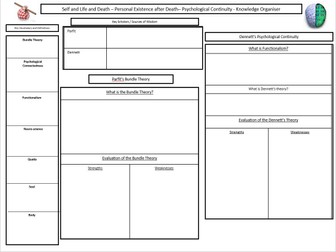
Knowledge Organisers for the Philosophy content
A level Religious Studies
AQA but could also be used for other exam boards
26 PPT slides which span across the entirity of the Philosophy Content for AQA Religious Studies Philsophy section.
These can be printed off, emailed or blown up to A3.
This printable textbook provides a systematic explanation for every point mentioned in the specification.
In the next section It then provides arguments for and against each point and, where appropriate, summarises arguments using premises and conclusions.
The file is a .doc Word file, 140 pages in length, 72000 words.
It is designed to be a comprehensive reader for AQA Philosophy students.
This should be viewed as a printable information book: it does not include learning activities or images. It aims to provide the necessary information as effectively and comprehensively as possible.
Note: it does not cover the Applied Ethics section which, if this resource succeeds, will be covered in a later volume.
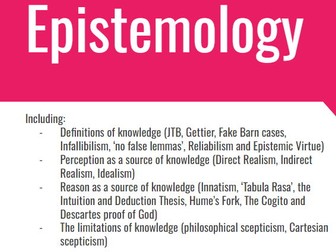
This resource contains all lessons for ‘Epistemology’ under AQA’s A-Level Philosophy course. Relevant for either the AS or A-Level, these resources summarise each respective argument/theory, alongside their critiques and any relevant defences. Exam questions are also included routinely.
Unit contains:
Definitions of knowledge (JTB, Gettier, Fake Barn cases, Infallibilism, ‘no false lemmas’, Reliabilism and Epistemic Virtue)
Perception as a source of knowledge (Direct Realism, Indirect Realism, Idealism)
Reason as a source of knowledge (Innatism, ‘Tabula Rasa’, the Intuition and Deduction Thesis, Hume’s Fork, The Cogito and Descartes proof of God)
The limitations of knowledge (philosophical scepticism, Cartesian scepticism)
Whilst this contains all relevant theoretical materials, and poses questions to probe understanding, please use the approved AQA textbook for relevant activities.
Note: any extra materials/resources or videos used herewithin are not owned by me, and I take no credit for these. Please refer to their URL links for the original designer/creator.
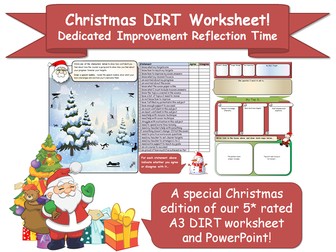
Perfect for a relaxed and fun Christmas lesson! This bundle includes a:
-AQA Philosophy Christmas quiz (KS5)
- Christmas A3 DIRT Worksheet (suitable for KS4 or KS5) and
-The Philosophical Debate Generator’!
.
Check-out some of our most popular resources on TES!
GCSE Religious Studies
Buddhism (20 Lesson Unit)
Buddhism (Thematic Studies Units)
Christianity (Thematic Studies Units)
Hinduism (20 Lesson Unit)
Hinduism (Thematic Studies Units)
Islam (Thematic Studies Units)
.
.
GCSE Sociology Resources
Complete Units (Whole Course)
.
AS/A2 Revision Sessions
OCR Religious Studies
AQA Philosophy
AQA Sociology
.
Philosophy for Children (P4C)
The Ultimate P4C Resource Pack
The Debating Society Toolkit
Philosophy Boxes
.
Other Tools
A3 DIRT Worksheet (15+ 5-star ratings!)
KS3 RE Units
Copyright Adam Godwin (2018)
A revision session covering the first topic within Epistemology for AQA Philosophy A-Level.
Includes overviews of:
JTB
Gettier
Reliabilism
Infallibilism
Virtue Epistemology
No False Lemmas
Plus exemplar exam questions
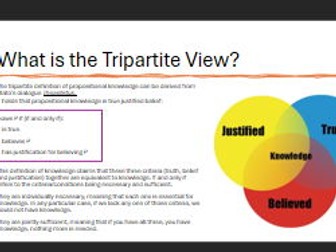
16 slides on the Tripartite View Section of AQA Philosophy
Includes what the spec says
What is the Tripartite View
Knowledge without Truth, Belief or Justification
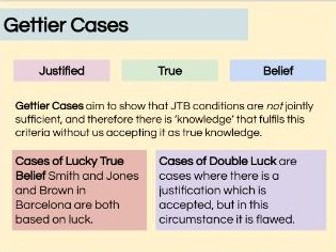
Gettier Cases
Infalibilism
No False Lemmas
Virtue Epistemology
And Criticisms of each
Used for a 1 on 1 tutorial session and it lasted me around 2 hours.
In a class of 30 you could probably stretch it if you include your own talking points etc.


 Quick View