

 Quick View
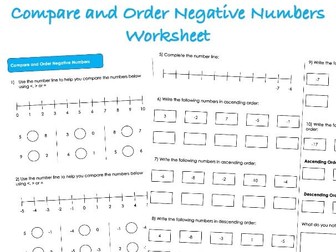
Negative Numbers Worksheet - Compare and Order Negative Numbers
A worksheet that provides a variety of questions linked to being able to understand negative numbers by being able to compare and order numbers (including using the inequality symbols to compare and sorting numbers in ascending and descending order). This is based on the Year 5 objective based on White Rose Maths but can easily be used in other year groups.
Included as part of the worksheet are 10 different questions that provide variation to check pupils understanding of being able to compare and order negative numbers.
Answers are also included for all questions.
This worksheet can easily be used as a worksheet when teaching the objective or used for recap/ revision or even to be sent home as homework.
 Quick View
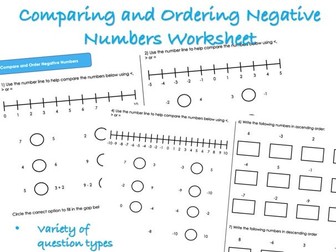
Comparing and Ordering Negative Numbers Worksheet
A worksheet that provides a variety of questions linked to being able to compare and order negative numbers.
Included as part of the worksheet are 7 different questions that provide variation to check understanding through the use of different models, representations and question styles.
There is also an extension task that provides challenge with a further 4 questions.
Answers are also included for all questions.
This worksheet can easily be used as a worksheet when teaching the objective or used for recap/ revision or even to be sent home as homework.
Ordering and Comparing Large numbers
A lesson on ordering and comparing large numbers. Powerpoint contains: a video for visual learners, sentence starters to encourage maths talk and inequality symbols to print out. Differentiated worksheets included. Aimed at SEND Year 8 students but can easily be used for KS1 & 2 or KS3 intervention groups. Dyslexic friendly font and powerpoint.
 Quick View
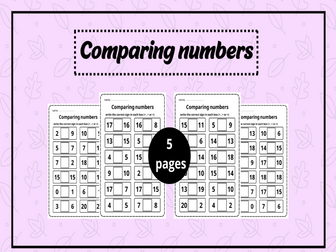
Comparing Numbers 1-20- Comparing Numbers activites.
comparing numbers is one of the basic skills that must be taught to children, usually at an early age, where some fun methods are used to teach children to comparing numbers, write them, and perform addition and subtraction mentally.
comparing numbers activities help develop the student’s ability to understand numbers deeply. Where he acquires sensory skills on counting numbers and calculating them mentally. The child can easily compare simple numbers visually, but with larger numbers it will be different. With the comparing numbers activities, the child can practice counting and comparing numbers with ease.
 Quick View
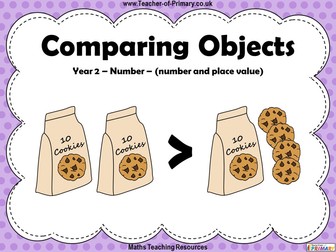
Comparing Objects - Year 2
Comparing Objects - Year 2
In this KS1 maths teaching resource, pupils compare objects using ‘more than’, ‘less than’ and ‘equal to’ and the signs < , > and =. These activities cover the year 2 curriculum objectives in the maths programme of study (Number - number and place value) and support the White Rose small steps guidance for year 2 - Autumn - Block 1 - Place Value. Content includes:
2 differentiated activities comparing 2 sets of objects using ‘more than’, ‘less than’ and ‘equal to’ and accompanying worksheets
2 differentiated activities comparing 2 sets of objects using <, > and = signs and accompanying worksheets
Reasoning and problem solving activity and worksheet
‘Comparing Objects - Year 2’ is editable so teachers can adapt the resource to meet their individual teaching needs.
Not quite what you’re looking for? Click below to see similar Year 2 place value resources:
Ordering Numbers to 20 - Year 2
Ordering Numbers to 100 - Year 2
Ordering Objects and Numbers - Year 2
Comparing and Ordering Numbers Up to 100 - Year 2
Comparing Numbers Up to 100 - Year 2
Comparing Numbers - Year 2
Greater Than and Less Than - Year 2
Year 2 Number and Place Value Bundle
Year 2 Place Value Bundle
undefined
 Quick View
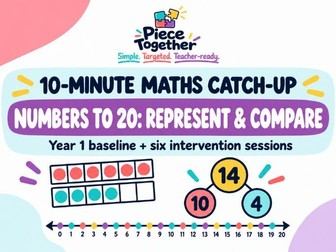
Year 1 Numbers to 20: Compare and represent intervention
**Can they make 14… but not explain why it’s bigger than 12?
A targeted Year 1 intervention for children who can recognise or make numbers to 20 but are less secure with quantity, teen-number structure, number-line position or comparison. The baseline helps pinpoint the exact gap and directs you to the most useful 10-minute session.
No planning required — designed to be picked up and used by a teacher or TA
Numbers to 20: Represent & Compare is part of the Piece Together 10-Minute Maths Catch-Up series. It is designed for short, focused intervention with a teacher or TA, using a baseline assessment to identify the precise gap and route the child to the right starting point.
The six sessions develop:
recognising structured quantities and linking them to numerals
representing teen numbers as 10 and some more
connecting concrete, pictorial and symbolic representations
linking quantity and magnitude to position on a 0–20 number line
comparing numbers using more, fewer, less, greater, smaller and equal
ordering numbers and choosing a representation to justify thinking
The pack moves children from seeing and making quantities towards explaining and comparing numbers more independently, with explicit mathematical language throughout. The progression runs from structured recognition through teen-number structure, representation, magnitude and comparison.
Included in the pack
Starting Point Assessment with I / R / P / N recording
clear diagnostic routing to the correct session
6 structured 10-minute intervention sessions
adult prompts and mathematical vocabulary
CORE and IF TIME tasks
quick checks and progress recording
Exit Check to measure progress
blank and fully numbered 0–20 number lines
optional 0–20 number track
numeral cards 0–20
structured dot / subitising cards
large printable double ten-frame
part-whole template
Designed for Year 1 / KS1, small-group or 1:1 catch-up, intervention sessions and targeted TA support.
Print-friendly greyscale design.
Part of the Piece Together intervention range: Simple. Targeted. Teacher-ready.
Number sense secure? The next gap may be understanding addition and subtraction itself. Addition & Subtraction Concepts helps children connect practical situations to combine, increase, take away, difference and the symbols +, − and =.
https://www.tes.com/teaching-resource/-13609103
 Quick View
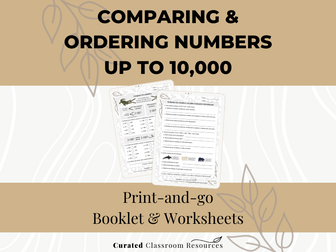
Comparing & Ordering Numbers up to 10,000 Math Booklet
This teaching resource focuses on instructing students in comparing and ordering whole numbers up to 10,000, utilizing the symbols “<”, “>”, and “=”, and grasping the concepts of greater than, less than, and equal to.
The resource offers a comprehensive teaching plan meticulously aligned with the upper elementary mathematics curriculum, ensuring the relevance and significance of the covered content for students. Alongside, classroom resources are provided, comprising diverse exercises to nurture students’ skills in comparing and ordering numbers, employing number lines for numerical representation, and identifying inaccuracies on a number line. Moreover, the resource fosters students’ articulation of their reasoning in comparing and ordering numbers, thereby enhancing their communication and critical thinking abilities.
Outcomes:
In accessible language, students will learn to:
Compare numbers up to 10,000 using the terms “greater than,” “less than,” and “equal to” (<, >, =)
Arrange numbers up to 10,000 in ascending order
Arrange numbers up to 10,000 in descending order
Justify their approach to ordering numbers in either ascending or descending order
Formulate and sequence 4-digit numbers in ascending and descending order
Detect erroneous numbers on a number line
Incorporate accurate numbers onto a number line
The worksheets enclosed within this PDF are adaptable for printing as a booklet or individually. Each page targets a distinct outcome, except for the final page in the booklet, which revisits all the aforementioned outcomes. The worksheet exercises progress in complexity with each subsequent question or prompt, aligning with Bloom’s Taxonomy chart.
"I Can" Growth Mindset Statements:
Each worksheet concludes with an “I can” statement, designed to celebrate students’ learning progress and bolster their self-esteem and growth mindset.
Answer Key:
An answer key is provided, denoted by the label “ANSWER KEY” above each corresponding worksheet.
In summation, this educational resource serves as a valuable asset for upper elementary school educators seeking effective strategies to teach their students how to compare and order whole numbers up to 10,000.
 Quick View
Comparing Numbers
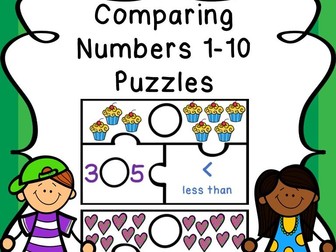
Looking for a fun interactive teaching idea for comparing numbers 1-10? Well look no further as Greater Than Less Than Game Puzzles, for K.CC.6 and K.CC.7, will serve as an exciting lesson plan for kindergarten elementary school classrooms. This is a great resource to incorporate into your unit as a guided math center rotation, review exercise, small group work, morning work, remediation, intervention or rti. It can also be used as a quiz, drill, test, or assessment tool to help determine student mastery of the learning target. Whether a student is homeschooled or given this as a homework assignment, kids will also love working on these at home to improve their skills.
This puzzle set includes 20 colorful jigsaw puzzles, answer key, and an optional station instruction page with an example. These come as pdf printable sheets that can be printed on card stock and laminated for long-term use. As a suggestion, store them in a sealable gallon storage bag and place them in a tub or bin for students to use throughout the year for enrichment when they finish early. Another idea, for a project, is students can glue the completed puzzles into a notebook or journal as a reference sheet. They can also be glued on a poster for displaying on a bulletin board or as a wall anchor chart.
It covers comparing two numbers between 1 and 10 using numerals, pictures, and also the greater than, less than, and equal to symbols ( >, <, = ). By solving the questions to compare the numbers and finding the matching picture model puzzle piece, students can gain confidence in an important skill. Your kindergartners will love to practice and learn to develop strategies about comparing numbers up to 10 with this product!
I hope you download and enjoy this engaging hands-on manipulative activity with your students! So set those worksheets aside and give our puzzles a try!
Relevant Kindergarten Common Core Standards:
K.CC.C.6
Identify whether the number of objects in one group is greater than, less than, or equal to the number of objects in another group, e.g., by using matching and counting strategies.
K.CC.C.7
Compare two numbers between 1 and 10 presented as written numerals.
Cross Reference: Texas TEKS K.2G K.2H and Virginia SOL K.1
Comparing Numbers
This lesson plan aligns with Oklahoma academic standard K.N.1.8, in which students will compare numbers using the words, “less,” “more,” and “equal.” Teach the lesson with the first several sheets and teach them that Alligator Andy prefers to eat the bigger number. Ask them, “Would he rather eat the number in the top box or the bottom box?” Help guide them to the answer of which box has the bigger number. To assess students, use the final sheet and orally ask them if the first number is less than, more than, or equal to the second.
 Quick View
Comparing Numbers
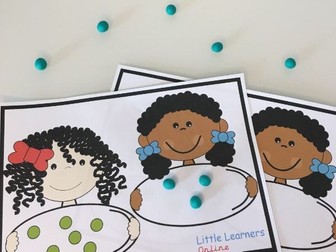
This Comparing Numbers pack consists of 4 different activities and 12 pages to support children in comparing quantities and introduce them to the vocabulary of more and fewer. The activities are as follows:
Add more/fewer peas to the plate. You could be really specific and add one more, two more, or one fewer etc.
Each player has a row of houses. Roll a die and deliver parcels or letters as you move along the row (use cubes as parcels or pieces of card for the letters). Don’t forget to talk about who has delivered more or fewer. The winner is the first one to deliver a parcel or letter to every house.
Sort the buttons into two jars according to whether there are more or fewer.
Order the picture cards from fewer to more
 Quick View
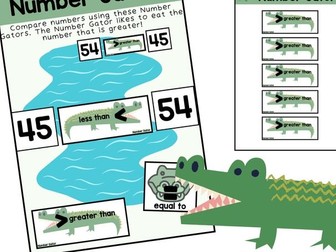
Number Gator Comparing Numbers
Number gator printable game for use with children practising using greater than, less than or equal to.
 Quick View
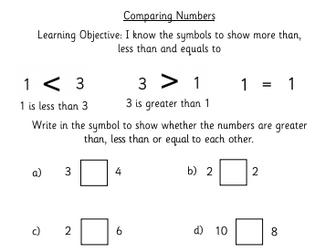
Comparing numbers
Write in the symbols to show whether the numbers are greater than, less than or equal to each other.
 Quick View
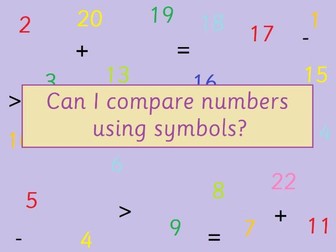
KS1 Maths Comparing Numbers Activity
KS1 Maths Resource as part of Number.
Comparing Numbers using greater than, less than and equal to symbols.
Challenge 1 and Challenge 2.
Can be used as a starter, main or revision activity.
Word doc. and PDF versions.
 Quick View
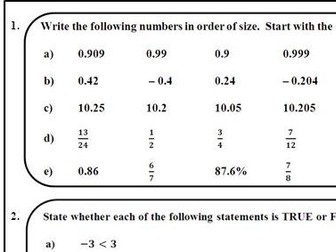
Ordering and Comparing Numbers
This worksheet covers the first GCSE (9-1) requirement for number skills:
"order positive and negative integers, decimals and
fractions; use the symbols =, ≠, , ≤, ≥"
 Quick View
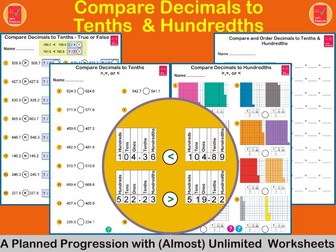
Compare Decimals to Tenths & Hundredths
National Curriculum Year 4
Number - fractions (including decimals)
Compare numbers with the same number of decimal places up to 2 decimal places
They make comparisons and order decimal amounts and quantities that are expressed to the same number of decimal places.
This resource is designed to support your students in honing their skills in comparing decimals up to hundredths (two decimal places). It focuses on fostering an understanding of decimal notation for fractions and the ability to compare decimal fractions.
Worksheet Overview:
You will find five sets of worksheets that offer practically endless opportunities for practice to reinforce the concepts you’ve taught in your classroom and provide ample practice to boost your students’ proficiency.
Set 1: Compare Decimals to Tenths on a Grid
Set 2: Compare Decimals to Tenths in Place Value Tables
Set 3: Compare Decimals to Tenths
Set 4: Compare Decimals to Tenths TRUE or FALSE
Set 5: Compare and Order Four Decimals to Tenths
Set 6: Compare Decimals to Hundredths on a Grid
Set 7: Compare Decimals to Hundredths in Place Value Tables
Set 8: Compare Decimals to Hundredths
Set 9: Compare Decimals to HundredthsTRUE or FALSE
Set 10: Compare and Order four Decimal to Hundredths
Challenges
Set 11: Compare Decimals to Tenths & Hundredths Mix
Set 12: Compare andOrder Four Decimal to Tenths and Hundredths Mix
Almost unlimited worksheets No-Prep Worksheet
With a simple click, all numbers in the worksheets can be randomized, providing a fresh set of exercises as many times as needed. These worksheets require no additional preparation. Just click, print, and you’re good to go!
Answer keys are generated automatically every time you create worksheets.
Compatibility
These resources work seamlessly with the official Adobe Acrobat Reader on both Windows and Mac computers.
Never downloaded a resource from Jeff’s Notebooks before ?
Wondering what (almost) unlimited worksheets means?
Download one of the FREEBIES at the top of Jeff’s Notebooks page when you click here, click on a button and see for yourself how they work.
 Quick View
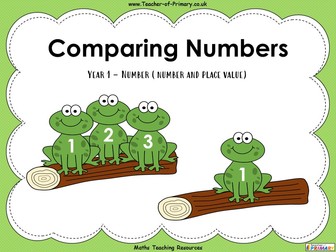
Comparing Numbers - Year 1
Comparing Numbers - Year 1
In this year 1 teaching resource pupils begin to identify whether the number of objects in one group is greater than, less than or equal to the number of objects in another group as per the statutory requirements of the year 1 maths programme of study (Number - number and place value).
This colourful and animated 37slide PowerPoint presentation includes:
1. Animated activities with 3 accompanying worksheets to use alongside the presentation
2. 1 further worksheet
3. Counters, sets and numbers to be cut out for a class activity
As with all our PowerPoint teaching resources, 'Comparing Numbers - Year 1' is completely editable so that teachers can adapt, alter and revise it as much or as little as required.
Comparing Numbers Worksheets
Comparing Numbers. Write the number for each group. Use the < > = symbols to record the results of comparisons.
Thank you to mycutegraphics.com for the clip arts.
Functional Skills Comparing numbers
A worksheet written to support Functional Skills Maths Comparing Numbers Entry Level 1 and Entry Level 2.
Before completing the worksheet students took part in a group discussion about when they might use function skills number outside of the classroom.
Comparing number sentences using < > =
Comparing addition of several ones.
Identifying missing numbers to make comparative number sentences correct.
Identifying missing numbers in the context of money to make comparative number sentences correct.