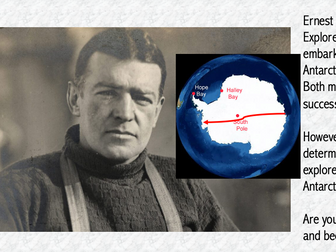
**Ernest Shackleton’s Antarctica Expedition - Endurance **
Great resource to teach children all about Shackleton. This resource is interactive and allows children to become a ‘recruit’ for Shackleton’s Endurance Expedition to Antarctica.
Powerpoint Presentation to support the teacher through explaining each activity.
Children to be sent a letter requesting them to embark on a hazardous journey. Children are then invited to vote whether they would like to take part or not. Votes counted and adventure begins.
Powerpoint presentation leads children through a variety of different activities for them to become apart of Shackleton’s Endurance crew.
Children are requested to create an ID card, an application letter, decide job roles on board, to explore the ship, to adopt a dog and to uncover the events that took place during this Antarctica Mission.
Resource includes:
Powerpoint Presentation
Attention Letter
Voting slip
ID card template
Lined paper template for application letter
Ship worksheet
Adopt a dog worksheet
Timeline Resource
Resource for ASN pupils planning what to pack for a walk or expedition.
Past tense statements about events that happened on the walk.
Future planning for “what I will bring” in my rucksack.
Suitable for a class planning a walk or expedition involving the use of a tent and a stove. e.g. a safe demonstration by a suitable adult.
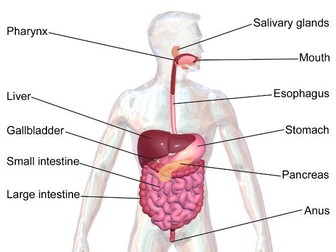
This is an overview of the digestive system and how our nutrients are digested!
SWBAT:
1. List the different nutrients
2. Identify organs in the digestive system and describe their function.
3. Identify which organs digest each of the nutrients and what enzymes are used.
Guiding Questions:
What are the nutrients you would find on a food label?
When they are digested, what do they get broken down into?
What are the organs of the digestive system?
What enzymes are found in the digestive system? What, specifically, do they break down?
Where are the three nutrients each digested? Which enzymes are involved?
What are some disorders of the digestive system?
What are the role of probiotics in the digestive system?
What does it mean if someone is lactose intolerant and can’t eat dairy?
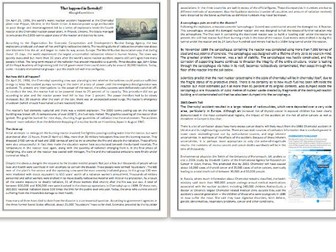
This Reading Comprehension worksheet is suitable for upper intermediate to proficient ESL learners. The text gives an account of all the tragic events that took place during the 1986 Chernobyl nuclear accident.
After carefully reading the text, students are required to complete some comprehension exercises including: True or False exercises, a definitions match exercise, a fill-in-the-gaps exercise, a fun crossword and engage in an in class discussion over nuclear energy, radiation and it’s effects on human health. The vocabulary used in the text is rather advanced and can also be used for IGCSE, TOEFL or IELTS vocabulary building purposes. The handout can be completed in class or assigned for homework. Ideally, this handout could be used along a #GoogleExpeditions NASA virtual reality trip! A full answer key is included.
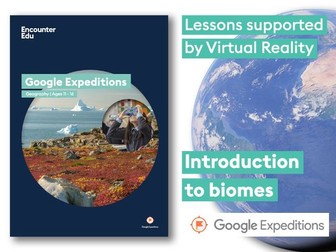
This #GoogleExpeditions lesson develops student skills understanding of biomes and ecosystems.
This introductory lesson introduces students to the main biomes around the planet, their features and locations. Further in-depth lessons on the different biomes are listed below.
Google Expeditions are immersive 360 degree photo stories designed for use in the classroom. For more see: https://www.google.com/edu/expeditions/.
This is Google Expeditions Lesson is number 1 of a 4 lesson sequence. It can be used as a standalone lesson or in conjunction with others listed below (links go to Google Docs versions of the lessons).
Lesson 1: Google Expeditions: Biomes & Ecosystems https://goo.gl/0eMtoz
Lesson 2: Google Expeditions: Biomes & Ecosystems: Tundra and Taiga https://goo.gl/L6cpjH
Lesson 3: Google Expeditions: Biomes & Ecosystems: Tropical Rainforest and Temperate Forests https://goo.gl/wGM97d
Lesson 4: Google Expeditions: Biomes & Ecosystems: Savannah and Desert https://goo.gl/sBrZzi
Starter article as stimulation for the topic, and worksheets for up to 4 different groups to work on.
Starter article gives details of a failed Arctic expedition with some literacy style short questions. Details of the task also given.
Groups then work on planning the individual elements of the expedition (When I used this the class had also studied diet - if you haven’t done this, that part could be omitted) on the relevant work sheets (I would recommend printing on A3).
Franklin’s lost expedition Handout
Text Overview
Student Questions Page
Source Analysis Template – can be used for pictures or used to work with the overview text
Timeline
2 KWL Templates
Scroll/Coin/Stamp/Book cover template pages
Coloring page
Brain Break Activity
Word Search Template
Extension Task Template
Read, Answer, Define, Summarize & Color
Students read a 300-350 word article
Students answer THREE comprehension questions
Students define Two key vocabulary words
Students summarize the topic
Students color an illustration of the topic
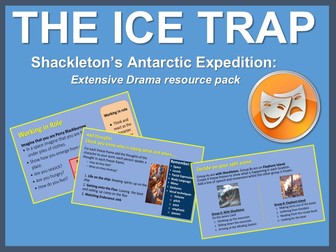
Explore the characters and experiences on Ernest Shackleton’s expedition to Antarctica. Centered around ‘The Ice Trap’ book, this extensive 6-lesson Drama resource pack provides you with a variety of activities, designed to develop pupils understanding, knowledge and empathy with regards to the experiences of Shackleton and his crew on their ship, The Endeavour.
All lessons come complete with detailed powerpoints and supporting resources, so no planning is needed and you are ready to go!
Lesson 1:- The Ice Trap introduction
Lesson 2:- Persuasion
Lesson 3:- Movement - Pack Ice
Lesson 4:- Freeze Frames & Thought Tracking
Lesson 5:- Cross-Cutting
Lesson 6:- Final reflection
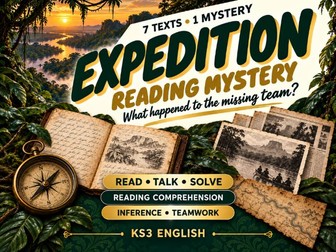
Build KS3 reading comprehension, inference and discussion as teams investigate a missing Amazon expedition using seven contrasting evidence sources.
Who can be trusted, and what really happened? Pupils piece together a newspaper report, a letter home, an elder’s note, a biography, a journal, a novel extract and an investigation report. They compare accounts, spot contradictions and justify a theory with evidence.
WHAT IS INCLUDED
One complete, print-ready 26-page PDF
Seven evidence sources with their individual newspaper, letter and journal designs
Nine pages of scaffolded reading questions
A final-deductions worksheet
Teacher guidance, the intended solution and a print guide
USE IT FOR
KS3 English, collaborative reading, inference practice and speaking and listening. Also suitable as a supported challenge for confident Year 5 and Year 6 readers. Choose a whole-team investigation or an expert-group reading activity using the teacher guidance.
The revised edition brings the complete pack together in one bookmarked PDF. Print only the pupil pages you need and keep the teacher solution separate. Colour printing preserves the visual details. This download is the PDF printing edition.
Explore the other Reading Mysteries in my shop for more read, talk and solve activities.
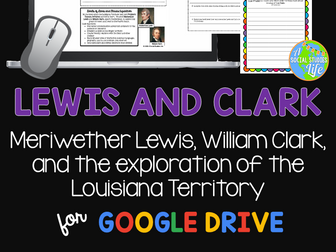
This word search is a great way to review the important terms and important persons of the Lewis and Clark Expedition. The solution to the puzzle is included.
Terms Included:
♦ Buffalo
♦ Compass
♦ Fort Mandan
♦ Keelboat
♦ Louisiana Purchase
♦ Meriwether Lewis
♦ Sacagawea
♦ Thomas Jefferson
♦ William Clark
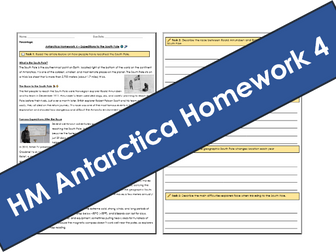
Expeditions to the South Pole - Homework 4
Reading comprehension & Extended writing homework
Can be used as a worksheet in lessons.
Part of the “Antarctica Homework Bundle, which includes 4 other Antarctica themed homeworks”.
Can also be purchased with the Antarctica SOW & Homework Bundle.
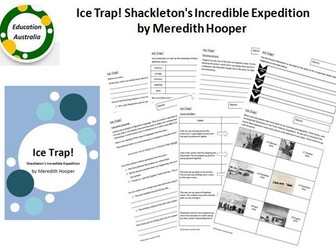
This resource is an eight page PDF document with activities to do based on the book Ice Trap! Shackleton’s Incredible Expedition by Meredith Hooper and M. P. Robertson. This book is about Ernest Shackleton’s 1914 Endurance expedition.
The activities allow the students to reflect on the story and extend their understanding of the text. There are some comprehension questions, vocabulary and writing activities plus cause and effect and timeline activities. There are seven worksheets for students in this resource.
Education Australia has other resources available for purchase.
 Quick View

 Quick View
 Quick View
 Quick View
 Quick View
 Quick View
 Quick View
 Quick View
 Quick View
 Quick View