2 HOURS OF CONTENT - A detailed and well differentiated editable history lesson all about what went on during the Holocaust and how each of the camps operated as well as what daily life was like for the different inmates. There is a lot of content here, so you may want to teach this over 2 lessons.
The lesson is very easy to just pick up and use and includes a detailed PowerPoint, a variety of activities, source questions, clip tasks, exam-styles practice questions, active tasks and more.
This assembly resource has been created with KS3 and KS4 secondary students in mind to be delivered on Holocaust Memorial Day (27th January). This resource has been created on Microsoft Powerpoint Teacher Notes have been added to the notes section underneath each relevant slide on the Powerpoint to support with the delivery of the content. I am a history teacher and the content of this assembly resource is an extension of a type of activity that I would deliver to my history students when teaching the holocaust.
This assembly resource offers a brief exploration using skills of inference of a historical artefact and relies upon student contributions through teacher questionning. A link to a Youtube video has been provided as part of this resource (please ensure you have access to youtube prior to use) This resource also makes reference to the 2026 Holocaust Memorial Day theme of ‘Bridging Generations’.
The utmost care has been taken to ensure this resource has been created with the utmost respect to the victims of the holocaust and to ensure that students have the opportunity to connect and empathise to the human beings to whom the attrocities of the holocaust were committed. There a no images or corpses in this resource - however the murder of victims is discussed.
I really hope you enjoy delivering this assembly and that your students find it engaging and valuable. If you are able to leave a review once you have taught it, I would be really grateful.
Teaching Holocaust in history? Check out lessons from my scheme of work!
Lesson 1: Ordinary Things
Lesson 2: Challenging stereotypes
A complete set of Holocaust Memorial Day assemblies for Primary, Lower Secondary and Upper Secondary learners, fully aligned with the 2026 theme Bridging Generations. These ready-to-use PowerPoints provide age-appropriate explanations, clear historical context and structured reflection opportunities to support remembrance and understanding. Ideal for whole-school assemblies, tutor time or PSHE.
Each presentation offers comprehensive, fully written slide text so staff can deliver confidently without additional planning. The assemblies explore key ideas including prejudice, discrimination, how the Holocaust unfolded, and why remembrance remains essential as survivor numbers decline. The theme of Bridging Generations is woven throughout, helping pupils understand their role in carrying forward memory, promoting respect and building inclusive communities.
The Primary assembly introduces the Holocaust sensitively, focusing on kindness, fairness and stories of courage, supported by clear explanations about Jewish communities and the importance of choosing respect.
The Lower Secondary assembly provides structured historical context, survivor perspectives and reflective links to modern responsibility and inclusion.
The Upper Secondary assembly delivers a more analytical exploration of genocide, propaganda, human rights and the enduring significance of memory, asking students to consider their part in confronting prejudice today.
This pack is suitable for schools seeking a high-quality, professionally written resource that supports thoughtful, meaningful commemoration across age groups while meeting curriculum and pastoral needs.
This lesson contains:
A starter with a ‘math’ question from Nazi Germany to get students thinking about the effect that such messages would have had on the acceptance of violence towards Jews.
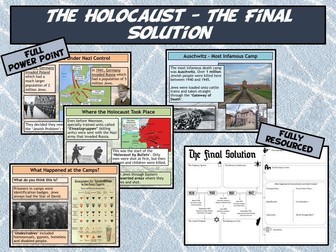
An activity to complete a knowledge organiser worksheet as you lead them through the powerpoint, covering:
* The Prophecy speech
* Increased number of Jews under Nazi control
* Madagascar Plan
* The Wannsee Conference (with 2 videos from YouTube that shows what happened and what was decided).
* Where the Holocaust took place
* What happened at the camps
* Death through work and gas chambers
* Auschwitz as a short study.
* A final plenary to consider the human impact of Auschwitz.
Attachments:
1 x Powerpoint Presentation
1 x Publisher File
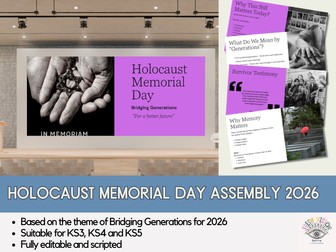
School assembly for secondary schools for Holocaust Memorial Day 2026 - theme “Bridging Generations”.
I delivered this every day to years 7 to 11. It was very well received by pupils and staff.
Gives scale of the Holocaust in numbers, the stages of the Holocaust, and German laws which led to the dehumanisation, ostracisation and ultimately the mass murder.
The chain of events is covered with Pastor Martin Niemoller’s poem “First They Came…”, followed by the stages of the Holocaust as described by the Holocaust Memorial Day Trust.
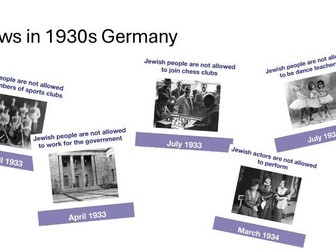
Pupils are then asked to think about how the German anti-Jewish laws put in place from 1933 to 1939 would have affected them.
Assembly finishes with images of victims and their names, ages and hometowns. Original photo image and a larger, colorised image to enhance.
The victims are from a wide range across Europe.
Assembly host asks the audience to repeat their names in unison. For younger years, Call and Response their names. For older, more reluctant audiences, quietly reflect on the victims and say their names in private later.
No atrocity or graphic images are included.
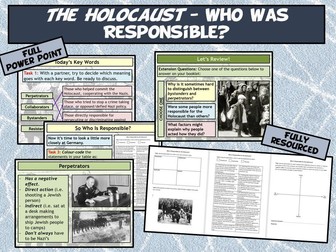
This lesson contains:
A starter that asks students to study a source image of Jews cleaning the streets. they are asked analytical questions about it and will return to the image later.
An overview of the key words for the lesson, which are ‘perpetrators’, ‘collaborators’, ‘bystanders’ and ‘resisters’. There is then a chance for students to make notes on each as you go through the next 4 slides with images.
A task to return to the source and judge who they believe in the picture fall into each of the categories. The extension is to consider why it’s sometimes hard to decide on the difference between those doing and those collaborating.
A colour-coding activity to look at a series of scenarios and judge what category of guilt they are to be placed in.
An extension of this task to then map the numbers of each scenario on a plot graph to note the impact of each and the level of ‘active’ or ‘non active’ each scenario showed. this can lead to greater analysis of the consequences of different peoples’ actions.
A review of the learning.
Attachments:
1 x Powerpoint Presentation
1 x Word File
This bundle contains:
L1 - What was the Holocaust?
L2 - Who Did the Nazis Persecute?
L3 - What Are the Roots of Antisemitism?
L4 - How Did Jewish Lives Change After 1933?
L5 - Kristallnacht
L6 - Children’s Kindtertransport Experiences
L7 - What Was Life Like in the Ghettos?
L8 - Did Jewish People Resist?
L9 - The Final Solution
L10 - How Did the Holocaust Affect British Soil?
The individual lessons would normally cost £22.50, so this bundle would save you 30%.
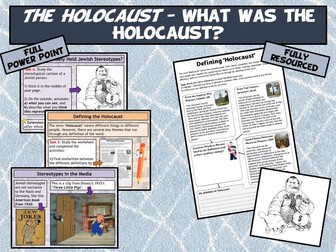
This lesson contains:
A starter to consider what students already know about the Holocaust. Students then draw a mind map to gather ideas about why they study it, what happened and when and to whom.
A video from YouTube which consolidates this and allows students to add to their knowledge. A slide then has suggested responses for some green pen work.
An activity to study 3 interpretations of the word ‘Holocaust’ and students find common factors between them, making their own definition at the bottom of the worksheet.
An introduction to stereotypes and students can annotate the picture of a Jewish stereotype. This will allow later study of German propaganda against the Jews. Students also have some slides to see on modern stereotypes which may interest them, before looking at how the Nazis then portrayed them.
A plenary to describe two features of the Jewish stereotype.
Attachments:
1 x Powerpoint Presentation
1 x Word File
1 x Publisher File
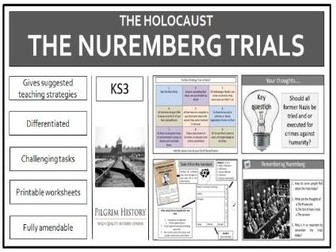
This lesson investigates how the leading figures of the Nazi regime were identified, prosecuted and judged in the aftermath of the Second World War.
Students begin by examining the process of Denazification and how the Allies attempted to remove Nazi influence from Germany in the immediate post-war period, before shifting Cold War tensions changed priorities. They also consider why Nuremberg was chosen as the location for the trials.
The main activity challenges students to analyse a range of key individuals involved in the Nazi regime and examine their actions during the war. They then decide which war crimes each person may have committed and categorise them according to their level of responsibility, from major offenders to followers.
Students go on to consider appropriate sentencing, deciding whether individuals should receive imprisonment, hanging or execution. These decisions are then compared with the historical outcomes revealed in the PowerPoint, allowing for discussion and reflection.
A video task provides powerful additional context, looking at the legacy of the trials 80 years on, including survivor testimony and perspectives from descendants such as the son of Hans Frank, offering a more personal insight into the impact of justice after genocide.
The lesson is underpinned by the wider enquiry running through the unit: Who was to blame for the Holocaust? Students continue to build and refine their ideas each lesson using a structured lightbulb activity, helping them track how their thinking develops over time and recognise the complexity of historical responsibility.
The resource is fully editable in PowerPoint format and fully differentiated, making it easy to adapt for a range of learners. Suggested teaching strategies are also included to support delivery.
Description
Whole-School Assembly for UK Secondary Schools | KS3 KS4 KS5
Deliver a powerful, respectful and professionally sensitive Holocaust Memorial Day assembly for UK secondary schools, based on the official 2026 theme: Bridging Generations.
This fully scripted, ready-to-deliver assembly helps students understand:
• What Holocaust Memorial Day is
• Why remembrance matters as survivor voices are disappearing
• How memory, testimony and responsibility pass from generation to generation
• Why the lessons of the Holocaust still matter today
It is carefully written to be suitable for whole-school delivery and to be politically impartial, safeguarding-aware and appropriate for KS3, KS4 and KS5.
It also includes clear staff guidance on how to handle sensitive questions about current conflicts, including Palestine and Gaza, in a calm, balanced and non-political way.
What’s Included
• Fully scripted Holocaust Memorial Day assembly (no prep needed)
• Slides and speaker notes covering:
o The Holocaust and Holocaust Memorial Day
o The 2026 theme: Bridging Generations
o Why memory and testimony matter
o A powerful Anne Frank slide
o A safe present-day relevance section focusing on warning signs such as dehumanisation and hatred
• Staff guidance slide and notes for handling sensitive comments about:
o Israel, Palestine and Gaza
o Current conflicts
o Genocide language
• Reflection moment and closing message
• Fully Editable
• Suitable for KS3, KS4 and KS5
Ideal For
• Holocaust Memorial Day assemblies
• UK secondary schools
• Form time, tutor time or year group assemblies
• RS, History and Personal Development (PSHE )
• Schools wanting a safe, non-political, high-quality, ready-to-use assembly resource
Why Teachers Choose This Assembly
• Avoids controversial political positions
• Does not compare current conflicts to the Holocaust
• Does not use contested genocide labels
• Focuses on remembrance, human dignity, responsibility and challenging prejudice and hatred
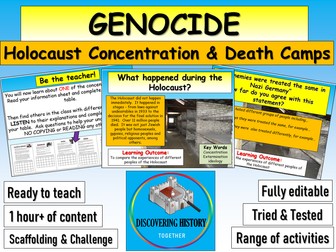
This Genocide lesson investigates what happened in the concentration/death camps during the Holocaust. 6 different camps are looked at to show how people experienced different things. Camps looked at include Theresienstadt, Sobibor, Dachau, Auschwitz-Birkenau, Ravensbruck and Bergen-Belsen.
This download includes a fully editable powerpoint with all activities, instructions, clip links and worksheets/information sheets you need. It is differentiated 2/3 ways where possible with scaffolding and challenge options and is fully planned with plenty of activities for your students to complete including a starter, all clips and related tasks, groupwork information learning activity, picture information extraction activity, a consolidation explain question and a plenary.
Activities are planned to encourage thinking and discussion.
This lesson can be used alongside my lessons on ‘ghettos & separation’ and ‘Nazi laws’, which can be found as a bundle at the bottom of this page.
This lesson can also be used as a part of a growing bundle on ‘Genocide’ which also includes Nazi laws, ghettos and separation, as well as genocide in Rwanda, Cambodia and Bosnia: https://www.tes.com/teaching-resource/genocide-12925147
Please take a look at my growing TES shop where you can find free or inexpensive lessons:
https://www.tes.com/teaching-resources/shop/DiscoveringHistory
CUSTOMER SERVICE IS VERY IMPORTANT TO ME - If, by any chance, you encounter any issues with the resource, please email me at discoveringhistoryuk@gmail.com and I’ll try to solve them for you. I really appreciate being given the chance to make things right.
Please support my small business by leaving a review.
There are more KS3 & GCSE History lessons on the way - follow my social media pages for freebies, new resources and interesting facts!
Got a lesson suggestion? Or looking for something in particular? Email me!
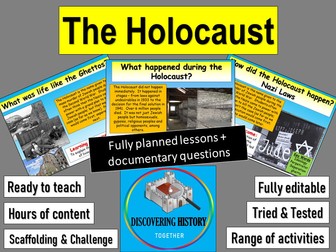
This great value Holocaust bundle includes the following lessons/resources:
Nazi Laws
Life in Ghettos
Concentration and death camps
documentary questions
This download includes everything you need to teach these lessons - all powerpoints, clips, activities, instructions, worksheets and information sheets. Scaffolding and challenge activities are included where possible. All lessons last at least one hour and are fully editable. Activities have been designed to promote thinking and discussion.
Please take a look at my growing TES shop where you can find free or inexpensive lessons:
https://www.tes.com/teaching-resources/shop/DiscoveringHistory
SAVE £££ BY BUYING GREAT VALUE BUNDLES!
CUSTOMER SERVICE IS VERY IMPORTANT TO ME - If, by any chance, you encounter any issues with the resource, please email me at discoveringhistoryuk@gmail.com and I’ll try to solve them for you. I really appreciate being given the chance to make things right.
Please support my small business by leaving a review.
There are more KS3 & GCSE History lessons on the way - follow my social media pages for freebies, new resources and interesting facts!
Got a lesson suggestion? Or looking for something in particular? Email me!
This assembly has been created for Holocaust Memorial Day. It starts by putting into perspective the sheer number of people murdered in the genocide by focusing on the figure 6,000,000 in real terms. It then considers how intolerance; racism and prejudice escalates and eventually can lead to genocide - testimonies of survivors are used to capture this. Have we learnt from the Holocaust? No - map of genocides around the world since the Holocaust. The assembly then moves onto the theme of resistance - what happens when people don’t speak out - clip of Marin Niemoller’s poem. The assembly end with the discussion of what can happen when people do act resist with a focus on Oskar Schindler - last 5 minutes of Schindle’s list included so that students can reflect on how many lives can be saved when people bravely resist brutality.
Duration: 30 minutes, but can be adapted if you don’t have this much time.
Suitable for KS2 - KS5
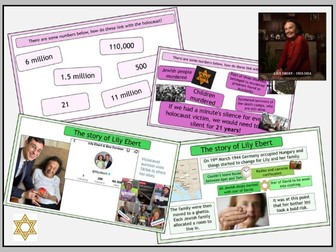
This assembly for Holocaust Memorial Month focuses on the story of Lily Ebert, a Holocaust survivor whose life story is both fascinating and heartbreaking.
The assembly begins with key statistics about the Holocaust, which immediately engage students and help them understand the scale and seriousness of what happened. It then moves on to Lily’s early life in Hungary and explains how everything changed when the Nazis took control. This helps students understand how quickly normal life was taken away from Jewish families.
Students connect even more deeply with Lily’s story because it has been shared widely thanks to her grandson, Dov Forman. Together, they wrote a book about Lily’s experiences, and more recently they have reached a huge audience on TikTok, where they educate people around the world about the Holocaust through Lily’s personal memories. This modern approach makes the history feel relevant and real to young people today. It also includes an example of her Tiktok and a link to a news report about Lily.
Since surviving the Holocaust, Lily has gone on to achieve incredible things. She has often said that living a full and successful life is her greatest revenge against the Nazis. One of her most notable achievements includes being awarded an MBE by the British monarchy for her work in Holocaust education.
Lily’s story is powerful and memorable, and it has had a lasting impact on students. Many still talk about this assembly long afterwards, showing how effective personal stories can be in helping young people understand history and remember its lessons.
This resource pack contains + 1x Assembly and 1 x tutor time PPT that can extend over two sessions .
All PowerPoints are fully resourced with YouTube links and activities to discuss the topic in question.
The Holocaust Assembly pack contains a PPT (12 Slides) with an A4 information sheet and a handout for you to make notes on each slide should you so wish.
The Holocaust Assembly and Tutor Time
The assembly introduces pupils to the holocaust what happened during this time.
It includes a link to a YouTube clips educating them on this. This resource includes inspirational quote and an OPTIONAL Christian prayer. It also has a link to the ‘Never Again’ song-This can be played as the pupils leave assembly.
The Holocaust Tutor Time pack contains 1 x Fully Resourced PPT (10 slides in total) Worksheet (1 A4 sheet)
The Topics to be discussed are:
A YouTube link on a cartoon version of an individual’s experience of the Holocaust
A place mat for them to record questions and information
A reflective quote
A YouTube link on what we can do in the modern age to end prejudice.
One of our interactive plenaries
The Holocaust resource booklet to accompany this pack contains a placemat for pupils to work on.
If you review this resource we will give you another resource of the same value for FREE.
We hope that you enjoy this resource! We would love your feedback, if you like what you see, please follow us: on Tes TeachElite’s Shop click the’Follow this Author button’ . We will keep you updated on any sales we throw or FREEBIES we upload.
You can find us on Twitter: https://twitter.com/TeachEliteRE
and Facebook: https://www.facebook.com/TeachElite/
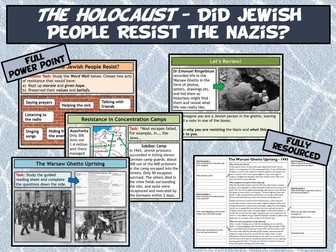
This lesson contains:
A ‘do it now’ starter based on previous learning on the course, but this can be edited to suit what you have taught.
An introduction to the idea of resistance and how it manifests. Students can explore types of resistance that can be done other than force. They then get introduced to some images of resistance in the ghettos, then discuss a ‘word wall’ with different ways the Jews resisted. Students categorise them as giving hope, morale or those preserving values and beliefs.
An overview of the difficulties faced when trying to escape from concentration camps. Students examine an excerpt and write down 3 reasons escape was hard. They then give specific examples from the next slide.
A guided reading task on the Warsaw Ghetto Uprising with questions around the outsides, differentiated to show where the information can be found.
A plenary to explain what resistance meant to Jewish people and what it means to them also.
Attachments:
1 x Powerpoint Presentation
1 x Publisher File
A lesson for UKS2 focussing on The Holocaust with information and resources included. Information available for children to go and research one particular aspect- children to then come back and teach their group what they have learnt. A lesson praised for the speaking and listening aspects as well as ensuring that the children had an independent approach towards their learning.
Differentiated questions at the end for children to apply their knowledge.


 Quick View