A clear, coherent resource card to assist in teaching how to write a diary entry. Great for KS2-KS4.
Aids indpendent learning, acts as a differentiation resource, and also just revises the elements reuired in a diary entry.
Links in nicely into the GCSE Language exams.
A workbook in which students handwrite the entire writing process leading to the submission of their final drafts of different IB English B text types. This is to verify that no AI was used to create their writing tasks.
For students to make all stages of the writing process visible, each workbook has two parts:
Part ONE contains worksheets to encourage students to do these activities:
read the jumbled version of the mentor text and sequence the different elements correctly
discuss and make decisions about the choice of text type to fulfil the requirements of the prompt
read the actual mentor text
answer comprehension questions to show understanding of the mentor text
identify and label the different features of the mentor text
explain the function of every punctuation mark
answer questions about synonyms, antonyms and the meaning of words
determine how the main ideas in paragraphs are developed and extended.
Part TWO invites students to write that text type using a follow-on prompt and to show handwritten evidence (by writing everything into the workbook) that they have …
conducted a mini-research project to provide them with the necessary background information for the content of the task
extracted relevant vocabulary and created sentence frames to assist the writing process
used a structured planning page to jot down notes for each element of the writing task
followed a step-by-step guide to writing their first draft
assessed their first drafts with an informative checklist that also contains relevant advice to help them improve their first draft.
Each Pack contains:
SL Version – with answer options for Part 1 worksheets
HL Version – without answer options for Part 1 worksheets
One-page Jumbled Mentor Text Starter – the elements of the mentor text are jumbled up and students need to sequence them correctly
An answer key for Part 1 worksheets.
The first 9 writing packs cover the following:
· Article about learning to learn (Human Ingenuity)
· Blog about the impact of social media (Identity)
· Diary Entry about cultural gaffes (Social Organization)
· Essay about the need to learn writing skills (Human Ingenuity)
· Informal Email about pet euthanasia (Experiences)
· Letter to the Editor about plastic pollution (Sharing the Planet)
· Proposal about improving International Day (Social Organization)
· Review of a fiction book (Experiences)
· Speech about saving a zoo (Sharing the Planet)
More packs and text types will be added soon.
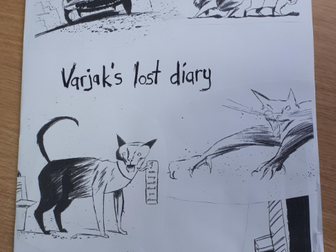
This is a 3 week KS2 writing unit based on an extract from ‘Varjak Paw’. Each of the 16 sessions has a clear and detailed lesson plan, presentation slides and differentiated activities (greater depth, on track and support) complete with resources. It’s all here!
For a large chunk of this unit, children explore a wonderful extract from chapter 21: Varjak discovers a toy shop and meets a toy cat. Using this passage for inspiration, children create short bursts of writing whilst learning and applying new skills. These short bursts are eventually combined to create a diary entry.
When you open the zip, you will find a folder for each session - everything is organised in a user-friendly way. As with all of my resources, all files have been created using PowerPoint and Word, so you can edit and adapt as you wish.
I have aimed this unit at Year 4, but it could be used in any KS2 setting - I would happily do this project with Year 6 pupils.
This unit has been very carefully sequenced and builds towards quality writing outcomes. It is packed with talk, reading, vocabulary, grammar and composition skills.
Unit Overview
Session 1 Prewriting activity – I can visualise a story setting
Session 2 Cold task – What do you already know about diary writing?
Session 3 I can notice and define adventurous words and phrases
Session 4 I can reuse adventurous words and phrases
Session 5 Reading activity: I can read like a detective
Session 6 I can use prepositions to show where something is (in relation to something else)
Session 7 I can use preposition phrases to organise a paragraph
Session 8 I can describe how a character is feeling using their body language
Session 9 I can punctuate direct speech correctly (sentence level)
Session 10 I can punctuate direct speech correctly (text level)
Session 11 I can use ‘but’ to change direction in an unexpected way
Session 12 I can write sentences using adventurous vocabulary and prepositions
Session 13 I can pick out the key features of diary writing
Session 14 I can use the key features of diary writing
Session 15 I can plan a diary entry independently
Session 16 Independent diary writing. Children have the opportunity to demonstrate their new skills and knowledge.
Teach Diary Entry, Post Card writing and Time line. Get this editable ppt and Worksheet to teach students how to express their feelings through writing.
Yrs 1,2&3 an introduction to how to write a diary entry. The Smartboard file explains what a diary entry is and gives examples for discussion. Over three days or sessions the children are then asked to write their own diary entry following a simple story set in the past. Details are given of a siege around Castle Strongfort. Children can then attempt their own diary entry using the story and the example diary entries as a scaffold for their own writing.
Resource containing a complete GCSE scheme of work for Original Writing - Diary entry. Students will complete a diary entry response to literature and texts from World War 1. These include Wilfred Owen's Dulce et decorum est and a series of fictional and non fiction letters from the front.
Original Writing: Diary entry. Worksheets to support the above scheme of work. Includes letters from the front, 'Dulce et Decorum est' and Exposure' by Wilfred Owen. Range of research and reading tasks.
This downloadable booklet introduces First Year students to the key elements of functional writing in a clear, accessible and engaging way. Designed specifically for mixed-ability Junior Cycle classrooms, it covers persuasive techniques, oral presentation skills, formal and informal letter writing, diary entries, and book reviews.
The resource includes:
• Student-friendly explanations of each writing type
• Step-by-step structures for letters, diary entries and reviews
• A complete introduction to persuasive techniques with examples
• Guided tasks, pair activities and creative challenges
• A 60-second speaking challenge to build oral confidence
• CBA2 (Oral Presentation) information explained simply
• Success criteria, sentence starters and visual supports throughout
All pages are professionally designed, easy to follow, and suitable for printing or digital use. Ideal for First Year English, literacy support, learning support groups, or as a foundation before beginning unseens and longer compositions.
A ready-to-use resource that helps students build confidence in the essential writing skills required across Junior Cycle. Let your students learn how to write with clarity, purpose and confidence.
An example diary entry text for The Butterfly Lion written from the point of view of the character Michael, plus writing feature identification worksheet and answers. This exemplar text is perfect to use as a WAGOLL whilst studying Michael Morpurgo’s prize-winning novel.
Resources provided:
• Exemplar diary text
• Feature find worksheet
• Feature find answer sheet
• Text extract from Chapter 1
The diary text contains the following language, grammar and punctuation features:
• Similes
• Rule of three
• Repetition for effect
• Alliteration
• Metaphors
• Hyperbole
• Personification
• Emotions
• Show not tell emotions
• Rhetorical questions
• Variety of sentence openers
• Fronted adverbials followed by a comma
• Variety of nouns to avoid repetition
• Noun phrases
• Apostrophes for contraction
• Apostrophes for singular possession
• Apostrophes for plural possession
• Hyphens
• Dashes
• Colons
• Semi-colons
• Brackets
• First person POV
The diary text recounts the events from Chapter 1, Chilblains and Semolina Pudding, from the character Michael’s point of view.
Pupils can read the model diary text, identify the features and then write their own diary entry from the point of view of Michael, Bertie, Millie or any other character from the story.
All resources are available as PDFs and editable Word documents.
If you buy this resource and are pleased with your purchase, leave a review and receive another up to the value of this one for free. Just email helen-teach@outlook.com with your username, the reviewed resource and the resource you would like for free.
Other Butterfly Lion resources:
✦ Example Text BUNDLE
✦ Timeline Activity Pack
✦ Dialogue Example Pack
✦ Character Profile Example Pack
✦ Character Sort Activity
Other popular resources:
✦ The Iron Man Unit of Work | Four Weeks | Year 3/4
✦ Stig of the Dump Complete Unit of Work | Six Weeks | Year 3/4
✦ Moon Landing Diary Unit of Work BUNDLE
✦ Christophe’s Story Example Diary Entries Pack
✦ How To Train Your Dragon Example Diary Text Pack
✦ The Twits Example Diary Text Pack
✦ Stone Age Boy Example Diary Text Pack
✦ Oranges in No Man’s Land Example Diary Text Pack
Visit Helen-Teach’s Shop for more resources.
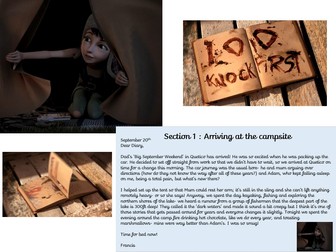
Stand alone 4 sessions of writing based on Francis (Literacy Shed). The children will explore the story, plan a diary entry and write it over 2 days. The focus is on how to make the diary entry the correct tone and use informal language.
Each session includes planning, a resource for the children (where needed) and a teaching powerpoint including modelled examples. The final write has a modelled example for each paragraph which can be used at your discretion.
An example diary entry text written from the point of view of Lila from The Firework-Maker’s Daughter plus feature find worksheets and answers, and differentiated planning templates. This exemplar text is perfect to use as a WAGOLL after reading chapters 2 and 3 of Philip Pullman’s novel.
Resources provided:
• Exemplar diary entry text
• Feature Find worksheets
• Feature Find answers
• Planning template differentiated 3 ways
The resources are available as PDFs and editable Word documents.
Pupils read the model diary entry, examine its features using the Feature Find worksheets and then plan and write their own diary entry using the differentiated templates.
The following language, grammar and punctuation features can be found in the WAGOLL:
• Similes
• Metaphors
• Idioms
• Rule of three
• Repetition for effect
• Onomatopoeias
• Alliteration
• Feelings
• Fronted adverbials followed by a comma
• Synonyms to avoid repetition
• Noun phrases
• Coordinating conjunctions
• Subordinating conjunctions
• Question marks
• Commas in lists
• Apostrophes for contraction
• Apostrophes for singular possession
• Apostrophes for plural possession
• Dashes
• Colons
• Semi-colons
• Hyphens
• Brackets
• First person POV
If you buy this resource and are pleased with your purchase, leave a review and receive another up to the value of this one for free. Just email helen-teach@outlook.com with your username, the reviewed resource and the resource you would like for free.
Other Firework-Maker’s Daughter resources:
✦ Example Text Pack BUNDLE
✦ Character Profile Example Text Pack
✦ Persuasive Letter Example Text Pack
✦ Newspaper Report Example Text Pack
Other popular resources:
✦ The Iron Man Unit of Work | Four Weeks | Year 3/4
✦ Stig of the Dump Complete Unit of Work | Six Weeks | Year 3/4
✦ The Twits Character Profile BUNDLE
✦ The Iron Man Character Profile BUNDLE
✦ Character Profile Example: Journey by Aaron Becker
✦ How To Train Your Dragon Character Profile Example Text Pack
✦ Stone Age Boy Character Profile Example Text Pack
✦ Christophe’s Story Character Profile Example Text Pack
Visit Helen-Teach’s Shop for more resources.
A week of looking at how the characters feel in the story.
The children will have to write a diary entry about an event and then how they felt.
Planning included
Example diary entry texts written from the points of view of King Hrothgar and Grendel from Beowulf plus feature find worksheet and answers, differentiated planning templates and word bank. These exemplar texts are perfect to use as WAGOLLs after reading the first seven pages of Michael Morpurgo’s re-telling of the classic Anglo-Saxon story.
Resources provided:
• Two exemplar diary entry texts
• Feature Find worksheets differentiated 2 ways
• Feature Find answers
• Planning template differentiated 3 ways
• Contractions word bank
The resources are available as PDFs and editable Word documents.
Pupils read the model diary entries, examine the features using the Feature Find worksheets and then plan and write their own diary entries from the point of view of one of the characters, such as King Hrothgar, Grendel, Edgetheow, King Hygelac or the heroic Beowulf himself, using the differentiated templates.
The following language, grammar and punctuation features can be found in the WAGOLLs:
• Alliteration
• Expanded noun phrases
• Fronted adverbials
• Introductory paragraphs
• Rule of three
• Synonyms to avoid repetition
• Rhetorical questions
• Subordinate clauses
• Thoughts/feelings/opinions
• First person POV
If you buy this resource and are pleased with your purchase, leave a review and receive another up to the value of this one for free. Just email helen-teach@outlook.com with your username, the reviewed resource and the resource you would like for free.
Other Beowulf themed resources:
✦ Beowulf: Example Texts & Grammar BUNDLE
✦ Beowulf Dialogue Writing Example Text Pack
✦ Beowulf Character Profile Model Text Pack
✦ Beowulf Fronted Adverbial Differentiated Worksheets
Other popular resources:
✦ The Iron Man Unit of Work
✦ Stig of the Dump Unit of Work
✦ Moon Landing Diary Unit of Work
✦ Stone Age Boy Example Texts BUNDLE
✦ The Twits Example Texts BUNDLE
✦ How to Train Your Dragon BUNDLE
✦ The Boy Who Grew Dragons: Example Text BUNDLE
✦ The Butterfly Lion: Example Text BUNDLE
✦ The Firework-Maker’s Daughter: Example Text Pack BUNDLE
✦ Varjak Paw WAGOLL Example Text Pack BUNDLE
Visit Helen-Teach’s Shop for more resources.
This is a diary entry based around the story of the pearl diver. It could be used as a general example of how to write a diary entry or be specifically linked to the text. Suitable for Year 5/6.
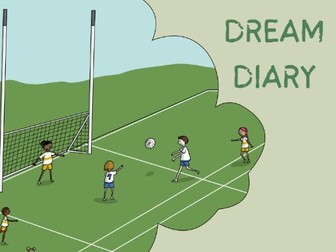
A free download themed around the story book ‘Tara Finds Her Team’. These diary pages give children the space to journal about their dreams. The diary pages have been designed for children ages 7-12 and are the perfect morning activity.
This inviting journal invites children to capture the magic of their dreams.
Each day, they can sketch and write about their dreams. They can write down what happened, how it made them feel, and even record who appeared in their dreams. This process fosters self-awareness, emotional intelligence, and imagination. Sharing their dreams becomes a delightful daily ritual, creating opportunities for bonding and conversation.
The dream journal pages are not just a diary; it’s a valuable tool for parents and teachers because it can offer insights into a child’s subconscious thoughts and emotions, helping adults better understand their world.
Year 4 / 5 / 6 – A full week of engaging Diary Entry writing planning based on the Halloween scene from the book and film, ‘Wonder’ by R.J. Palacio. Included are daily PowerPoints, resources to print, and a planning explanation. The diary entry is told from Auggie’s perspective as he deals with the excitement of coming to school for Halloween only to face his friend’s talking about him in class.
This highly exciting, emotive, and engaging writing planning could be used and adapted for either Year 4, 5 or 6. This could be used as a week’s English unit, with children publishing their writing in lesson 5. The planning would work alongside children reading the text; however, children would not need to have read the whole book to be able to access the planning. There is an accompanying YouTube clip from the film, Wonder (included in the planning), which can be used for a standalone diary entry unit. All resources are made in PowerPoint so are easily editable.
Included in the download:
There are 4 complete lessons included in the pack. (Please note, all printed resources have been duplicated for planning ease.)
4 x PowerPoint Lesson Plans (this includes a Learning Objective, starter activity, slide to model writing, extension / challenge task).
4 x Starter Tasks – all starter tasks are used to develop higher order critical thinking skills.
4 x Main Tasks + Success Criteria / Structure Strips to support Writing
1 x high quality Diary Entry WAGOLL
2 x Word Banks
1 x Diary Entry Features Poster
4 x Challenge / Extension Tasks
1 x Planning proforma to support the use of PowerPoints
This planning was used as part of an inspection and was graded, ‘Outstanding’ when lessons were observed. All children produced high quality writing by the end of the week.
Further ideas
As the children have ‘imitated’ the WAGOLL, creating their own version, they could now ‘innovate’ their own diary entry based on how another character felt during the scene.
First two slides show pupils an example of how to write a diary extract with a particular focus on past tense.
The last three slides are differentiated worksheets from LA to HA
This three-lesson Greater Depth writing sequence is designed for Upper KS2 pupils (Years 4–6) and focuses on developing authorial intent, sentence control, and independent application.
Pupils explore what makes writing effective, learn how to manipulate sentence structure for impact, and then apply these skills independently through a haunted house writing context of their choice (description, diary entry, poem, or short story).
Each lesson includes:
Clear teacher guidance
Model texts (basic vs greater depth)
Structured pupil tasks
Worksheets to support thinking, not over-scaffold writing
Ideal for writing clubs, stretch groups, or whole-class Greater Depth teaching.
A resource pack for a lesson using Pigeon Impossible from the Literacy Shed. Can be used in a stand alone lesson or developed into unit of work. I have used this across Key Stage 2 in every year group and every single child has loved it. Has a focus of using ‘show not tell’ to enhance the writing and make it more descriptive.
Pack includes:
Presentation for input
Show not tell word mats
Storyboards and pictures for sequencing
Activity sheets for group work to mindmap how the characters are feeling at different stages
An mp4 of Pigeon Impossible
Large and small lined paper with a picture from Pigeon Impossible on using Twinkl Create
Diary entry checklist from Twinkl
I have used this for an interview, dissertation research across KS2 and standalone assessments - all of which had good feedback from observers and children.


 Quick View