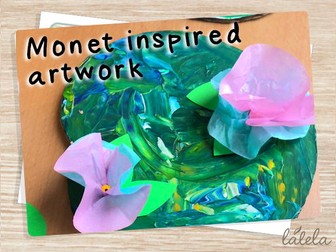
Introduce little artists to the magic of Claude Monet with this free, easy-to-use painting activity! Designed especially for early years, it encourages creativity, colour exploration, and fine motor skills - all while having fun with impressionist art. Perfect for classrooms or home learning!
The author is a retired attorney but still producing artist.
37 Art Figures ~ Art History Figures ~ Creative ~ like Paper Dolls
These are 37 art figures which were made digitally by turning the central figure into a silhouette and then filling that image with paintings from art history. These are very fun images and can be used in varied classroom activities. Also good for your class web site and for real or virtual bulletin board. Some of the artists included in these figures are: Monet, Manet, Cezanne, Picasso, Matisse, Sisley, Seurat, Titian, Tintereto, Fra Anglico, Raphael, Rousseau, Van Gogh, Renoir, Morisot, Cassatt, Michaelangelo, Degas, DaVinci, Botticelli, Bonnard. Some of the art movements are Impressionist, Post Impressionist, Renaissance, Cubist, etc.,
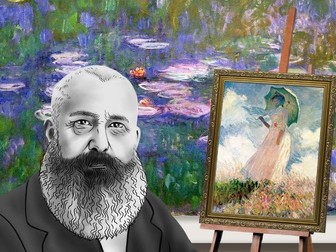
A resource focused on the Impressionist artist, Claude Monet and his artworks.
The resource focuses on analysing Monet’s artworks, both visually and in terms of their meaning. It begins with a brief summary on the artist, his background and his legacy, followed by a series of questions on particular artworks.
A ‘contrast & compare’ worksheet looking a Impressionist & Post-Impressionist paintings.
Perfect for a starter activity, plenary, extension task, or to encourage disciplinary literacy within the subject.
This links to Modern movement project and has activities for starters and a list of activities to take place weekly.
It has a Glossary with it for the project.
it has an evaluation for project.
Also resources for students to understand the movements.
There is a separate bundle for the whole project- with all the schemes for each movement with starter activities.
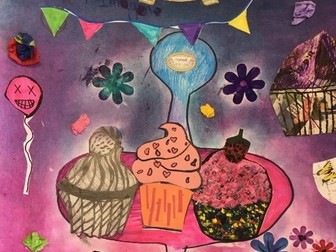
But, the outcomes are successful and students enjoy learning about the art movements and making cup-cakes in the various art styles.
WEEKLY
1 Discuss Art themes
2 Realistic drawing of a cup-cake and shading skills in book
3 Pop Art – To make a 2D relief cup cake using paper cut shapes
4 To draw a cake/biscuit e using the Cubism Collage and capturing geometric shapes light to dark
5 Continuation of drawing of biscuit/cake but doing this in Paint now and capture bright colours- Fauvism
6 Expressionism Doing a polyprint of cup-cake drawing in print and rolling ink
7Doing a Neo-impressionist cake drawing
8 and 9 Surrealism outcome –adding magical creature to cake
Presentation of cupcake stands
Evaluation of project
An introduction to Vincent Van Gogh and his work through the use of Line and Colour.
Using his work we progress through some of his most famous pieces.Through the use of exercises along the way it teaches children to really look at an image, compare two images and learn about how a Post- Impressionist painting is made from line and colour.
NB: Please note there are some teacher notes on the 'Starry Night' slide for an activity.
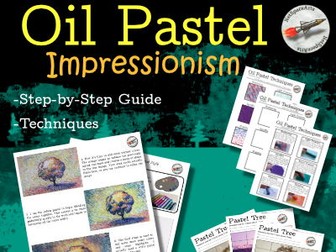
**‘All about Oil Pastels’ **is a complete no prep sequence of oil pastel art lessons that covers many aspects of the medium. Inspired by Impressionists, it has everything you need to teach this beautiful medium to a range of capabilities.
**Includes: **Practical step by step lessons, art literacy, art history. Can be used as a set or as seperate activities. Also contains guides on presenting final artworks and assessment tools and lesson planners to leave for a Sub plan or to assist in getting the most out of the package.
7 learning activities which make up 3 major projects, each with a ‘Project Outline for Teachers’ (including relevant art history & literacy-focused theoretical material, activity templates, & teacher answer guides)
A session-by-session ‘Lesson Planner’ for teachers (lesson stages & pacing, discussion questions, vocabulary words/definitions, & additional learning support strategies)
6 assessment rubrics based on the US National Core Arts Standards (for individual activities & the complete unit)
Below is a break-down of the resources included in the individual projects.
Project 1: Oil Pastel Techniques
‘A Short History of the Medium’ information sheet
‘Oil Pastel Techniques Description Guide’, ‘Examples Guide’ & ‘Template’
3 Gridded ‘Observational Drawing Templates’ (with supporting assessment material)
Project 2: Impressionist Style Artwork
‘Impressionism Information Sheet’, ‘Critical Reflection’ & ‘Answer Guide for Teachers’ (introduction to the Impressionist movement with supporting assessment material)
‘Impressionism Word Search’ & ‘Impressionism Crossword’
‘Seashell Art’ worksheet & ‘Pastel Seashell’ step-by-step guide with 4 gridded image templates (with supporting assessment material)
‘Impressionist Style Pastel Tree’ step-by-step guide with 3 gridded image templates (with supporting assessment material)
Project 3: Final Artwork Using the Design Process
‘Final Artwork Idea Development Techniques’ worksheet (with supporting assessment material)
‘The Design Process Journal Example’ (pictorial guide on how to create a visual record of engagement in the design process (with supporting assessment material)
‘From Idea to Artwork’ worksheet (with supporting assessment material)
‘Final Artwork Mounting for Presentation’ guide
‘Final Artwork Personal Evaluation’ worksheet (with supporting assessment material)
Copyright Notice
This work is copyright. You may download, display, print and reproduce this material in unaltered form for educational purposes only. Apart from any use as permitted under the Copyright Act 1968, all other rights reserved. Reproduction or distribution in part or whole, without written permission from NetSpaceArts Ltd, is prohibited.
Introduction and activities related to impressionism paintings
Slide 1: Title with one of the most famous painting of the impressionist movement (Dance at Le Moulin de la Galette from Pierre-Auguste Renoir, 1876)
Slide 2: Introduction of “Romantic”, previous movement to “Impressionism”.
Slide 3 - 6: Example of Romantic paintings showing historical scenes and their details.
Slide 7: Overview of impressionism.
Slide 8: Impressionist painting port de morlaix.
Slide 9: show differences in details of the drawings.
Slide 10: four paintings which highlights the particularities of impressionism paintings.
Slide 11-17: most famous impressionist painters highlighting the particularities of impressionism paintings. (painting names in the notes)
Slide 18: Specificity of Claude Monet’s paintings.
Slide 19: other specificities of impressionist paintings.
Slide 20-23: Famous impressionist paintings.
Edgar Degas’ in quotes - the famous Paris artist on his painting art & life in France’ Impressionism - free resource for students, pupils and teachers in French art history
.
Edgar Degas’ artist quotes illustrate the surprising fact that he was a rather active and organizing artist in the group of the Impressionist painters. He attributed a lot to the famous Impressionist exhibitions, organized as an alternative for the official Paris Salon. Degas wrote about his relations with other artists, o. a. his friendship with Edouard Manet.
Degas’ quotes show moreover that he was in fact the only not-Impressionist between all the Impressionist artists, because he hated to paint outdoor. He disliked the color-mix of Monet and other artists; he was very critical om that color-mixture which made him mad, see the quote below. He loved and adored the classical painters - they were his inspiration!. Degas has become most famous for his many paintings of ballerina-dancers. Many of his quotes here are taken from his letters.
.
Some selected artist-quotes of the famous French artist Edgar Degas - as a short introduction of his extended quotes in the PDF:
’I am busy on a portrait of my aunt and my two cousins… .I am doing it as if I were doing a picture… .The older one is really a lovely thing, the younger one has the devil in her as well as the kindness of an angel. I am doing them with their black dresses and little white pinafores which suit them delightfully’ - Degas’ quote, in a letter to his friend and painter Gustave Moreau, Nov. 1858
’Make portraits of people in familiar and typical positions, above all give their faces the same choice of expression one gives their bodies. Thus if laughter is typical for a person, make him laugh – there are, naturally, feelings that one cannot render…’ - quote of Degas, in his Notebook of 1869
’I met Monet himself there, and I said to him, ‘Let me get out of here. Those reflections in the water (in Monet’s paintings at the Durand-Ruell-exhibition) hurt my eyes!’ - Degas’ quote, cited by his art-seller Ambroise Vollard, in his book ‘Degas: An Intimate Portrait’, 1927
.
editor: Fons Heijnsbroek / Matrozenhof
12 Henri Rousseau Style Colouring Sheets - Teaching Cover or One-Off Lesson
Description:
Enhance your art lessons with this engaging collection of 12 Henri Rousseau style colouring sheets, perfect for a teaching cover or a one-off lesson. These beautifully designed sheets are inspired by the distinctive style of the renowned French post-impressionist painter Henri Rousseau, known for his vibrant jungle scenes and imaginative compositions.
Features:
12 Unique Colouring Sheets: Each sheet features a different Rousseau-inspired scene, complete with exotic plants, animals, and dreamy landscapes.
Educational and Fun: These sheets not only provide a fun coloring activity but also serve as a great way to introduce students to Rousseau’s artistic style and post-impressionist art.
Versatile Use: Ideal for art classes, substitute teacher plans, or as a creative break during a busy school day.
Skill Development: Promotes creativity, fine motor skills, and an appreciation for art history.
High-Quality Illustrations: Each sheet is carefully designed to capture the essence of Rousseau’s work, providing an authentic and inspiring colouring experience.
Lesson Plan Suggestion:
Introduction to Henri Rousseau: Begin with a brief introduction to Rousseau, his life, and his unique style. Show examples of his famous works, such as “The Sleeping Gypsy” and “Tiger in a Tropical Storm.”
Coloring Activity: Distribute the coloring sheets and encourage students to explore the use of color, inspired by Rousseau’s vibrant palette
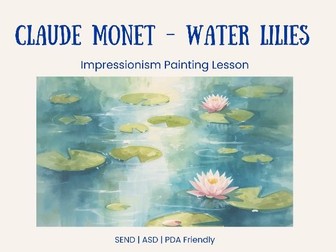
This calm, creative art lesson introduces pupils to Claude Monet and the Impressionists movement through a low demand Water Lilies painting activity.
Designed to be SEND, ASD and PDA friendly, this resource uses choice based language, flexible pacing and non-pressured instructions to support emotional regulation, autonomy and creative confidence.
Pupils explore colour mixing, layering and soft brush techniques inspired by Monet’s famous water lily paintings, while learning that there is no single “right” result in art.
The resource is suitable for:
Primary classrooms (KS1-KS3)
Art Clubs
Low - demand and trauma informed teaching
WHAT’S INCLUDED:
Artist introduction
Simple explanation of Impressionism
Step by step Water Lilies painting process (6 steps)
Material list
Choice-based, low-pressure instructions
Calm reflection worksheet
SEND/ASD/PDA friendly design throughout
LEARNING OBJECTIVES
Learn about the artist
Understand key features of Impressionism
Experiment with colour mixing and layering
Create personal artwork inspired by Monet
WHY THIS RESOURCE WORKS WELL:
Low-demand, choice-based language
No time pressure
Supports autonomy and regulation
Suitable for mixed-ability groups
Encourages creativity and self-expression
Post impressionist painter Odilon Redon SEMI Analysis worksheet
‘SEMI’ is an acronym used with in art to describe the Subject, Elements, Media and Intention of a piece of work. - Students can follow to structure to critically analyse the Redon images provided.
This worksheet can be used as part of a lesson, starter activity, home learning activity or as an extension task.
Impressionism Painting Worksheet
The A4 PDF Work sheet looks at different forms of painting and artist that were predominant within the movements, a brief overview of impressionism, tips on impressionist inspired painting techniques, and the painting activity.
The activity id to look outside your window, using either oil pastels or watercolours create what you see on a piece of A4 paper.
Can be used as part of a scheme of work, as a stand alone lesson, a home learning activity, blended learning activity, extension task or cover lesson.
Oil Pastel Tree Drawing Lesson - Sub Art Plan with Colour step by step demonstration. Created by a professional artist in the medium.
This art lesson plan using oil pastels is helpful when introducing students to the medium and appropriate use of the materials. Due to their soft consistency and paint like quality, Impressionist colour techniques work very well with oil pastel. Students will be well prepared to try their own design after using the techniques template that covers a range of mark-making that is not only fun, but confidence building! The lesson includes:
An oil pastel techniques Description Guide (with photos)
An oil pastel techniques Examples Guide with accompanying Create your Own Examples template page so students can try their own
A series of high resolution tree templates for students to apply a variety of techniques
A standards based assessment rubric
This activity guides students through the fundamental elements such as handling materials, mark-making, and the related terminology. Students are required to refer to the example sheet while recreating the various techniques on the template sheet.
A two-page demonstration of a tree drawn in the Impressionist style
This activity features a series of steps students can follow. Each step is numbered, with written instructions and accompanying images.
This Lesson Pack is appropriate for teachers wishing to support their students to build an understanding of the medium and its related terminology, and to combine the various oil pastel techniques with their observational skills.
Please assist us in continuing to improve our resources by leaving a review.
Copyright Notice: This work is copyright. You may download, display, print and reproduce this material in unaltered form for educational purposes only. Apart from any use as permitted under the Copyright Act 1968, all other rights reserved. Reproduction or distribution in part or whole, without written permission from NetSpaceArts Ltd, is prohibited. Some images are used under Fair Use Copyright from Pexel.com
Terms of Use
NetSpaceArts encourages you to use this resource:
For your own personal or teaching purposes
By providing it to your students for use in the classroom in electronic or printed form
In the ways listed above, year after year
By purchasing additional licenses at a discount so you can pass it on to other teachers
By recommending it—or showing its results—online, as long as you also include a link to its listing on TES
NetSpaceArts does not allow you to:
Give this resource to anyone, in any form, other than those listed above
Post it anywhere online, including all websites
Publish, copy or modifying any part of it, including its images, for any purpose
Store it anywhere it would be easily accessible to others
These three packs offer students the opportunity to explore Normandy’s rich, treasured history across three topics. Each of these education packs is full of fascinating facts, figures, pictures, paintings, photographs, glossaries, timelines, quizzes, challenges, games and puzzles, all guaranteed to bring your history lessons to life. Highlights from the packs include a historical detective activity, an exclusive interview with a D-Day veteran, an artistic challenge - ‘Paint like an Impressionist’ and a detailed map of historic Normandy.
This complete lesson is perfect for prompting class discussions on the topic of art. Beginning with reading and comprehension exercises on Vincent van Gogh, this lesson will encourage students to express their opinions on post-impressionist art, and then test student’s reading, writing, and speaking skills through challenging activities.
I designed this lesson for an intermediate or upper intermediate class (secondary/high school), but the materials can easily be adapted for higher or lower ability.
Any of the worksheets can be set as homework, used in a classroom, or in a one-to-one tutoring lesson.
This resource includes:
Teacher Resources:
Teacher’s PowerPoint [7 slides]
PowerPoint includes 2 class discussion activities & worksheet answers
Worksheets also include glossary for key vocabulary
Student Resources / Worksheets:
Biography of Vincent van Gogh (including glossary) [Text]
Match the Dates with the Biographical Information [Reading Activity]
Biography Comprehension Questions [Reading & Writing Activity]
Video Link [YouTube] & Comprehension Questions [Listening Activity]
Choose an Artwork to Write About [Writing Activity / Homework]
Activity answers are included on the PowerPoint
Separate worksheets with UK and US spelling
a) familiarise yourself with the French Impressionist painting 'Les Tuileries'.
b) plan a series of activities for a visit to Paris using the future tense.
c) make suggestions for alternative activities using si .
d) make comments about planned activities using ce sera and an adjective.
e) predict what Paris will be like in 2050 using il y aura and il n’y aura plus.
f) revise the articles au, à la, aux.
g) write a short letter to a French friend inviting him/her to visit Paris with you.
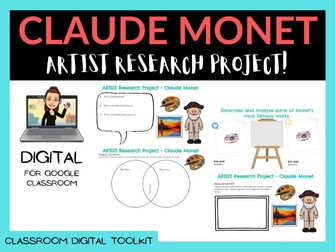
Artist Research Project - Google Slides, ready to be uploaded to Google Classroom!
Students love to research and use their digital skills to learn about the famous artist Claude Monet.
Students will research and learn:
Who is Claude Monet?
When and where was he born?
Where did Claude Monet grow up?
Describe Claude Monet’s artistic style
What are the key elements of his famous works?
Showcase and Analyse some of Claude Monet’s most famous works.
Critical Thinking…
How does Monet’s use of color contribute to the mood of his paintings?
Think about a painting by Claude Monet that you like. How does the use of colors, light, and brushstrokes in the painting make you feel?
How does Monet’s depiction of nature differ from more traditional landscape paintings?
Visual Art Activity:
Create a Monet-style artwork: Students create their own artwork inspired by Monet’s style.
Compare and Contrast…
Students compare Monet’s work with that of another impressionist artist.
Multimedia Activity:
Students use their digital skills to upload video clips where people discuss Monet’s artwork and philosophy.
They are also required to research and provide links to virtual tours of exhibitions featuring Monet’s art.
INCLUDES PERSONAL REFLECTION AND MARKING RUBRIC!!!
8 Slides and Marking Rubric
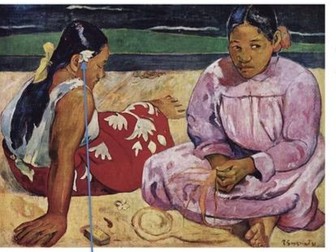
This comprehensive 21-slide PowerPoint (Keynote also available for Mac users) on Paul Gauguin offers an engaging and informative resource for Leaving Certificate Art History teachers. The presentation thoroughly covers key aspects of Gauguin’s work, making it an invaluable tool for classroom instruction.
Highlights of the Presentation:
Artistic Features:A detailed exploration of Gauguin’s signature use of vibrant colours, bold outlines, and flattened perspectives, helping students identify key elements of his Post-Impressionist style.
Primitivism: Insightful analysis of Gauguin’s fascination with ‘primitive’ cultures and how this concept influenced his artistic themes and visual approach.
Works in Tahiti: In-depth examination of Gauguin’s paintings created during his time in Tahiti, exploring the ways he depicted the island’s people, landscape, and cultural life.
Colonial Influence: Critical discussion of the impact of colonial perspectives on Gauguin’s portrayal of non-Western subjects, encouraging students to reflect on the cultural and ethical dimensions of his work.
Engaging Student Activities: The final slide includes thought-provoking questions designed to promote student analysis and interpretation of Gauguin’s iconic painting Where Do We Come From? What Are We? Where Are We Going? Example questions include: How does Gauguin use colour to convey different emotions or ideas in this painting? Why do you think the painting is read from right to left rather than the traditional left to right? How does this affect your interpretation? What elements of Post-Impressionism are evident in this work?
Why Teachers Will Love It: This presentation not only provides a comprehensive overview of Gauguin’s life and work but also encourages critical thinking and engagement through visual analysis and open-ended questions. It is visually appealing, well-structured, and designed to help students make connections between Gauguin’s art and broader art historical themes, including Primitivism and Post-Impressionism. A ready-to-use and thought-provoking resource, this PowerPoint will enrich your art history lessons and spark insightful classroom discussions.
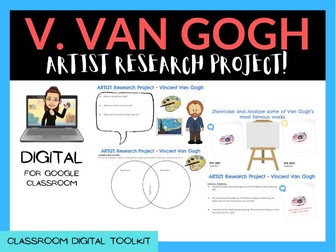
Artist Research Project - Google Slides, ready to be uploaded to Google Classroom!
Students love to research and use their digital skills to learn about the famous artist Vincent Van Gogh.
Students will research and learn:
Who is Vincent Van Gogh?
When and where was he born?
Where did Vincent Van Gogh grow up?
Describe Van Gogh’s artistic style
What are the key elements of his famous works?
Showcase and Analyse some of Van Gogh’s most famous works.
Critical Thinking…
How do the bright colors and wiggly lines in Van Gogh’s paintings make you feel?
Can you find a painting that you think shows a happy or sad feeling, and explain why you feel that way when you look at it?
Look at one of Van Gogh’s famous paintings. What is the main thing you notice about the colors he used?
Visual Art Activity:
Create a Van Gogh-style artwork: Students create their own artwork inspired by Van Gogh’s style.
and Contrast…
Students compare Van Gogh’s work with that of another impressionist artist.
Multimedia Activity:
Students use their digital skills to upload video clips where people discuss Van Gogh’s artwork and philosophy.
They are also required to research and provide links to virtual tours of exhibitions featuring Van’ Gogh’s art.
INCLUDES PERSONAL REFLECTION AND MARKING RUBRIC!!!
8 Slides and Marking Rubric


 Quick View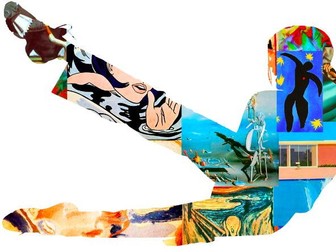
![Vincent van Gogh Lesson [Worksheets & Presentation]](https://l.imgt.es/resource-preview-imgs/f55da80a-69c1-4fc1-b6f3-0d2f0af1cf63%2FScreenshot20200223at134322.crop_680x509_7%2C0.preview.png?profile=res-img-med-legacy-v2)