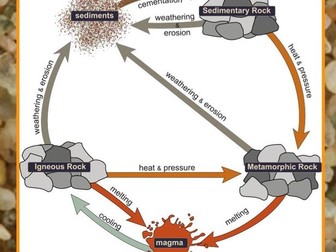
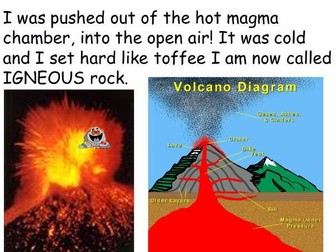
Perfect lesson resource for KS3 Chemistry! A fully differentiated and resourced lesson that assists students in learning about how how the rock cycle links the formation of sedimentary, igneous and metamorphic rocks. Students will describe the processes that interconvert the three types of rocks, construct a labelled diagram to illustrate the processes of rock formation, and use the rock cycle to explain how the material in rocks is recycled.
The resource includes a detailed and engaging lesson PowerPoint with differentiated activities, worksheet and quizzes for students to complete. This resource is part of The Earth topic and has been created for the delivery of the Activate KS3 Science course. Also great for KS2 Science.
24 slides in total for the lesson PPT
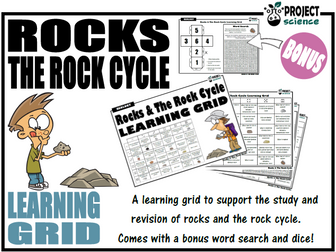
A learning grid to support the study and revision of rocks and the rock cycle. Students use a dice to decide which square they land on and then answer the question. Can be used individually, in pairs or in small groups. Great for collaborative revision.
Comes complete with an answer key, cut and paste dice, instructions and a blank grid for students to write their answers on if they wish to.
Also includes a bonus word search.
Includes a variety of questions on igneous, metamorphic and sedimentary rocks and how they form.
Clipart by:
Ron Leishman
ToonClipart
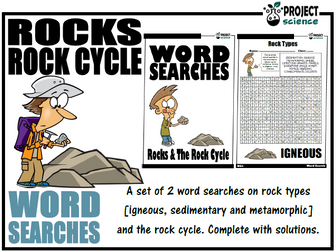
A set of 2 word searches with solutions on rock types [igneous, sedimentary, metamorphic] and the rock cycle. Great as a lesson starter, plenary or vocabulary review and consolidation.
Includes the following terms:
Rock Types Word Search
sedimentary
igneous
metamorphic
gneiss
limestone
granite
marble
sandstone
shale
schist
pumice
obsidian
conglomerate
dolerite
Rock Cycle Word Search
erosion
deposit
sediment
compaction
cementation
sedimentary
metamorphic
magma
igneous
crust
mantle
lava
volcano
crystals
Clipart by:
Ron Leishman
ToonClipart
Revision mat for KS3 science topics "rock cycle". Includes revision the rock cycle, different forms of weathering, acid rain and the structure of the Earth. Includes completed revision mat.
Comprehension and additional task exercises pages 104 and 105 from Next Page Science KS3 Complete. Accompanying PowerPoint and word searches available for** free** from the website.
This exercise covers:
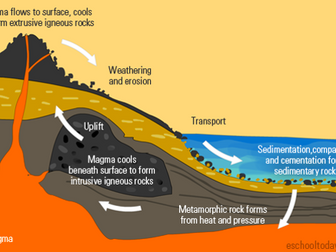
• A pictorial description of the rock cycle: weathering, erosion, deposition, compaction and uplift
• The three types of rock: sedimentary, metamorphic and igneous with examples
• Intrusive and extrusive rocks and the large and small crystal structures
• A detailed description of the rock cycle and each rock formation
• A labelling exercise consolidating the rock cycle
• An exercise on uplift
• Amazing WHAT? facts
We are always looking for ways of making our lessons more exciting and accessible to the pupils, doing something different in a different way to make a difference. Enterprising teaching and learning by any other name. Here I offer a lesson that I have taught to a low ability year 7. The topic was ‘The Rock Cycle’ and I wanted to show how through the application of heat and pressure you could change the structure of the rocks (i.e. how metamorphic rock is formed). This is a difficult concept for some pupils to grasp. So what better way to demonstrate this concept than by making CHEESE TOASTIES. Please have a go at teaching the lesson and make a difference through doing something different in a different way.
This resource bundle will test and challenge students knowledge on the various rock types, their formation and uses, and the transformation of one rock type into the other. Answers have also been provided to support students learning.
During 7.1.4 The rock cycle Year 7 students work through a variety of activities to develop their understanding of the processes involved in the rock cycle. Based on the 4th lesson from the AQA KS3 Activate 1 (OUP) 7a: Earth- 7.1 Earth structure chapter.
Also available as a digital worksheet, which is ideal for distance learning, independent study or catch-up of missed work through absence.
Aimed at a mixed ability Year 7 class.
Presentation contains (22 slides)-
Bell work activity
Lesson objective and success criteria
Information slides
Challenge activities (group work)
Practical activity (where appropriate)
Demonstrate understanding tasks (with answers)
Lesson resources (additional to scheme)
Please note: Activate (Kerboodle) worksheets from scheme are not included due to license.
The rocks and the rock cycle science doodles is a great way for students to organise information and review concepts in a visual and engaging way. Includes the three main rock types [igneous, metamorphic, sedimentary] with examples of each.
Students can complete either of the two differentiated versions.
Version 1: Students research the rock types to complete the science doodles.
Version 2: Students write the key words into the gap fill spaces to complete the science doodles.
Also includes a rock cycle diagram for students to complete by adding the transformational processes.
Includes a PowerPoint word bank of key words for the gap fill version as well as a model examples which can be used as an answer key.
Clipart by:
The Painted Crow
Ron Leishman
ToonClipart
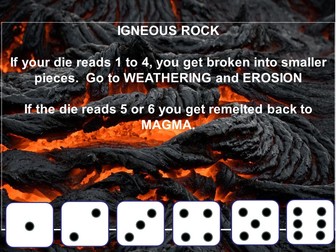
A fun game to teach your class about the rock cycle and the different parts of the process. Teachers print out the following slides for 10 stations around your room.
At each station place a cup and die.
Assign students different starting points around the room and follow the instructions by rolling the die to select what happens to you as you progress through the rock cycle.
Students record their journey using the student handout worksheet contained in the presentation.
Alternatively, this could be played as an interactive game with a whole class, by using a die and clicking on the relevant numbers on each slide.
Discover the various types of rocks that exist on Earth with the help of these entertaining printable worksheets on types of rocks! Students in first grade, second grade, third grade, and fourth grade can learn about igneous rocks, metamorphic rocks, and sedimentary rocks with the help of these rock printables. Information on the life cycle of rocks is also included, along with a worksheet showing the cycle. You can start learning with these practical science worksheets for kids by simply printing the rock cycle worksheet.
There are several no-prep activities in this printable pack that don’t require any preparation and are centered around the various types of rocks that are present on Earth and the rock cycle, such as:
Rocks reading comprehension
Igneous rocks
Metamorphic rocks
Sedimentary rocks
Rock definitions worksheet
Classifying rocks worksheet cut and paste activity
Rock report
Describing rocks
Name some famous rocks
What are rocks used for?
Minerals
What are minerals used for?
Word Search
Cross word
Vocabulary page
Rock cycle poster
Rock cycle labelling activity
Rock cycle worksheet
These useful rock printables are great for parents, teachers, and homeschoolers alike. Use them as additional science practice, at home, or in the classroom!
Utilize these no-prep worksheets to practice and gain more knowledge about the various kinds of rocks and their formation. These are useful for science lessons with first-graders, second-graders, third-graders, and fifth-graders in the elementary grades.
We adore FEEDBACK! You also obtain CREDITS!
Terms of Use: By purchasing and/or downloading this electronic file, you are allowed to use the product for personal use as you like, but you are not allowed to resell or redistribute.
Follow my store and get all the newest product updates and freebies by clicking the green star ★ above.
This lesson considers the main rock types and students complete and make a comparison pyramid to display in the classroom or in their books. Students then examine the rock cycle and have a variety of key terms and phrases to include in how rocks change shape and state as they journey through the cycle.
There is also a homework task to consolidate learning.
KS3 Chemistry Lesson on The Rock Cycle
Slides are fully animated, with constant AfL, differentiation, scaffolding of learning and review of objectives.
LO1: State what is meant by the rock cycle (Level 3)
LO2: Describe using a diagram the rock cycle and the processes that are involved (Level 4)
LO3: Explain what is meant by uplift and why it is so important (Level 5)
(All resources including worksheets included)
Slides also include keywords on each slide and Stretch & Challenge for each activity. Interleaving Questions included at the start of each lesson.
Pupils will learn about how sedimentary, metamorphic and igneous rocks are formed as part of the rock cycle. Pupils then explore the different characteristics of each rock type and locate these within the UK. Finally, pupils can apply their knowledge with a range of activities.
Suitable for KS3.


 Quick View