Ancient Romans - Roman WritingQuick View
PrimaryTopicShop

Ancient Romans - Roman Writing

(1)
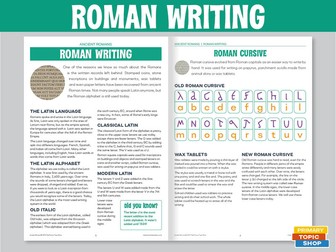
Teach your students about the Latin alphabet and ancient Roman writing with reading, worksheets and a fun activity. The PDF resource includes information about Roman writing including the Latin language and alphabet, old italic, classical Latin and modern Latin alphabets, Roman Cursive. There is also a key of the Roman cursive alphabet and a visual timeline showing the evolution of the Latin alphabet. Multiple choice questions test reading comprehension and students get to try out reading and writing Roman cursive with a variety of fun activities. Suitable for KS2. Pages: 13 (including 4 answer sheets) Contents: 2 Information Handouts 1 Timeline 1 Discussion Page 1 Decipher the Sentence Activity 1 Writing Fun Activity 1 Secret Message Activity 1 Multiple Choice 1 Matching Activity 4 Answer Sheets
Roman armyQuick View
leighbee23

Roman army

(14)
A series of three lessons on the Roman Army- based on recruitment and why the army was successful. Includes three tasks labelling, card sort, spy task, recruitment advert task. Lots of high quality resources for KS2 and KS3 students
Romans Planning Unit KS2Quick View
KS2History

Romans Planning Unit KS2

(21)
Romans in Britain: 10 lessons for KS2 A fully-resourced unit of 10 history lessons for KS2, covering the Roman Britain topic. WHAT YOU GET 10 detailed lesson plans 10 Powerpoint files Teachers’ notes including curriculum coverage Pupil activity sheets for all lessons **** About the Unit**** The ten sessions in this unit aim to give an overview of the history of Roman Britain, including the main events of the period and the way in which Britain changed as a result. A focus is given to the impact of the Roman occupation, to its legacy on modern Britain and to gaining an appreciation of the evidence that forms our understanding of this period of world history. Aims of the unit To gain an overview of the impact of the Roman Empire on Britain, including its lasting legacy To consider how different historical sources help us to know about Roman Britain To research what it might have been like to live in Britain during the period of Roman occupation. ** Lessons in the Unit** Where did the Roman Empire come from? How did the Roman army help to expand the Roman Empire? What was Britain like before the Romans invaded? How did Britain become part of the Roman Empire? Who was Boudica and how did she rebel against the Romans? What did the Romans build after they settled in Britain? What were houses like in Roman Britain? What can archaeological sites tell us about Roman Britain? How did bathhouses provide leisure for Romans in Britain? What lasting impact did the Romans leave in Britain? This pack contains everything you need to teach this unit, including differentiated activity ideas so that it can be adapted to the needs of your class. The Powerpoint text is also editable. This resource is brought to you by KS2History. If you like our Romans Planning pack, you may also like these: Escape from Pompeii Literacy Planning Pack Romans Literacy Planning Pack (Instructions Unit) Romans Planning Bundle of all three planning packs
KS3 Romans - How Healthy Were the Romans?Quick View
History_Wizard

KS3 Romans - How Healthy Were the Romans?

(0)
This lesson contains: A discussion activity to discuss Ancient Rome and for students to share what they know using the picture prompts. An overview of what public health means. An activity using the on-board information and the info sheet provided to complete questions on the importance of the army and how the army helped medical progress. Discussion of public health measures used by the Romans, followed by info and an activity on the uses and effectiveness of aquaducts, toilets, sewers and Roman baths. A plenary to use a radar graph to determine the most important parts of Roman public health. Attachments: 1 x Powerpoint Presentation 3 x Publisher Files
KS3 Romans - Why Did the Roman Empire Fall?Quick View
History_Wizard

KS3 Romans - Why Did the Roman Empire Fall?

(0)
This lesson contains: A starter to consider two images of Rome and consider what has happened to Rome in between them, and why. A background into the problems the Roman Empire was facing. Students watch a brief YouTube video for context and then use the sources sheet provided to complete questions on the board to evidence the different problems the Romans faced (i.e. invasion, corruption, less food to feed the people etc.) A task to study a series of events in the fall of Rome on the info cards provided. Students put the cards in order then complete the timeline. The point here is to write in each event higher or lower, according to the axis, depending on whether each even had a minor, some, major or devastating effect on Rome, giving students an opportunity to make a judgement as they set up the timeline. They can extend this by colour-coding the events that came from inside Rome, and those form outside, to provide for a discussion. A background of the Empire after the fall, including the survival of the Eastern Empire. Students then do a plenary to discuss a quote from Dan Snow about the main reason for the fall. Students argue for or against Dan Snow’s view, using evidence from the lesson. Attachments 1 x Powerpoint Presentation 3 x Publisher Files
KS3 Romans - Why Was the Roman Army So Effective?Quick View
History_Wizard

KS3 Romans - Why Was the Roman Army So Effective?

(0)
This lesson contains: A starter that discusses the problems Rome has with such large territory. Students explore the idea that the army needed to be large etc. A walkthrough of some of the major threats the Romans faced from abroad. The Iberians, Parthians and Britons are used as examples with a question to answer for each. An overview of the major tactics used. The lesson teases, from hints on the board, at the wedge, testudo and use of catapaults. There are images and video footage to support each, as well as two extra slides with a ballista and seige tower on for extra information. A slide on the importance of roads to the armies too with a chance to discuss it. The main task which asks students to use information sheets provided to complete the worksheet to show how effective the army was. For each section they also rate the effectiveness of each reason to help form a judgement. A plenary gap fill exercise to summarise the lesson. Attachments: 1 x Powerpoint Presentation 2 x Publisher Files
Design a Roman shield - worksheets and presentationQuick View
ummishaq

Design a Roman shield - worksheets and presentation

(0)
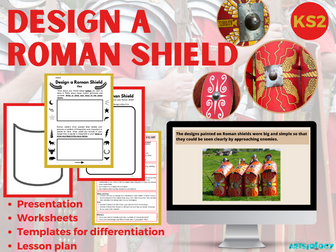
This resource will enable children to learn all about Roman shield designs. They will look at favourite colours and shapes along with finding out why the Romans usually included eagle wings and thunderbolts on their shields. Working through this activity children will look at a variety of Roman emblems and motifs before moving on to plan and design their own, personalised shield using Roman shields as their inspiration. This resource includes: A presentation on Roman shield designs Worksheets Lesson plan Templates for those that need additional support This is a fun, engaging activity that requires minimal art supplies- just pencils, erasers and something to colour with.
Introducing The Romans - KS2Quick View
Online_Teaching_Resources

Introducing The Romans - KS2

(0)
Introducing The Romans - KS2 'Introducing The Romans - KS2' is an ideal introduction to the topic of the Roman Empire and can be used in a lesson covering the KS2 history curriculum objective - the Roman Empire and it impact on Britain. This PowerPoint presentation provides an introduction to the following: 1. Who were the Romans 2. The extent of the Roman Empire at its height of power 3. The story of Romulus and Remus 4. Roman rulers 5. Life in Rome 6. Roman society 7. The impact of the Roman Empire on the world 8. The fall of the Roman Empire 9. Activities to support the teaching of this objective with worksheets 'Introducing The Romans - KS2' is completely editable so that teachers have the freedom to adapt the resource to suit the individual needs of each class they teach.
Roman SettlementsQuick View
a_skinner

Roman Settlements

(1)
A lesson about Roman settlements in Britain including a recap starter, a worksheet on Roman towns, an extension on Roman houses, a video and a role play activity on Roman roads.
KS3 Romans -  Were the Romans Religiously Tolerant?Quick View
History_Wizard

KS3 Romans - Were the Romans Religiously Tolerant?

(0)
This lesson contains: A starter with a quote from Polybius about the nature of Roman religion. Students discuss the importance of religion in the Roman world. An overview on the board of religion in Rome, including the nature of polytheism, the pantheon of Gods, the temples and importance of festivals, the use of augurs and shrines. Students then complete a gap fill, with a word bank, to show their learning. A task to match the most famous Roman gods with the roles they played. A discussion of what tolerance is before a main task to use the information sheet to complete the worksheet to show how the Romans treated the Druids, the Jews and the Christians. Students shade an amphora to show to what extend they were tolerant, or not. A final plenary to weigh up the overall tolerance of other religions. Attachments: 1 x Powerpoint Presentation 3 x Publisher Files
Romans AssemblyQuick View
frazert2

Romans Assembly

(0)
Assembly all about the romans, involves a lot of acting and has a line for each child. My year 3 class really enjoyed this and the whole school were interested in Romans the rest of the week. Approriate for y2-y6! Enjoy :)
KS3 Romans - Why Did the Romans Invade Britain?Quick View
History_Wizard

KS3 Romans - Why Did the Romans Invade Britain?

(0)
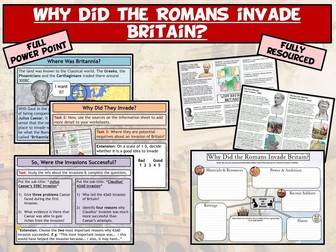
This lesson contains: A starter to consider why people come to Britain today. Students might suggest money, education, work, tourism. This leads on to the theme for this lesson. An overview of where Britannia fit into the Roman’s plans and who lived on the island before the Romans came. An activity to watch a video which briefly summarises the reasons why the Romans wanted to invade, and students make notes on their worksheet. The students then get given a more detailed sources sheet which will then help them flesh out their notes and read contemporary sources to extract the information. This can be extended by considering the main reason and giving a score to each. A task for students to study the two invasions and to answer questions on the board about each. This includes noting why Caesar’s invasion may have failed as well as why Claudius’ invasion was more successful and worked. The students get this information from an information sheet. A set of slides which give a brief overview of the consequences of the invasion using pictures and text. A plenary with a quote from Tom Holland and his view of the reason why the Romans invaded. Students can argue with or against this view using what they learned in the lesson. Attachments: 1 x Powerpoint Presentation 2 x Publisher Files
Romans Instructions Planning PackQuick View
KS2History

Romans Instructions Planning Pack

(11)
Download our popular ten-lesson unit of work based on reading and writing instructional texts with a Romans theme. Pupils will make a chocolate Roman road and then create instructions based on becoming gladiator champions! The ten lessons in this unit aim to give children the opportunity to understand the features of instructions as a genre. In the first week, children will engage with the text type by following instructions to make edible Roman roads out of biscuits, chocolates and custard! There is also a grammar focus on using prepositions and imperative verbs. In the second week, pupils will use drama to develop ideas and extend their vocabulary. They will then plan their own set of instructions about becoming Roman gladiator champions and they will then have the opportunity to draft, edit and present their final instructions. The English objectives covered in this unit are: - To give and follow verbal instructions - To use prepositions - To read and follow written instructions - To identify how language, structure and presentation contribute to meaning - To use a range of imperative verbs - To prepare a group performance - To make a plan for my writing - To write my own instructions - To edit my writing - To make decisions about how to present my writing The PDF file contains ten lesson plans and all accompanying pupil resources. Perfect to link literacy and history in your Romans topic! You may also like: Roman Britain Planning Pack Escape from Pompeii Literacy Planning Pack Romans Planning Bundle of all three planning packs .
Roman MosaicsQuick View
charleygirl5

Roman Mosaics

(0)
A 6 week unit of work for Art and Design looking at Roman Mosaics. This has been planned for Year 4, however can be used for all year groups in key stage two.
The Romans - The Roman Invasion of Britain - Lesson!Quick View
TandLGuru

The Romans - The Roman Invasion of Britain - Lesson!

(0)
In this engaging lesson, children are provided with an introductory understanding of the Romans, through: -Remembering what Britain was like before the Romans invaded; -Understanding the main events of the Roman invasion of Britain; -Understand the key features that made the Roman army strong. The learning is guided by a clear and colourful PowerPoint presentation, which guides students through the following step-by-step journey: -Answering recall questions based upon their knowledge of the Romans so far; -Gathering base information about life in the Iron Age in Britain before the arrival of the Romans; -Gaining an understanding aboutJulius Caesar’s initial attempts to conquer Britain, with reference to an adapted version of his own writings; -Understanding what helped Claudius to eventually conquer large parts of Britain; -Following clear instructions and precise dates to create their own Roman shields; -Self-reflecting on the extent to which they feel they have met the learning objective. Included is the comprehensive PowerPoint presentation (23 slides) and the reading (in both Word and PDF) In the past, I have used this lesson with children in lower KS2 (years 3 and 4) - the key learning is aligned with curriculum expectations for history. All images are licensed for commercial use.
The Romans leave BritainQuick View
a_skinner

The Romans leave Britain

(0)
A lesson about why the Romans left Britain including a recap starter, teacher exposition, a fill in the gap activity and a true or false activity.
The Romans - Class Assembly ScriptQuick View
TheTeacherTreasureTrove

The Romans - Class Assembly Script

(0)
This engaging and educational Year 4 assembly script, titled “Rome Wasn’t Built in a Day”, brings the fascinating world of the Romans to life. Featuring 30 speaking parts, it explores Roman achievements, from their mighty army and architectural wonders to daily life, gods, and famous figures like Julius Caesar and Boudicca. The rhyming dialogue keeps it fun and accessible, while reflective moments provide deeper learning. With opportunities for creative costumes, props, and a lively song to accompany the performance, this script is perfect for captivating an audience and celebrating history.
RomanQuick View
saz0885

Roman

(3)
Display heading saying 'Romans'