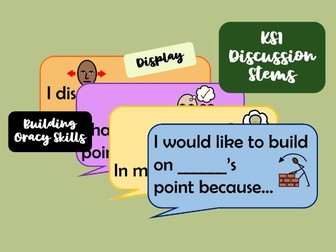
I have used these discussion bubbles to aid communication and partner talk in a wide range of lessons.
Contains symbols from Widgit Inprint 3 software.
3 bubbles - giving a new opinion
3 bubbles - agreeing
3 bubbles - disagreeing
3 bubbles - building/questioning an opinion
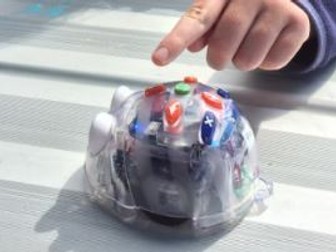
Stem (Science, Technology, Engineering and Mathematics): Blue-bots in Special Education. There is an introduction to Blue-bots and coding using a Smart notebook program. Blue-bots are introduced and then the student is encouraged to program / code the Blue-bot to move from 1 to 2, and around a square. There is also activities to take the Blue-bot on a journey.
To accompany this there is a worksheet where you can do the above activities using paper and sticking the visuals for the coding on to a coding sheet.
There is a Comprehensive lesson plan, which outlines the above activities giving Learning Intentions as well as highlighting 21st Century skills.
There is a handout on Blue-bots with technical advice, lesson plans and resources list.
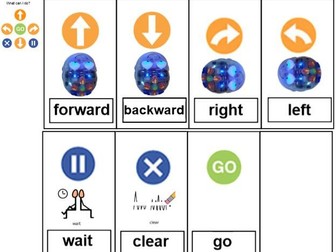
There are visual symbol boards for the coding of the Blue-bot.
This activity was created for students with special needs (SEN) but can be used as a valuable resource for early years.
This is a set of four hands which introduces Stem (Science, Technology, Engineering and Mathematics) into the special education classroom. My school was part of a Stem pilot project and we trialled a range of technology across the school and then presented to a Special Education meeting. These handouts were made for the meeting.
It looks at Blue-bots, Spheros, Virtual Reality and Scratch Jr. Each handout has technical advice, lesson plans with learning intentions and a list of resources.
These activities were created for students with special needs (SEN) but can be used as a valuable resource for early years.
This is a ready made display in PowerPoit format complete with links, qr codes, pictures of neurodiverse individuals associated with STEM and some information about those individuals. This would make an inclusive and positive display for any educational environment.
Plants Special topics describe plant adaptations, tropisms and hormones. The adaptations section goes over the specialized leaves, stems and protective adaptations. The tropisms cover how plants respond to water, light, tough and gravity. The various hormones are described in terms of how they affect the plants, fruit and leaves during various times of year.
STEM Challenges is a fun way to incorporate science, technology and design into your classroom. This packet focuses on STEM challenges with a May and May the 4th be with you theme. Each activity in this book includes step by step instructions, large challenge card with instructions, six page STEM mini-journal and a one page quick STEM page. The STEM activities in this packet are centered around the month of May.
The STEM, STEAM or Makerspace challenges are:
Build a Space Station
Recreate Yourself
Create a Robot
Build a Kaleidoscope
There are two different options for your students to use to journal their STEM challenges. The first is a mini-booklet that they can make which has a half of piece of paper to work on each section of the design process. This option gives the students more room to work on the design process.
The second option is a quick STEM printable you can use which saves paper, while giving students to develop their project using design methodology.
Each option has its own benefits and you can use which one suits your needs. You can also attach both options into a stem notebook if you have one available for each student.
These were made to be versatile to work as stand alone stem centers that require minimal supervision or a whole class activity.
STEM Challenges is a fun way to incorporate science, technology and design into your classroom. This packet focuses on STEM challenges with an October theme. Each activity in this book includes step by step instructions, large challenge card with instructions, six page STEM mini-journal and a one page quick STEM page.
The STEM, STEAM or Makerspace challenges are:
Christopher Columbus Floatable Sailboat
Haunted House
Glow in the Dark Binary Code Necklace
Bat Plane
There are two different options for your students to use to journal their STEM challenges. The first is a mini-booklet that they can make which has a half of piece of paper to work on each section of the design process. This option gives the students more room to work on the design process.
The second option is a quick STEM printable you can use which saves paper, while giving students to develop their project using design methodology.
Each option has its own benefits and you can use which one suits your needs. You can also attach both options into a stem notebook if you have one available for each student.
These were made to be versatile to work as stand alone stem centers that require minimal supervision or a whole class activity.
All artwork is original and create by myself.
Thanks for looking at my products,
Yvonne Crawford
The use of centres in an ESL classroom can greatly improve language acquisition and help to encourage conversation between students.
Studies have shown the importance of play in Early Years and Primary classrooms.
This resource will help to develop fine motor skills, cognitive abilities like problem-solving and spatial awareness, and creativity.
This resource contains 15 specific tasks and some fun facts!
Can be used as a whole class task or laminated and used for centres.
Many of the challenges we face such as finding new energy sources, responding to the health needs of an ageing population and developing sustainable food supplies rely on innovative uses of science, technology, engineering and maths (STEM). STEM skills and qualifications open the doors to exciting and rewarding careers…what can parents and families do to help their children make the right choices and keep their options open? (Science, Technology, Engineering & Maths)
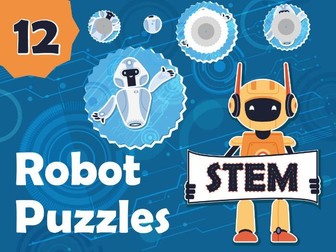
12 printable robot puzzles with three ways to play. Quick to prepare and ideal for building logical thinking, visual-spatial skills, concentration and fine motor skills.
Children explore, rotate, match and assemble circular puzzle pieces to reveal a complete robot while developing important early learning skills.
Each puzzle has its own unique combination of shapes and background colours. These built-in visual clues encourage children to compare, sort, test ideas and solve each puzzle independently.
As children build the robots, they naturally develop visual perception, spatial awareness, logical thinking, concentration, fine motor skills and problem-solving skills through play.
How to Use
These robot puzzles can be used in several different ways depending on the age and ability of your learners.
1. Cut and Paste
Children cut out the puzzle pieces, assemble the robot and glue the completed picture onto the page.
Ideal for independent work, fine motor practice, scissor skills or homework.
2. Spin and Build
Laminate the puzzle pieces, stack the circular layers and fasten them together with a paper fastener. Children simply rotate the circles until the robot is complete.
This version is especially suitable for younger learners because there are no loose pieces to manage.
3. Mix, Match and Solve
Laminate the pieces and use them as separate puzzle parts. Children rebuild each robot independently.
For a greater challenge, mix pieces from several robots together. Learners compare shapes and colours, decide which pieces belong together and solve each puzzle using observation and logical thinking.
What Is Included
12 unique robot puzzles
Individual puzzle pieces ready to cut
Reference pages with smaller completed robot images
Numbered robot examples for easy identification
Printable PDF file
Please note that the completed robot images are provided as reference examples only. They are not designed to be used as puzzle mats.
Skills Developed
Visual perception
Visual spatial reasoning
Problem solving
Logical thinking
Fine motor skills
Scissor skills
Hand-eye coordination
Attention and concentration
Part-to-whole relationships
Sorting and classification
Suitable For
STEM activities
Maths centres
Fine motor activities
Early finishers
Independent learning
Small group work
Continuous provision
Morning activities
Indoor play
Home education
Robot and technology topics
Teacher Tip
For long-term classroom use, print the puzzles on card and laminate the pieces.
Use them as a simple cut-and-stick activity, create rotating puzzles with paper fasteners, or mix pieces from several robots together to provide an extra challenge.
This versatile printable resource offers different levels of difficulty, making it suitable for a wide range of learners while encouraging problem solving, independent thinking and hands-on learning.
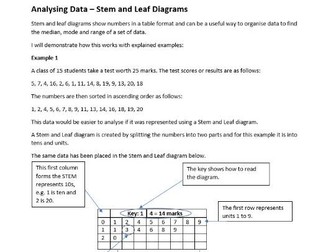
Statistics: Analysing Data using Stem and Leaf diagrams. Clearly demonstrates the methods used to produce a stem and leaf diagram and how to use the diagram to analyse the data. The file includes two worked examples, a question sheet and an answer sheet. The questions are of varying level of difficulty and should prepare students for anything they are likely to encounter in a GCSE exam. Many hints, tips and checks are also included. This could be useful, as the basis of a lesson observation, enjoy!
This inquiry-based STEM unit aligned with standards takes students of all abilities into natural and/or virtual settings to observe flight. Watching butterflies, an albatross, and a dragonfly, students learn the science of flight and apply it to engineering designs for paper airplanes. Formative assessment is used to assess prior knowledge and what students learn from experiential learning and inquiry. After completing the unit, typical and gifted students are challenged to design a paper airplane unlike any previously designed. Gifted students are also encouraged to investigate how observing flight in nature is being used to create robotics and drones
STEM Challenges is a fun way to incorporate science, technology and design into your classroom. This packet focuses on STEM challenges with a November theme. Each activity in this book includes step by step instructions, large challenge card with instructions, six page STEM mini-journal and a one page quick STEM page.
The STEM, STEAM or Makerspace challenges are:
Voting Ballot Box (featuring special and optional Hillary Clinton and Donald Trump Graphics)
Native American Longhouse
Thanksgiving Table Challenge
Thanksgiving Turkey Trap
There are two different options for your students to use to journal their STEM challenges. The first is a mini-booklet that they can make which has a half of piece of paper to work on each section of the design process. This option gives the students more room to work on the design process.
The second option is a quick STEM printable you can use which saves paper, while giving students to develop their project using design methodology.
Each option has its own benefits and you can use which one suits your needs. You can also attach both options into a stem notebook if you have one available for each student.
These were made to be versatile to work as stand alone stem centers that require minimal supervision or a whole class activity.
All artwork is original and create by myself.
Thanks for looking at my products,
Yvonne Crawford
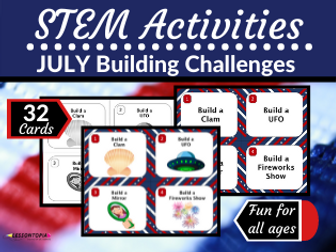
Use this set of 32 building task cards with a July theme to help build fine motor and problem-solving skills while encouraging creativity and persistence. Includes cards for special days in July such as Independence Day, Chocolate Day, Video Games Day, National French Fries Day and much more. There are a variety of building activities ranging from easy to complex which allows you to use this set with children of all ages and abilities.
Three styles of cards are included for each build. One is a full-color version with a cartoon picture, the second is a print-friendly version of the first, and the third is a color version with no pictures. The picture version is good to use with children who need an idea of what to build before they start, while the no-picture version is ideal for your perfectionists who would get frustrated if they could not replicate the picture exactly or to allow more creativity.
Print on heavy paper (cardstock) and laminate to use again and again. Works great in classrooms and homeschools for STEM or STEAM centers, early finishers, morning time or just for fun! You can use blocks (LEGO, DUPLO, etc.) or any craft items for the building materials. Provide children with an assortment of materials, choose a card, and watch them create!
Includes:
32 task cards in three versions
• Color with picture
• Black and white with picture
• Color without picture
Check out my shop for other building challenges and bundles.
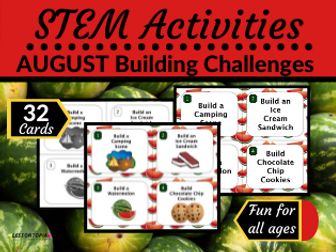
Use this set of 32 building task cards with an August theme to help build fine motor and problem-solving skills while encouraging creativity and persistence. Includes cards for special days in August such as National Lighthouse Day, Frankenstein Day, Race Your Mouse Day and much more. There are a variety of building tasks ranging from easy to complex which allows you to use this set with children of all ages and abilities.
Three styles of cards are included for each build. One is a full-color version with a cartoon picture, the second is a print-friendly version of the first, and the third is a color version with no pictures. The picture version is good to use with children who need an idea of what to build before they start, while the no-picture version is ideal for your perfectionists who would get frustrated if they could not replicate the picture exactly or to allow more creativity.
Print on heavy paper (cardstock) and laminate to use again and again. Works great in classrooms and homeschools for STEM or STEAM centers, early finishers, morning time or just for fun! You can use blocks (LEGO, DUPLO, etc.) or any craft items for the building materials. Provide children with an assortment of materials, choose a card, and watch them create!
Includes:
32 task cards in three versions
• Color with picture
• Black and white with picture
• Color without picture
Check out my shop for other building challenges and bundles.
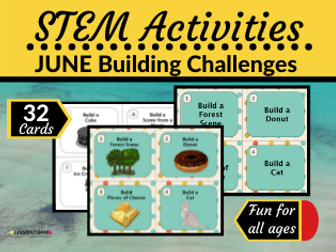
Use this set of 32 building task cards with a June theme to help build fine motor and problem-solving skills while encouraging creativity and persistence. Includes cards for special days in June such as Father’s Day, Hug Your Cat Day, National Cheese Day, Best Friends Day and much more. There are a variety of building activities ranging from easy to complex which allows you to use this set with children of all ages and abilities.
Three styles of cards are included for each build. One is a full-color version with a cartoon picture, the second is a print-friendly version of the first, and the third is a color version with no pictures. The picture version is good to use with children who need an idea of what to build before they start, while the no-picture version is ideal for your perfectionists who would get frustrated if they could not replicate the picture exactly or to allow more creativity.
Print on heavy paper (cardstock) and laminate to use again and again. Works great in classrooms and homeschools for STEM or STEAM centers, early finishers, morning time or just for fun! You can use blocks (LEGO, DUPLO, etc.) or any craft items for the building materials. Provide children with an assortment of materials, choose a card, and watch them create!
Includes:
32 task cards in three versions
• Color with picture
• Black and white with picture
• Color without picture
Check out my shop for other building challenges and bundles.
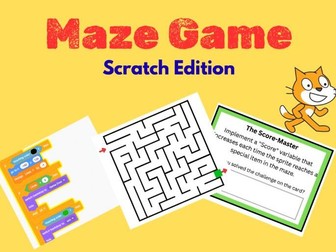
Introduce your students to the world of game design and computer science with this comprehensive Scratch Maze Game project. Designed specifically for Grades 3–6, this resource provides everything you need to guide students through building a functional maze game, from character movement to win/loss conditions.
This resource is designed to be “ready-to-go” and includes:
Teacher_Guide: A detailed 3-lesson plan complete with learning objectives, discussion questions and troubleshooting tips.
Student Mission Sheet: Step-by-step guides for students to build their game, covering character movement, maze design, collision logic, and win conditions.
Bonus Mission: Engaging extension activities including adding timers, scores, moving obstacles, and custom sound effects.
Exit ticket -Bug report: A formative assessment tool for students to reflect on their code and debug their logic.
Learning Outcomes
By the end of this project, students will be able to:
Understand and implement event-driven programming.
Utilize conditional statements (if/then) and variables to control game behavior.
Apply computational thinking to design and test their own unique game.
Systematically identify and fix “bugs” within their code.
Perfect For:
Primary and Middle School STEM/ICT classes.
Computer Science clubs or after-school coding programs.
Educators looking for project-based learning (PBL) resources that are easy to implement with no prior specialized training required.
STEM Challenges is a fun way to incorporate science, technology and design into your classroom. This packet has four unique STEM challenges for each month of the school year. Each activity in this book includes step by step instructions, large challenge card with instructions, six page STEM mini-journal and a one page quick STEM printable.
This bundle is discounted by $13.50 - three free months of STEM activities.
The STEM, STEAM or Makerspace challenges are:
August/September - Back to School
October - Christopher Columbus Day and Halloween
November - To be added
December - To be added
January - To be added
February - To be added
March - To be added
April - To be added
May - To be added
There are two different options for your students to use to journal their STEM challenges. The first is a mini-booklet that they can make which has a half of piece of paper to work on each section of the design process. This option gives the students more room to work on the design process.
The second option is a quick STEM printable you can use which saves paper, while giving students to develop their project using design methodology.
Each option has its own benefits and you can use which one suits your needs. You can also attach both options into a stem notebook if you have one available for each student.
These were made to be versatile to work as stand alone stem centers that require minimal supervision or a whole class activity.
All artwork is original and create by myself.
Thanks for looking at my products,
Yvonne Crawford
STEM Challenges is a fun way to incorporate science, technology and design into your classroom. This packet focuses on STEM challenges with an Easter and spring theme. Each activity in this book includes step by step instructions, large challenge card with instructions, six page STEM mini-journal and a one page quick STEM page. The STEM activities in this packet are centered around the month of April and the Easter season.
The STEM, STEAM or Makerspace challenges are:
Build an Egg Tower
Create an Egg Launch
Create a String Art Flower Card
Build a Windmill
There are two different options for your students to use to journal their STEM challenges. The first is a mini-booklet that they can make which has a half of piece of paper to work on each section of the design process. This option gives the students more room to work on the design process.
The second option is a quick STEM printable you can use which saves paper, while giving students to develop their project using design methodology.
Each option has its own benefits and you can use which one suits your needs. You can also attach both options into a stem notebook if you have one available for each student.
These were made to be versatile to work as stand alone stem centers that require minimal supervision or a whole class activity.
More STEM Units:
STEM BUNDLE - THE ENTIRE YEAR - 3 FREE MONTHS!
STEM Center Challenges - Back to School
STEM Center Challenges - October
STEM Center Challenges - November
STEM Center Challenges - December - Christmas
STEM Center Challenges - January
STEM Center Challenges - February - Valentine's Day and Presidents Day
STEM Center Challenges - March - St. Patrick's Day and Johnny Appleseed
STEM Center Challenges - April - Easter
STEM Center Challenges - May - May the Fourth be with You, Spring
All artwork is original and create by myself.
Thanks for looking at my products,
Yvonne Crawford


 Quick View