

Mental Health Prints
A selection of Mental Health prints to engage children’s thoughts through discussion.
Year 6 Maths - life problem scenario
A selection of Year 6 Maths problems in the form of a booklet. They cover multiple areas of Maths topics.
Year 6 Christmas dinner activity
A Maths investigation where the children can choose to look and compare costs between two supermarkets for Christmas dinner.
Verbal and Non-Verbal Help Sheets
Here are two documents that can be used to help and remind a child what the type of questions are while giving them a process to follow.
11+ English help sheet
This resource is designed to clearly state the techniques required for 11+ comprehension and creative writing.
This can also be used in the classroom as a revision resource.
undefined
Bundle
 Quick View
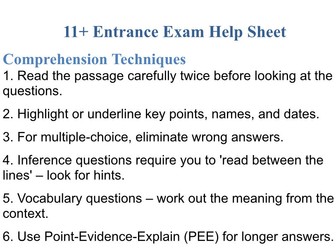
11+ Help Sheets
A bundle of help sheets that could be used at home or in the classroom. interview practice and some technique guidance.
Mixtures and Separations Year 5
Here are six powerpoints with worksheets for each powerpoint to consolidate learning and understanding
Philosophy KS2
A series of powerpoints to promote Philosophy teaching. The themes should engage the children. These are lessons 3 & 4:
Lesson 3 = is it ever ok to lie?
Lesson 4 = what makes you YOU?
Introduction to mixtures and separation
A powerpoint and worksheet to help give children an introduction to mixtures and separation.
Solution and solubility
A powerpoint to show a different understanding of ‘mixtures and separation’
Mainly for KS2
James Lind. Who he was and what he did?
Here is a powerpoint about James Lind. It details:
What James Lind did?
What he found out?
How it affected what we know today?
You can animate yourself and add you own appropriate pictures
KS2 Science Smoking and Vaping
A powerpoint based around ‘How does smoking or vaping affect your health?’ It goes through key information:
What are smoking and vaping?
What is in cigarettes or vape?
short term and long term affects on health
affects on others
Myths about vaping
Healthier choices
There is also a accompanying worksheet to check understanding of the lesson.
Key Stage 2 Column method for addition and subtraction
a simple yet effective powerpoint which looks at column addition and subtraction. it can be amended to suit level of children.
It has a mental starter, clear method explanation, examples for fluency and word problem application.
Maths essential knowledge for end of key stage 2
A powerpoint depicting the areas within the primary curriculum with the added layer of examples so teachers can use this a stepping stone towards helping their class understand specific areas.
It can also be used as a revision tool.
Multiplying and divinding by 10, 100 and 1000
Here is a worksheet based around dividing and multiplying by 10, 100 with the use of 1000 as a challenge. Can be used as a starter or as a morning activity or to support the main part of a lesson…it is up to you!
Philosophy KS2
Here are two powerpoints which can used in the classroom to support childrens development of Philosophy.
These are the first two in a series of 6 "lessons. They cover:
Powerpoint 1 = What is thought?
Powerpont 2 = Can something be true if nobody believes it?
Philosophy KS2
Here are two powerpoints to engage children in Philosophy. These are lessons 5 and 6 in a whole series of lessons. The lessons are about:
Lesson 5 = Is the world real or just in your head?
Lesson 6 = What does it mean to be fair?
Bundle
 Quick View
Philosophy block of PowerPoints for KS2
In this bundle, there are six powerpoints that all address a different philosophical question.
Take the children on a path of opinion and discussion without judgement.
11+ sample interview questions
Please find a useful starter to get children use to what questions they may face in an interview for another school. These can be adapted as needed. They also come with tips for the pupil so they can get an idea of what their answer may need to contain.
This has helped my current year 6s become more open to conversation and confident.
Group scenarios for interviews
Please find a selection of group scenario’s that can be used as a mock group interview or they can be used as part of a classroom discussion.
Each scenario can be adapted to suit your cohort or the level of challenge you want to offer.