 Quick View
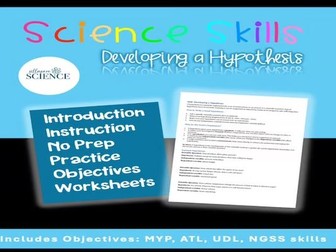
Developing a Hypothesis Scientific Method Skills
This student-friendly guide teaches how to correctly develop testable hypotheses for science experiments. It explains what makes a strong hypothesis, introduces the If…then… format, and highlights the importance of identifying independent and dependent variables. Students practice spotting weak or opinion-based hypotheses, correcting them, and writing their own using real-world scenarios.
Included in the resource are complete objective descriptions for MYP Criterion, ATL, UDL, NGSS, and standard objectives.
Resource Highlights:
· Clear instructions on how to:
o Ask scientific questions that can be tested
o Write hypotheses in the If…then… format
o Identify independent (cause) and dependent (effect) variables
o Recognize and correct vague or non-testable hypotheses
o Apply hypotheses to real-world examples
· Example hypotheses included:
o Fertilizer and plant growth
o Wheel size and toy car speed
· Practice worksheet:
o Part 1: Error identification in flawed hypotheses
o Part 2: Identify independent and dependent variables
o Part 3: Write your own hypotheses from given variables
o Part 4: Extended scenario practice with IV/DV identification
· Support tools:
o Student checklist for writing strong hypotheses
This resource builds essential science inquiry skills and prepares students for designing controlled experiments. It can be used as a class activity, independent practice, or formative assessment.