docx, 15.42 KB
docx, 15.42 KB
pptx, 1.77 MB
pptx, 1.77 MB

A complete lesson covering sections 4.1.2.1 (Chromosomes) and 4.1.2.2 (Mitosis) from the AQA Combined Science Trilogy specification, also appropriate for GCSE Biology classes.

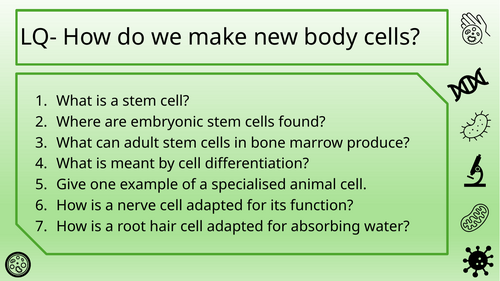
The lesson begins with a recall starter, revisiting key knowledge about prokaryotic and eukaryotic cells. Students then complete an exam‑style question to check their understanding of cell types and their structures before progressing into new content.

The main teaching section introduces the reasons for cell division, including growth, repair, and replacement. Students then explore the cell cycle, learning about interphase, DNA replication, and the stages of mitosis, supported by clear diagrams and explanations.

A set of quick‑check questions allows students to confirm their understanding of key terms such as chromosome, chromatid, and spindle fibres. Learners then complete a diagram activity, labelling and sequencing the stages of mitosis to reinforce the process visually.

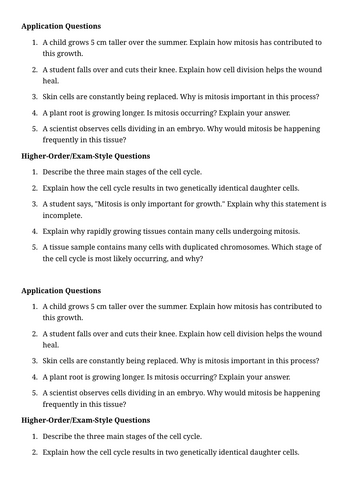
Students apply their knowledge through application questions, linking mitosis to real biological contexts such as tissue repair and growth. This is followed by an exam‑style data question, where students interpret information about cell division rates, developing skills in analysing scientific data.

The lesson concludes with a plenary, where students revisit the Learning Question and demonstrate how their understanding has developed.

All answers are provided to support marking, modelling, and self‑assessment.

Get this resource as part of a bundle and save up to 63%

A bundle is a package of resources grouped together to teach a particular topic, or a series of lessons, in one place.

Bundle

AQA Science cell structure and function

A complete bundle of lessons covering sections 4.1.1 and 4.1.2 of the AQA Combined Science Trilogy specification, focusing on cell structure, microscopy, specialised cells, stem cells, cell division, and mitosis. Each lesson begins with a recall starter, revisiting key ideas such as the differences between prokaryotic and eukaryotic cells, organelle functions, magnification calculations, and the stages of the cell cycle. Throughout the sequence, students complete a wide variety of activities designed to check, develop, and deepen understanding. Examples of included lesson activities: Microscopy practicals: preparing onion epidermis and cheek cell slides, identifying visible structures under the microscope, and practising magnification calculations with worked examples and unit conversions. Specialised cell analysis: identifying the function of sperm cells, nerve cells, root hair cells, and other examples from the specification, followed by a worksheet exploring how adaptations improve efficiency. Stem cell classification tasks: distinguishing embryonic, adult, and meristem stem cells, evaluating their uses, and completing extended‑response exam questions on ethical and medical considerations. Mitosis sequencing and diagram work: labelling and ordering the stages of mitosis, interpreting data on cell division rates, and applying knowledge to biological contexts such as growth and tissue repair. Across the bundle, students tackle a variety of exam‑style questions, including calculation practice, data‑interpretation tasks, extended writing, and specification‑aligned application questions. Every lesson concludes with a plenary revisiting the Learning Question to consolidate progress and reinforce key concepts. All answers are provided

£4.50

Reviews

Something went wrong, please try again later.

This resource hasn't been reviewed yet

To ensure quality for our reviews, only customers who have purchased this resource can review it

Report this resourceto let us know if it violates our terms and conditions.
Our customer service team will review your report and will be in touch.