zip, 5.4 MB
zip, 5.4 MB
pdf, 113.63 KB
pdf, 113.63 KB
png, 432.92 KB
png, 432.92 KB
png, 244.42 KB
png, 244.42 KB
png, 608.4 KB
png, 608.4 KB
png, 268.16 KB
png, 268.16 KB

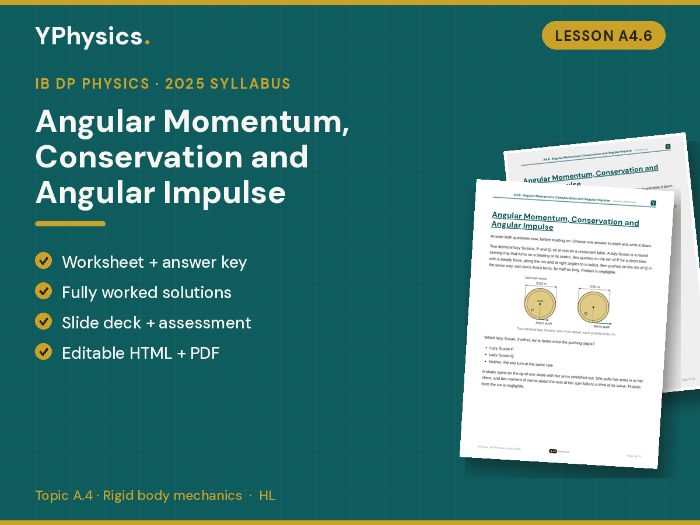
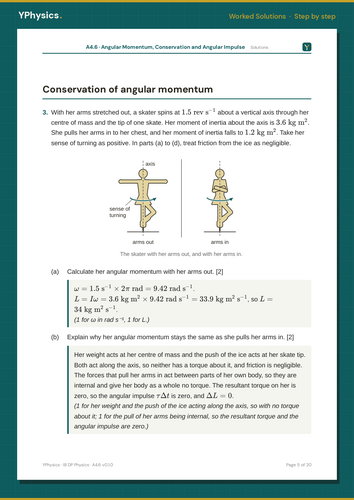
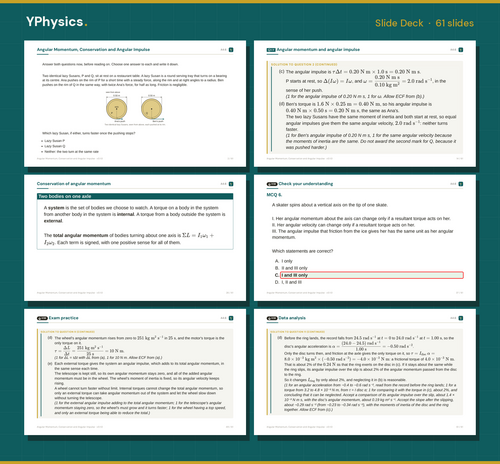
IB DP Physics lesson pack on angular momentum, its conservation and angular impulse, Topic A.4 Rigid body mechanics, HL only, first assessment 2025. The class builds L = Iω from p = mv, then uses angular impulse and conservation to predict how a spinning body, or two bodies on one axle, will turn. Editable worksheet, 61-slide lesson deck, teacher key, worked solutions and a questions-only assessment, supplied as self-contained HTML plus colour and black-and-white PDF.

What students learn

  • L = Iω, built from p = mv, with a sign for the sense of turning and its SI unit.
  • Angular impulse, ΔL = τΔt, to find a change in angular momentum, an angular velocity or a torque.
  • When angular momentum stays constant, for one body or for two that pass it between them.
  • The new angular velocity when a body’s moment of inertia changes, or once two bodies turn together.
  • Why τ = Iα needs a constant moment of inertia, and ΔL = τΔt does not.

IB skills (Tool 3: Mathematics):

  • Select and manipulate equations (practised).
  • Understand direct and inverse proportionality (practised).
  • Interpret features of graphs (practised).
  • Appreciate when some effects can be neglected (practised).

What’s included:

  • Student Worksheet - 21 pages
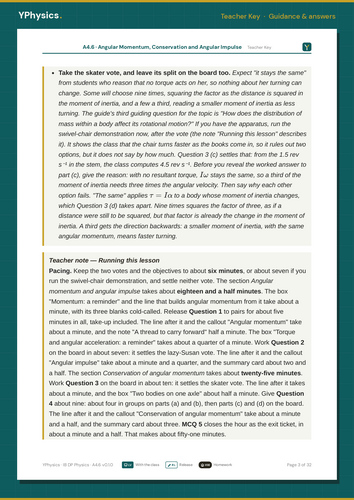
  • Teacher Key - 32 pages
  • Worked Solutions - 20 pages
  • Assessment - 15 pages
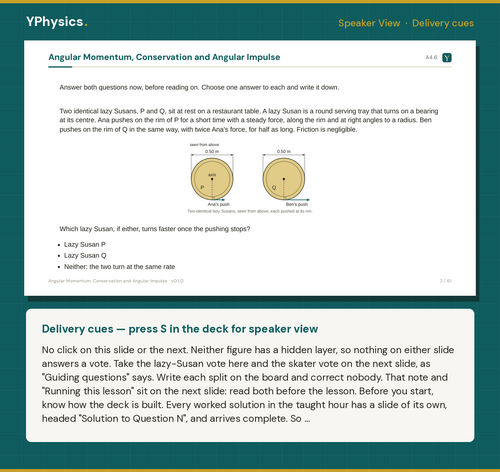
  • Lesson deck - 61 slides

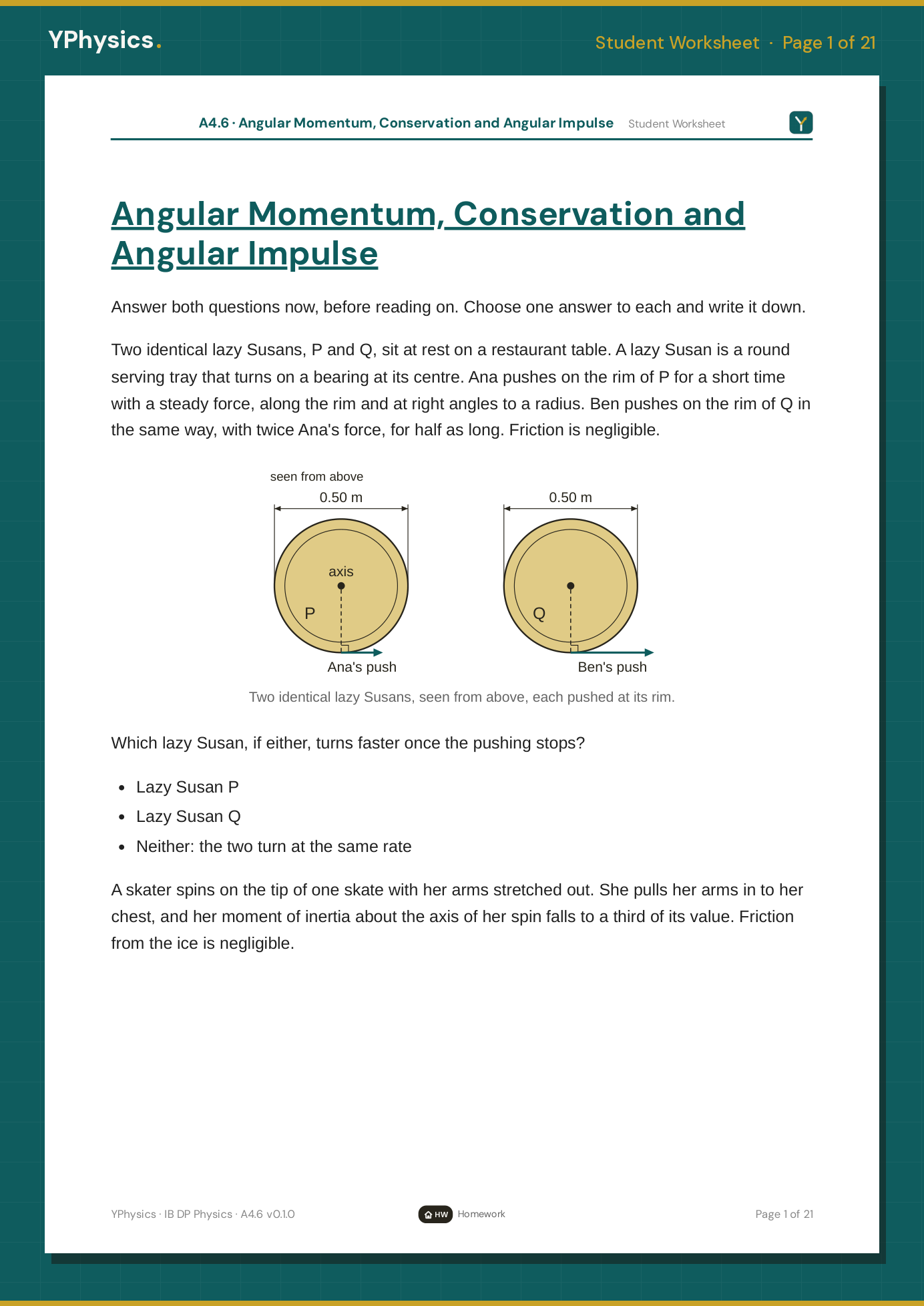
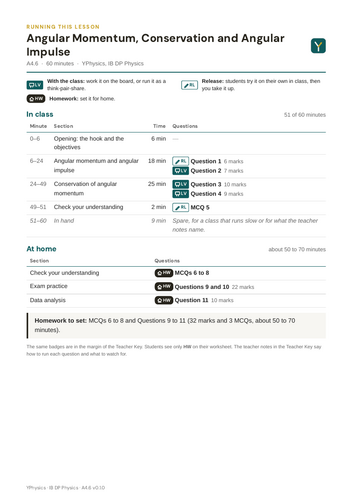
Seven structured questions and four multiple-choice items: 64 marks across 30 parts, and eight figures. It opens on two votes, about two lazy Susans pushed in different ways and a skater pulling her arms in, which Questions 2 and 3 settle. The class works four questions, 32 marks, in the lesson, then a multiple-choice exit ticket. The rest goes home, including two exam-style questions and a ten-mark data question in the Paper 1B pattern: a ring dropped onto a turning disc, with a printed sensor record of ω against t to read and no graph to draw.

It is the sixth lesson of the topic. Angular momentum has no vector treatment, as the guide allows. The kinetic energy of rotation comes later in the topic. Moment of inertia and τ = Iα are used, not retaught. SI units, IB notation and IB command terms throughout. Suitable for grades 11-12 (ages 16-19) as a lesson, cover lesson, homework or revision.

Part of the A.4 Rigid Body Mechanics Complete Unit Bundle, 30% off buying the packs separately.

Related resources:

A rating helps other teachers find this.

Get this resource as part of a bundle and save up to 30%

A bundle is a package of resources grouped together to teach a particular topic, or a series of lessons, in one place.

Bundle

IB DP Physics (2025) A4 Rigid Body Mechanics Bundle

The complete Topic A.4 Rigid body mechanics unit for IB DP Physics, HL, first assessment 2025: seven lesson packs, a video-analysis practical, the HL topic test and a maths skill pack, 30% off buying them separately. **What's in the unit** - Seven lesson packs in teaching order: Torque and Rotational Equilibrium; Unbalanced Torque and Angular Kinematics; Angular suvat; Moment of Inertia; Newton's Second Law for Rotation, τ = Iα; Angular Momentum, Conservation and Angular Impulse; and Rotational Energy and Rolling. - A practical, Moment of Inertia from Rolling Motion: a steel cylinder rolls down a board at five angles, filmed on a phone and timed frame by frame, as a full pack with its own deck. - The Topic A.4 test at HL: Paper 1 (50 minutes) and Paper 2 (45 minutes), 25 marks each, with AO-tagged mark schemes. - A maths skill pack: Trigonometry, Radians, Powers and Roots, with 37 answered questions. Together the seven lessons cover all 12 understandings of Topic A.4, from torque and rotational equilibrium to angular kinematics, moment of inertia, Newton's second law for rotation, angular momentum and its conservation, angular impulse and the kinetic energy of rotation, rolling without slipping included. The topic test assesses all 12. **Every lesson pack includes:** - An editable student worksheet - A teacher key with every answer and marking point - Worked solutions with every step and its units - A questions-only assessment with IB mark allocations - A choreographed lesson deck with staged reveals Across the seven: 150 student worksheet pages, 241 teacher key pages and 437 slides. **IB skills (mostly Tool 3: Mathematics):** resolving vectors; exponents, powers, roots and trigonometric ratios; selecting, manipulating and deriving equations; proportionality; free-body diagrams; graph features, best-fit lines, linearizing, extrapolation and sketching; propagated uncertainties, uncertainty bars and maximum and minimum gradients; and, from Tools 1 and 2 and Inquiry 1, 2 and 3, measuring an angle, video analysis of motion, predictions and variables, collecting and processing quantitative data, random and systematic errors, and weaknesses and improvements. Everything ships as self-contained HTML that opens in any browser with nothing to install, every worksheet editable, plus colour and black-and-white PDF of every document. The test's grade boundaries are set by YPhysics, not the IB, and you can edit them. SI units, IB notation and IB command terms throughout. Suitable for grades 11-12 (ages 16-19) for first teaching, assessment and revision. **Also in the catalogue, sold separately:** - [A.3 Work, Energy and Power Complete Unit Bundle, the topic before this one](https://www.tes.com/teaching-resource/resource-13660475) - [Foundations of Motion: Distance and Displacement, a whole lesson pack in this format, free](https://www.tes.com/teaching-resource/-13516114) *A rating helps other teachers find this.*

£58.80

Reviews

Something went wrong, please try again later.

This resource hasn't been reviewed yet

To ensure quality for our reviews, only customers who have purchased this resource can review it

Report this resourceto let us know if it violates our terms and conditions.
Our customer service team will review your report and will be in touch.