


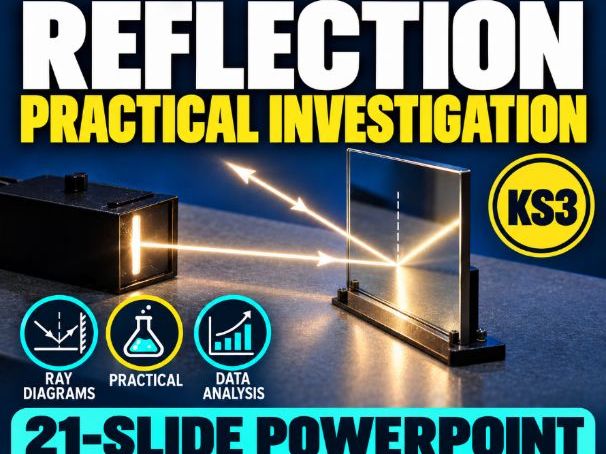
KS3 Reflection lesson for high-ability learners: editable PowerPoint with a ray-box practical, ray diagrams, data analysis and challenge tasks.
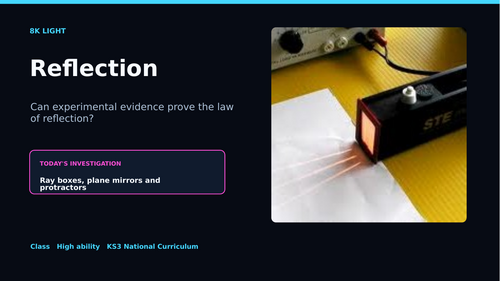
Challenge students to investigate the law of reflection and judge how closely their experimental evidence supports angle of incidence = angle of reflection.
Designed for higher-attaining KS3 learners, this 21-slide PowerPoint combines explanations and retrieval practice with a structured practical investigation. Suitable for a Year 8 Light topic, including use alongside Exploring Science 8K.
What’s included?
- Five-question retrieval starter with answers, revisiting light, ray diagrams and the normal.
- Labelled reflection ray diagrams explaining incident and reflected rays, the normal and the point of incidence.
- The law of reflection, including questions that address the common mistake of measuring angles from the mirror surface.
- Regular and diffuse reflection, explaining why rough surfaces scatter light.
- Mini-whiteboard hinge questions with answers to check understanding before the practical.
- Ray-box investigation with a hypothesis, variables, step-by-step method, safety guidance and precision checklist.
- Results table for testing incidence angles of 15°, 30°, 45° and 60°, with three repeat readings at each angle.
- A 20-minute practical structure with partner roles and progress checkpoints.
- Data analysis and graph guidance, including calculating means, comparing incidence and reflection angles, and interpreting the range of repeat readings.
- Evaluation prompts linking sources of uncertainty to their effects and specific improvements.
- Optional blind-corner mirror challenge, suitable for extension or homework.
- Five-question exit ticket with answers.
Challenge for higher-attaining learners
Students move beyond recalling the law of reflection to assessing the evidence for it. They consider measurement uncertainty, identify results that need repeating and compare their graph with the ideal relationship y = x, including its gradient and intercept.
The lesson develops Working Scientifically skills through accurate measurement, repeat readings, graphical analysis and evidence-based conclusions.
Format and equipment
Supplied as one editable PowerPoint presentation, with tasks, practical instructions and a results-table template included within the slides.
Practical equipment required: ray boxes with a narrow slit and suitable power supplies, plane mirrors, protractors, rulers, pencils and paper.
Something went wrong, please try again later.
This resource hasn't been reviewed yet
To ensure quality for our reviews, only customers who have purchased this resource can review it
Report this resourceto let us know if it violates our terms and conditions.
Our customer service team will review your report and will be in touch.
£2.50