


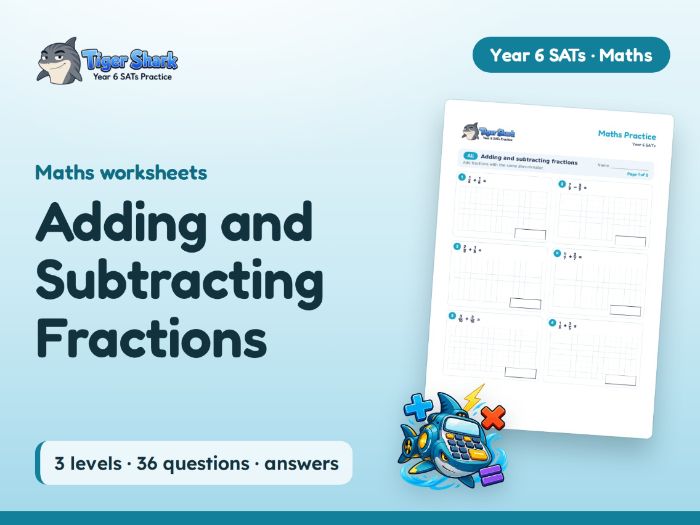
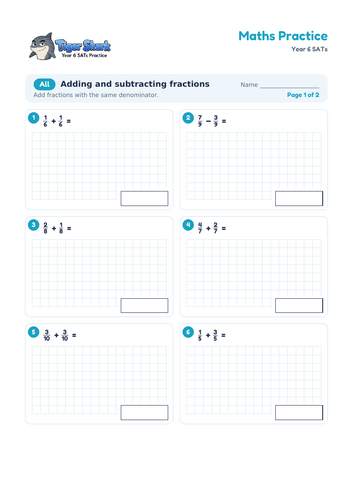
Year 6 SATs maths worksheets on adding and subtracting fractions: 36 questions in three levels (All, Most, Some), with working space and answers. Free PDF.
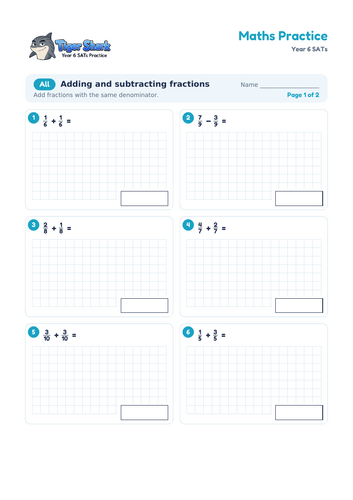
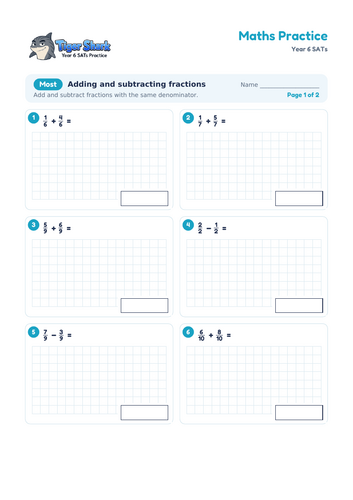
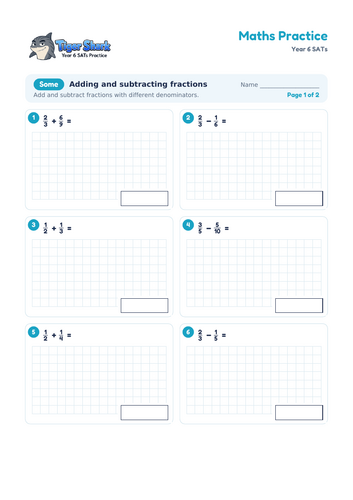
7-page A4 PDF from the Tiger Shark Education question bank. All: Add fractions with the same denominator. Most: Add and subtract fractions with the same denominator. Some: Add and subtract fractions with different denominators. Each level is two pages of six questions, each with a squared working area, and the last page has every answer, with short working for multi-step questions. Each level is also available as its own 3-page PDF. Example questions from the Some level: 2/3 + 6/9 = / 2/3 − 1/6 =.
What is adding and subtracting fractions? When fractions have the same denominator, add or subtract the numerators. When they have different denominators, first convert them to equivalent fractions with a common denominator. Year 6 pupils add and subtract fractions with different denominators and mixed numbers.
Common mistakes and tips: The most common error is adding both numerators and denominators (½ + ⅓ = 2/5). Fraction walls show quickly why this cannot be right. With mixed numbers, children often forget to deal with the whole numbers or struggle when subtracting requires exchanging a whole. Converting to improper fractions first is a reliable approach.
This topic is part of the Year 6 National Curriculum for maths, and it regularly appears on the KS2 SATs papers. The All, Most and Some levels let you check basic fluency first and then move on to the multi-step, contextual questions found on the reasoning papers.
How teachers use these sheets: as a lesson’s independent task, as a starter to revisit a topic from earlier in the year, or as a revision pack in the weeks before the SATs. Children can mark their own work with the answer page, then explain one mistake to a partner to deepen understanding.
Reasoning and explanation: once children can answer the questions, ask them to explain their method to a partner or write a short explanation of one answer. The SATs reasoning papers include ‘explain how you know’ questions, and talking about methods deepens understanding far more than repeating calculations.
Use All for children working towards the expected standard, Most for secure Year 5 skills and Some for SATs-standard practice: three entry points to the same lesson. Suits whole-class differentiation, intervention groups, homework and SATs revision, and upper KS2 generally.
Part of a set of 42 Year 6 maths topics.
Something went wrong, please try again later.
This resource hasn't been reviewed yet
To ensure quality for our reviews, only customers who have downloaded this resource can review it
Report this resourceto let us know if it violates our terms and conditions.
Our customer service team will review your report and will be in touch.
£0.00