


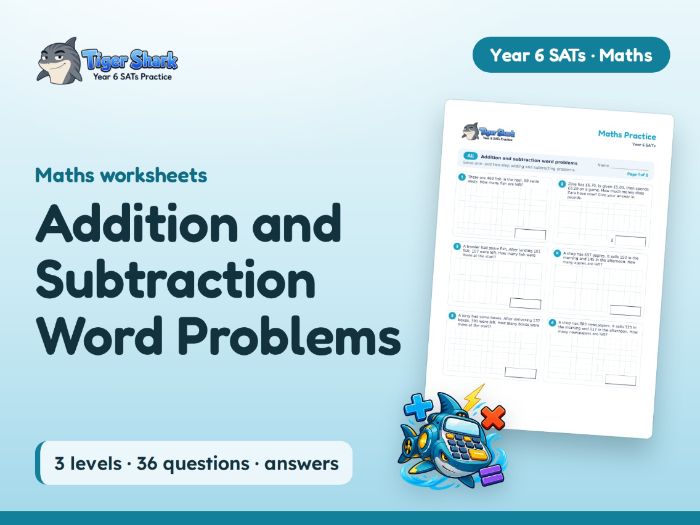
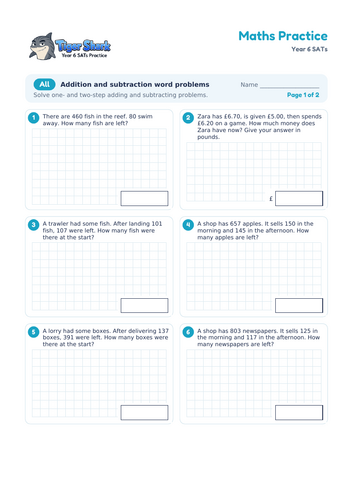
Year 6 maths worksheets on addition and subtraction word problems: 36 questions in three levels (All, Most, Some) with answers. Free PDF.
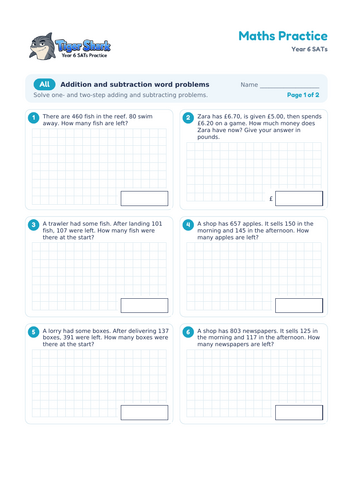
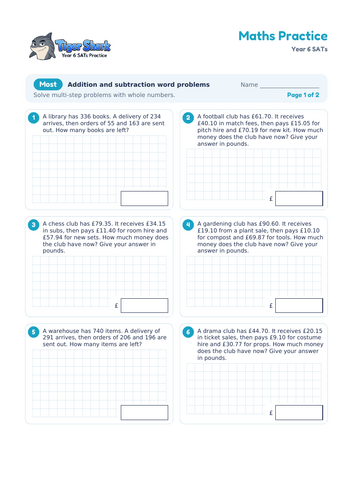
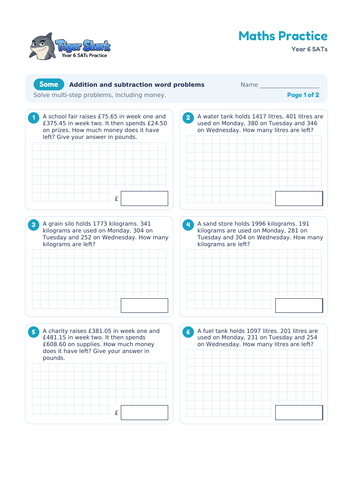
7-page A4 PDF from the Tiger Shark Education question bank. All: Solve one- and two-step adding and subtracting problems. Most: Solve multi-step problems with whole numbers. Some: Solve multi-step problems, including money. Each level is two pages of six questions, each with a squared working area, and the last page has every answer, with short working for multi-step questions. Each level is also available as its own 3-page PDF. Example questions from the Some level: A school fair raises £75.65 in week one and £375.45 in week two. It then spends £24.50 on prizes. How much money does it have left? Give your answer in pounds / A water tank holds 1417 litres. 401 litres are used on Monday, 380 on Tuesday and 346 on Wednesday. How many litres are left?
What are addition and subtraction word problems? These are real-life problems where children must decide which operation to use, and in what order, before calculating. Year 6 problems are often multi-step, involve large numbers or money, and include information that has to be selected carefully. Bar models are a powerful way to represent the structure of the problem.
Common mistakes and tips: The most common error is choosing the wrong operation, often by reacting to a keyword such as ‘more’ without reading the whole question. Others answer only the first step of a two-step problem. Encourage children to draw a bar model, estimate first, and reread the question to check that their answer actually responds to what was asked.
In the KS2 SATs, this topic can appear on the arithmetic paper, on the two reasoning papers, or both. Reasoning questions often wrap the skill in a context or ask children to explain an answer, so the three levels on this sheet build from fluency to the kind of problem pupils meet in the test.
Ways to use it: whole-class differentiation (three levels for the same lesson), focused intervention for children working towards the expected standard, homework, or targeted revision before the SATs. Set one level as a quick assessment and use the answers to decide who needs another lesson on the topic.
Building fluency over time: revisiting this topic little and often throughout the year, rather than only in one unit, helps children retain it for the SATs. A few questions from the All or Most level make a good retrieval starter several weeks after the topic was first taught.
Use All for children working towards the expected standard, Most for secure Year 5 skills and Some for SATs-standard practice: three entry points to the same lesson. Suits whole-class differentiation, intervention groups, homework and SATs revision, and upper KS2 generally.
Part of a set of 42 Year 6 maths topics.
Something went wrong, please try again later.
This resource hasn't been reviewed yet
To ensure quality for our reviews, only customers who have downloaded this resource can review it
Report this resourceto let us know if it violates our terms and conditions.
Our customer service team will review your report and will be in touch.
£0.00