



WORKBOOK
The Ancient Sumer Curriculum Workbook is a comprehensive educational resource designed to introduce students to the world’s first civilization in an engaging and accessible way. The workbook contains short, informative articles accompanied by thought-provoking questions to encourage critical thinking and deepen understanding. Students explore a wide range of topics, including an overview of Sumer, its geography, government, culture, daily life, religion, social classes, and economic systems such as trade, commerce, and agriculture.
The workbook also examines technological and scientific innovations, from the invention of irrigation canals and the wheel to the development of pictographs and cuneiform writing. Students learn about the growth of cities, such as Eridu, Uruk, and Ur, monumental architecture, royal tombs, and city walls. Key historical events and figures are highlighted, including Gilgamesh, Lugalzagesi, Sargon of Akkad, and Enheduanna. The workbook also covers military conflicts like the Umma-Lagash War, the rise of kingship, and the formation of the Akkadian Empire.
Cultural achievements, including literature, arts, clothing, and the roles of men and women, are explored to give students a well-rounded view of Sumerian society. With questions accompanying each article, the workbook encourages students to think critically about how early innovations, leadership, and culture shaped not only Sumer but the foundations of human civilization.
Assignments Included:
Overview
Geography
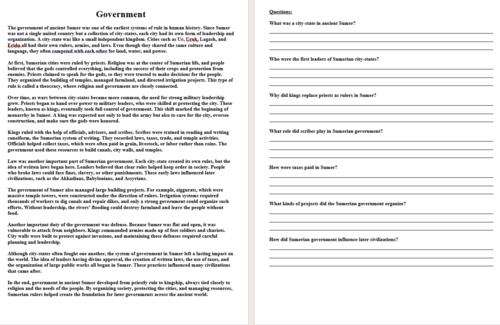
Government
Culture
Daily Life
Religion
Social Classes
Food & Agriculture
Education
Arts & Entertainment
Clothing
Technology & Science
Trade & Commerce
Military & Warfare
Literature
Men’s Roles
Women’s Roles
First Farming Settlements
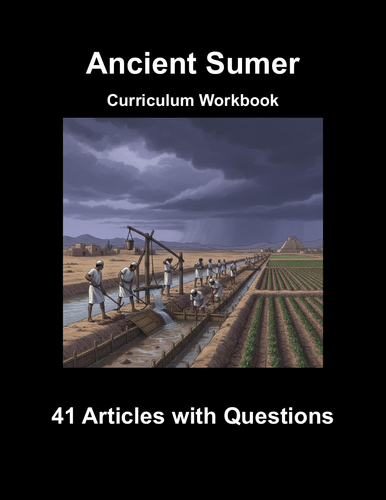
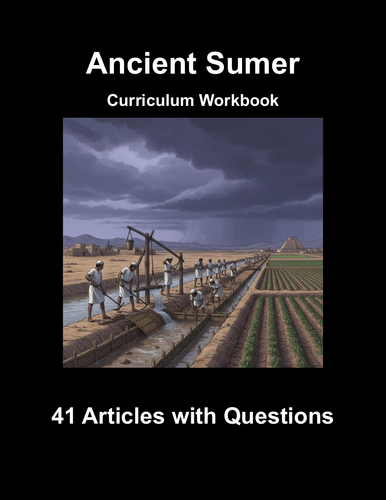
Invention of Irrigation Canals (c. 5000 BCE)
Founding of Eridu (c. 5400 BCE)
Early Temples in Eridu (c. 5000–4500 BCE)
Founding of Uruk (c. 4000 BCE)
Invention of the Wheel (c. 3500 BCE)
Invention of Pictographs (c. 3400 BCE)
Standardization of Cuneiform (c. 3200 BCE)
Uruk World’s Largest City (c. 3100 BCE)
First Known King Lists Appear (c. 2900 BCE)
Gilgamesh Becomes King of Uruk (c. 2700 BCE)
Building of Massive Walls of Uruk (c. 2700 BCE)
Development of Cylinder Seals (c. 2600 BCE)
Royal Tombs of Ur (c. 2600 BCE)
Sumerian City-States Emerge (c. 2600–2500 BCE)
The Rise of Kingship
Umma and Lagash War (c. 2450 BCE)
Stele of the Vultures (c. 2450 BCE)
Lugalzagesi of Umma (c. 2350 BCE)
Sargon of Akkad Rises to Power (c. 2334 BCE)
Enheduanna (c. 2300 BCE)
Sargon’s Conquest of Uruk and Ur (c. 2334 BCE)
Formation of the Akkadian Empire (c. 2334 BCE)
Legacy of Ancient Sumer
Something went wrong, please try again later.
This resource hasn't been reviewed yet
To ensure quality for our reviews, only customers who have purchased this resource can review it
Report this resourceto let us know if it violates our terms and conditions.
Our customer service team will review your report and will be in touch.
$24.99