

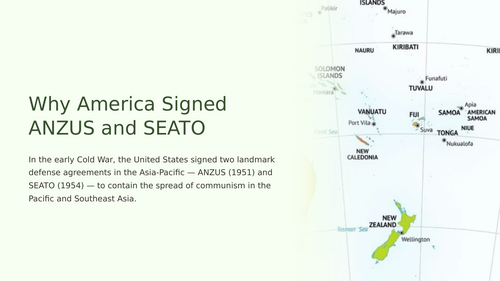

Looking for a clear and engaging way to help students understand Cold War alliances in the Asia-Pacific? This ready-to-use presentation explores the ANZUS Treaty and the SEATO agreement, helping students examine how fear of communism shaped international relationships during the Cold War.
Through this structured and informative slideshow, students investigate why the United States and its allies created regional defence agreements after the Korean War and the rise of communist China, and evaluate why these alliances had mixed success over time.
What’s Included
- 15-slide PowerPoint / Google Slides presentation
- Clear explanations of the ANZUS Treaty
- Overview of the SEATO alliance
- Background on the Cold War in the Asia-Pacific
- Discussion of the Korean War and the spread of communism
- Analysis of the goals and structure of each alliance
- Examination of member nations and their roles
- Slides explaining why these alliances were formed
- Evaluation of successes, challenges, and long-term outcomes
- Key historical concepts presented in a student-friendly format
Benefits for Teachers
- Ready-to-use lesson resource that saves planning time
- Clearly structured content that guides students through complex Cold War alliances
- Ideal for whole-class instruction, guided discussion, or note-taking activities
- Easily adaptable for PowerPoint or Google Slides
Benefits for Students
- Builds understanding of Cold War geopolitics in the Asia-Pacific
- Helps students connect events like the Korean War to broader international strategies
- Encourages critical thinking about why alliances succeed or fail
- Supports development of historical analysis and evaluation skills
Curriculum Fit
This resource is ideal for units covering:
- The Cold War
- Containment and the spread of communism
- US foreign policy in the Asia-Pacific
- Post–World War II international relations
- Australia and global alliances
Suitable for middle and high school history or social studies courses studying the Cold War era.
Something went wrong, please try again later.
This resource hasn't been reviewed yet
To ensure quality for our reviews, only customers who have purchased this resource can review it
Report this resourceto let us know if it violates our terms and conditions.
Our customer service team will review your report and will be in touch.
£1.00