


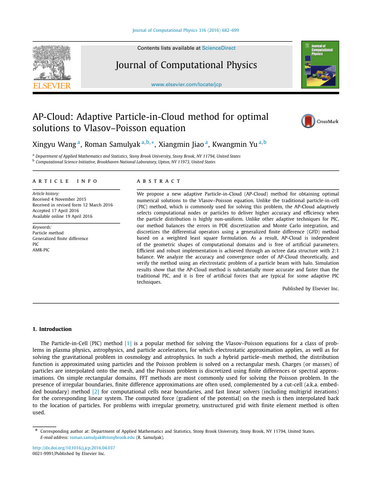
The Particle-in-Cell (PIC) method [1] is a popular method for solving the Vlasov–Poisson equations for a class of problems in plasma physics, astrophysics, and particle accelerators, for which electrostatic approximation applies, as well as for solving the gravitational problem in cosmology and astrophysics. In such a hybrid particle–mesh method, the distribution function is approximated using particles and the Poisson problem is solved on a rectangular mesh. Charges (or masses) of particles are interpolated onto the mesh, and the Poisson problem is discretized using finite differences or spectral approximations. On simple rectangular domains, FFT methods are most commonly used for solving the Poisson problem. In the presence of irregular boundaries, finite difference approximations are often used, complemented by a cut-cell (a.k.a. embedded boundary) method [2] for computational cells near boundaries, and fast linear solvers (including multigrid iterations) for the corresponding linear system. The computed force (gradient of the potential) on the mesh is then interpolated back to the location of particles. For problems with irregular geometry, unstructured grid with finite element method is often used.
Something went wrong, please try again later.
This resource hasn't been reviewed yet
To ensure quality for our reviews, only customers who have purchased this resource can review it
Report this resourceto let us know if it violates our terms and conditions.
Our customer service team will review your report and will be in touch.
£5.00