


Lesson Snapshot
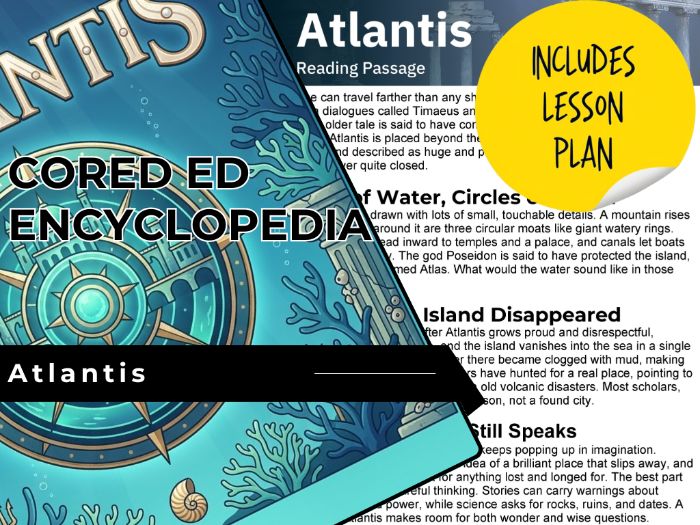
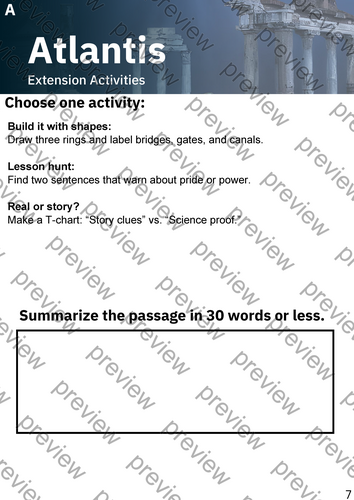
• Title: Atlantis
• Genre: Nonfiction (informational passage about a myth/story’s origins and meaning)
• Subject: Reading (Informational Text) / Social Studies (Myths & ancient world references)
• Primary Topic: Atlantis in writing, details, and “lesson” meaning
• Estimated Guided Reading Level (A–Z): T
What This Lesson Teaches Best
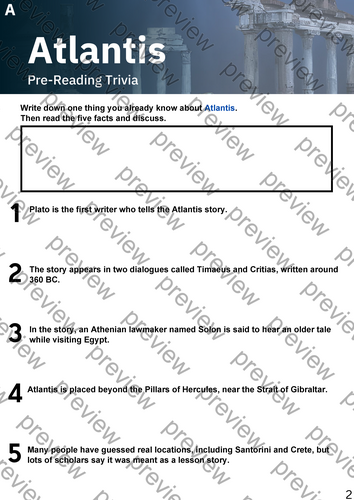
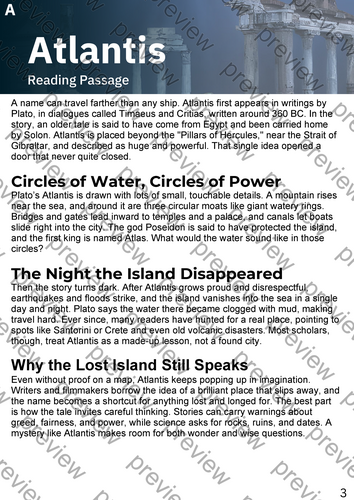
• Identifying where an idea “first appears in writings” and tracking its source (the passage names Plato and two dialogues).
• Visualizing and describing setting details from informational text (rings of water, bridges, gates, canals, temples, palace).
• Cause/effect in a legend: how pride and disrespect lead to destruction (earthquakes, floods, island vanishes; travel becomes hard).
• Distinguishing story-meaning vs scientific proof: stories can warn; science looks for “rocks, ruins, and dates.”
• Understanding how a name becomes a symbol for “anything lost and longed for” and why mysteries keep people thinking.
Learning Goals
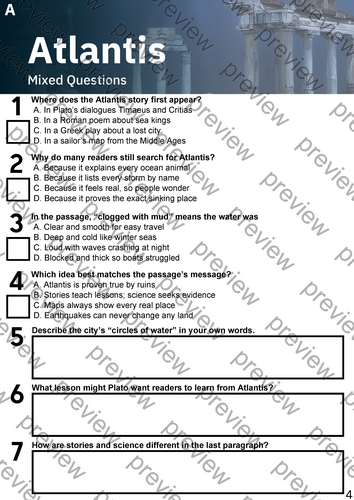
• Students will identify where the Atlantis story first appears and name the two dialogues the passage lists.
• Students will describe Atlantis’s “circles of water” using details from the passage (moats, bridges, gates, canals).
• Students will explain what events cause the island to vanish and how the water changes afterward.
• Students will summarize why people keep hunting for a real location and what “most scholars” think instead.
• Students will compare what the passage says stories do versus what science asks for.
• Students will explain how the passage describes Atlantis as a “shortcut” for things that are lost.
Key Vocabulary From the Text
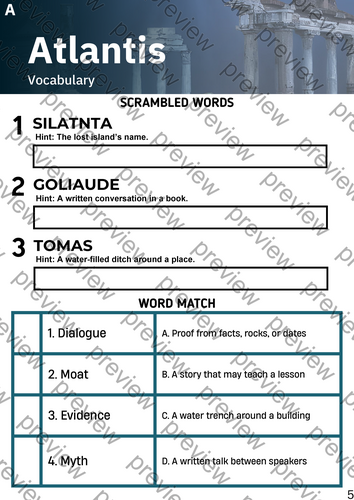
• dialogues — written conversations between speakers.
• moats — water ditches around a place.
• canals — water paths that boats can travel on.
• clogged — blocked so movement becomes difficult.
• scholars — people who study a topic deeply.
Something went wrong, please try again later.
This resource hasn't been reviewed yet
To ensure quality for our reviews, only customers who have purchased this resource can review it
Report this resourceto let us know if it violates our terms and conditions.
Our customer service team will review your report and will be in touch.
£1.25