

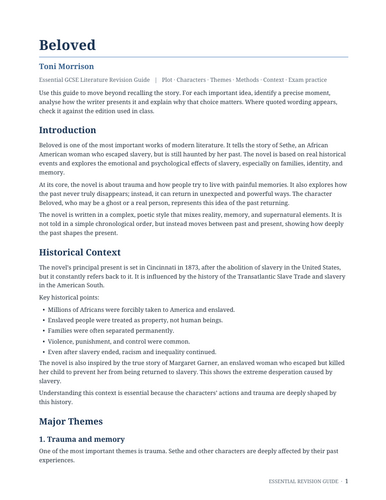

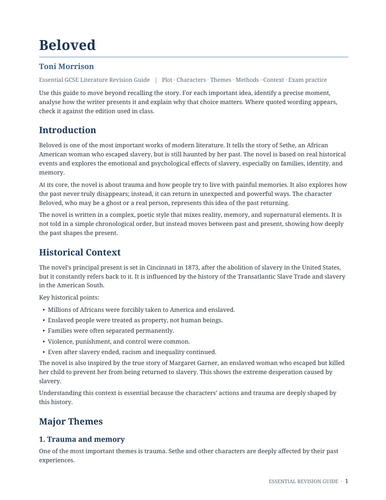
Beloved – Toni Morrison – Essential GCSE Literature Revision Guide
A concise but substantial revision resource covering the plot, characters, themes, historical context, narrative methods and analytical writing needed for effective study of Beloved. It focuses particularly on trauma, memory and the lasting effects of slavery, showing how Morrison blends realism, fragmented chronology and supernatural elements to explore the difficulty of living with a past that refuses to disappear.
Key features:
- Clear introduction to the novel’s historical context, including slavery in the United States, the treatment of enslaved people as property, family separation, violence and the continuing effects of racism after abolition
- Exploration of the Margaret Garner case as an important historical influence on Sethe’s story and the novel’s examination of motherhood under impossible conditions
- Detailed coverage of major themes including trauma and memory, the supernatural, motherhood and love, identity and selfhood, guilt and forgiveness, and community and isolation
- Character analysis of Sethe, Beloved, Denver, Paul D and Baby Suggs, with emphasis on trauma, survival, emotional repression, independence and the possibility of healing
- Focused symbolism and motif work on 124, the tobacco tin, the chokecherry tree and water, linking physical objects and spaces to memory, repression, slavery and transformation
- Analysis of Morrison’s methods including non-linear chronology, shifts between past and present, multiple perspectives, stream-of-consciousness, fragmented storytelling, poetic language and deliberate ambiguity
- A concise quotation and evidence section supported by interpretive lenses on haunting as historical memory, the moral pressure of motherhood and the role of community in creating the possibility of change
- GCSE-style exam practice with model analytical paragraphs, a worked essay plan, retrieval questions with answers, a final revision checklist and higher-level critical vocabulary for building sustained literary arguments
Something went wrong, please try again later.
This resource hasn't been reviewed yet
To ensure quality for our reviews, only customers who have purchased this resource can review it
Report this resourceto let us know if it violates our terms and conditions.
Our customer service team will review your report and will be in touch.
£1.50