


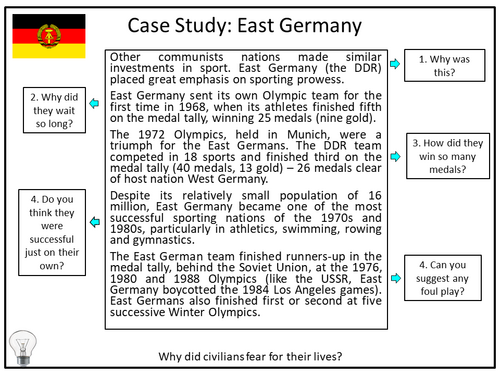
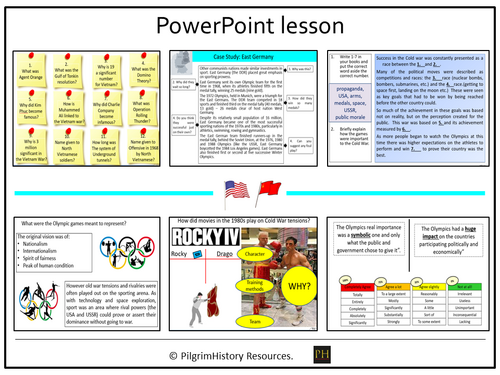
Why did sporting competitions become so important during the Cold War, and what did Olympic success reveal about the rivalry between the United States and the Soviet Union?
This lesson explores how sport became another front in the Cold War. Alongside the arms race, technological competition and the Space Race, sporting success provided an opportunity for both superpowers to demonstrate the supposed superiority of their political systems, gain international prestige and project power without direct military confrontation.
Students begin with a recall, retention and retrieval activity based on the previous lesson on the Vietnam War before testing their understanding through an interactive true-or-false quiz.
They then analyse Olympic medal tally statistics from different Games, identifying patterns and anomalies before reaching conclusions about what these results might reveal about Cold War competition and national priorities.
Students are introduced to the history of Olympic success and investigate why winning medals became such an important objective for governments on both sides of the Iron Curtain.
Through source-based and discussion activities, they consider how sporting achievements were used as propaganda tools and why international sporting events became symbolic contests between competing ideologies.
Throughout the lesson, students continue to revisit the wider enquiry question: Why did civilians fear for their lives during the Cold War? Using the ongoing light bulb activity, they annotate and develop their ideas, exploring how fear of failure, competition and international rivalry drove both nations to pursue success at almost any cost.
The lesson also examines the cultural impact of Cold War sport through the famous Rocky films. Students analyse how the rivalry between Rocky Balboa and Ivan Drago reflected wider Cold War attitudes and stereotypes, considering themes of determination, patriotism, propaganda and accusations of performance-enhancing drug use. They are then challenged to evaluate different interpretations and use persuasive language to defend their opinions in structured discussion and debate activities.
To conclude, students complete the highly engaging Blob Olympics activity, encouraging creativity, collaboration and deeper thinking as they make links between key concepts and themes explored throughout the lesson.
Included in this lesson:
Fully editable PowerPoint lesson
Recall, retention and retrieval starter activity
Investigation into sport as Cold War propaganda
Activities exploring Olympic success and national prestige
Structured discussion and debate activities
Persuasive argument and evaluation tasks
Suggested teaching strategies and lesson guidance
Fully differentiated throughout
Suitable for KS3 and GCSE History
Ready-to-teach with minimal preparation required
Please leave a review if you find this resource useful. Your feedback is greatly appreciated .
Something went wrong, please try again later.
Amazing resources as always. Informative and clear to follow with great lesson activities that stretch and engage students in equal measure. Amazing history lessons!
superb resources
useful thank you
Report this resourceto let us know if it violates our terms and conditions.
Our customer service team will review your report and will be in touch.
£0.00