


Complete GCSE Physics lesson on gas temperature and pressure, with PowerPoint, scaffolded worksheet, technician notes and assertive monitoring resources.
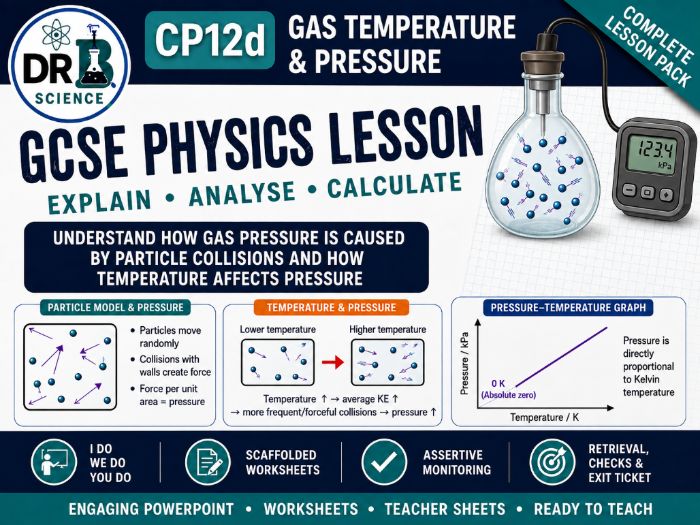
A ready-to-teach Dr B Science CP12d: Gas Temperature and Pressure lesson, designed for Pearson Edexcel GCSE Combined Science and easily adaptable for other GCSE specifications.
The lesson develops understanding of how particle collisions create gas pressure and how changing the temperature of a fixed volume of gas affects its pressure. It progresses from the particle model through Kelvin temperature, absolute zero and Celsius–Kelvin conversions to GCSE exam-style application.
The lesson follows a structured I Do → We Do → You Do approach, with explicit modelling, Show Me Boards, Cold Call, guided practice, independent application and assertive monitoring.
Covers:
- Particle motion and gas pressure
- Collisions with container walls and force
- Temperature, average kinetic energy and particle speed
- Pressure changes at fixed volume
- Celsius and Kelvin temperature scales
- Celsius ↔ Kelvin conversions
- Absolute zero and 0 K
- Direct proportionality with Kelvin temperature
- Pressure–temperature graphs
- GCSE explanations and calculations
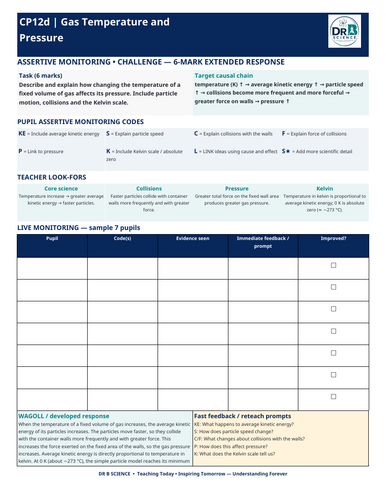
- 6-mark extended response
Included:
- Complete PowerPoint with detailed teacher/presenter notes
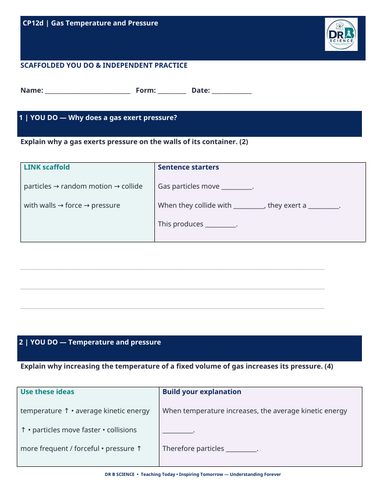
- 5-page scaffolded You Do and independent-practice worksheet with LINK chains, sentence starters and word banks
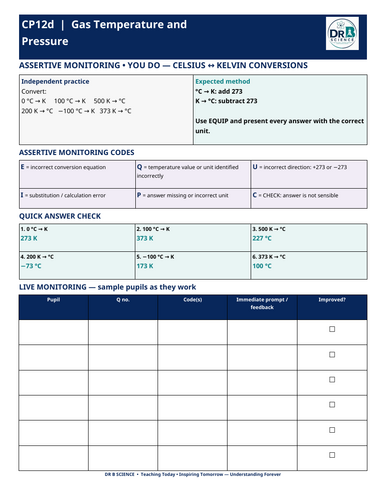
- EQUIP-supported Kelvin conversion practice
- Multiple GCSE exam-style questions
- 6-mark challenge with planning support
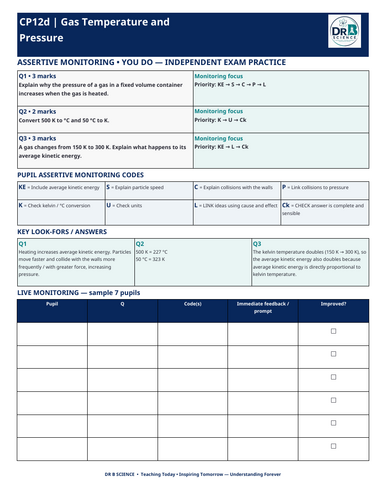
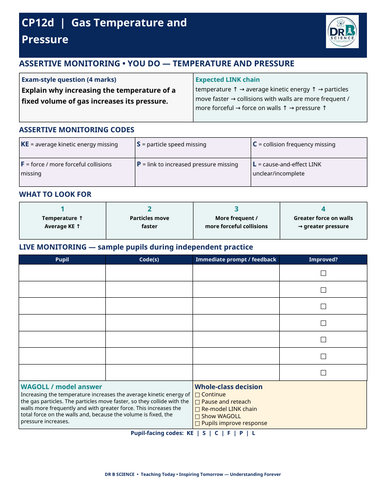
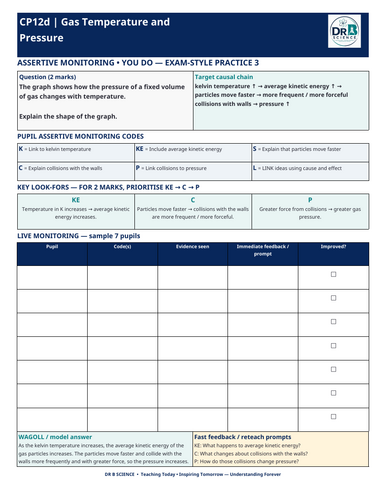
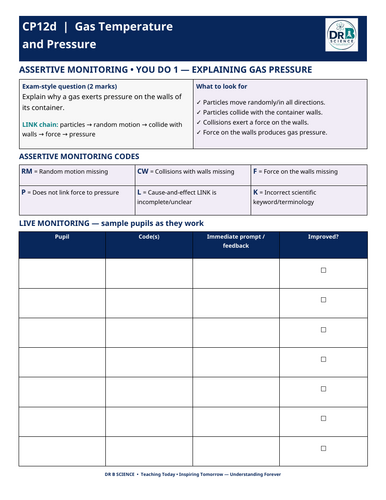
- Assertive monitoring teacher sheets for each key independent task
- Pupil-facing live-marking codes, WAGOLLs, teacher look-fors and feedback prompts
- Retrieval Do Now and explicit vocabulary teaching
- I Do modelling and We Do guided practice
- Show Me Board and Cold Call checks
- LINK cause-and-effect explanations
- Independent practice and green-pen review
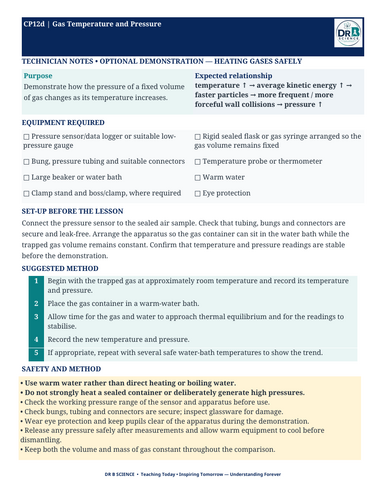
- Optional heating gases demonstration
- Technician notes with equipment, preparation, method and safety guidance
- Exit ticket linked to the key component knowledge
The scaffolded worksheet provides graduated support from explaining basic gas pressure through to Kelvin conversions, graph interpretation, independent exam questions and a final 6-mark response.
The assertive monitoring resources support rapid, precise feedback during independent practice, targeting common gaps in average kinetic energy, particle speed, collisions, force, pressure, Kelvin conversions and scientific cause-and-effect reasoning.
Ideal for Year 10/11 GCSE Combined Science, mixed-attainment classes, adaptive teaching, GCSE revision, lesson observations and teachers developing explicit instruction and checking for understanding.
Something went wrong, please try again later.
This resource hasn't been reviewed yet
To ensure quality for our reviews, only customers who have purchased this resource can review it
Report this resourceto let us know if it violates our terms and conditions.
Our customer service team will review your report and will be in touch.
£4.50