


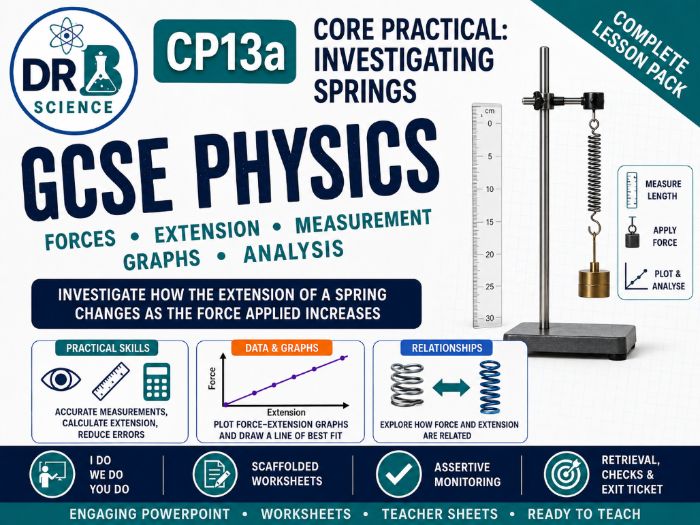

Complete GCSE Physics core practical on investigating springs, with PowerPoint, scaffolded worksheet, technician notes and assertive monitoring resources.
A ready-to-teach Dr B Science CP13a Core Practical: Investigating Springs lesson, designed for Pearson Edexcel GCSE Combined Science and easily adaptable for other GCSE specifications.
The lesson guides pupils through investigating how the extension of a spring changes as the applied force increases, with a strong focus on accurate measurement, practical technique, data handling and graph skills. Spring constant is deliberately reserved for the following lesson.
The lesson follows a structured I Do → We Do → You Do approach with explicit practical modelling, Show Me Boards, Cold Call, guided practice, independent investigation and assertive monitoring.
Covers:
- Measuring original and stretched spring length
- Calculating extension
- Force and extension relationships
- Accurate ruler readings and reducing parallax error
- Identifying anomalous results
- Recording results with appropriate units
- Converting extension between cm and m
- Plotting force–extension graphs
- Selecting appropriate graph scales
- Drawing a line of best fit
- Direct proportionality
- Practical safety and improving data quality
Included:
- Complete lesson PowerPoint with detailed presenter notes
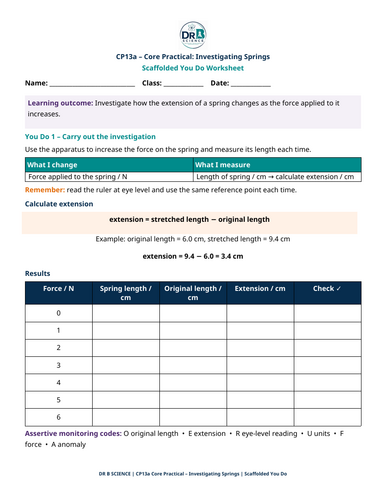
- 3-page scaffolded practical and graphing worksheet with results table and graph paper
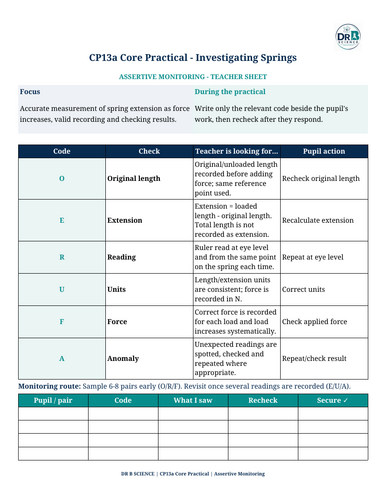
- Practical assertive monitoring teacher sheet targeting original length, extension, readings, units, force and anomalies
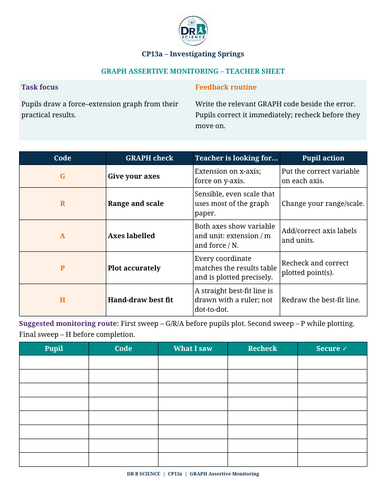
- Dedicated GRAPH assertive monitoring sheet for axes, scale, labels, accurate plotting and line of best fit
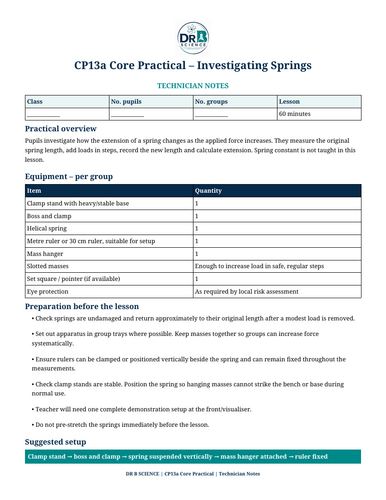
- Technician notes with equipment, preparation, setup, safety controls and practical guidance
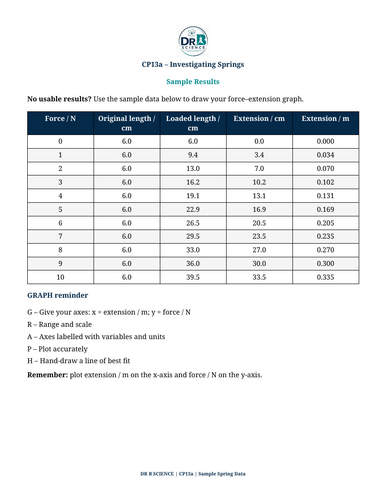
- Sample spring data for pupils who are unable to obtain a complete set of usable practical results
- Retrieval Do Now and explicit vocabulary teaching
- I Do practical demonstration and We Do calculations
- Show Me Board, Turn & Talk and Cold Call activities
- Pupil-facing assertive monitoring codes
- Practical checkpoint and quality-of-data checks
- Structured GRAPH routine for independent graph drawing
- Exit ticket linked directly to the key knowledge
The assertive monitoring resources support rapid feedback during both the practical investigation and graphing stages, targeting common errors such as confusing total length with extension, inaccurate ruler readings, incorrect units, reversed axes, unsuitable scales and dot-to-dot graphs.
Ideal for Year 10/11 GCSE Combined Science, required/core practical preparation, mixed-attainment classes, adaptive teaching, GCSE revision and lesson observations.
Something went wrong, please try again later.
This resource hasn't been reviewed yet
To ensure quality for our reviews, only customers who have purchased this resource can review it
Report this resourceto let us know if it violates our terms and conditions.
Our customer service team will review your report and will be in touch.
£4.50