


Easy Start to School — 10 Practical Activities for First Graders
School Adjustment • Communication • Independence • Emotions • Real School Situations
Starting school is about much more than letters, numbers, and new lessons.
Children also need to learn how to meet other children, join a game, decide what to do during recess, ask an adult for help, pack their school bag, start a conversation, and find a Plan B when the first plan doesn’t work.
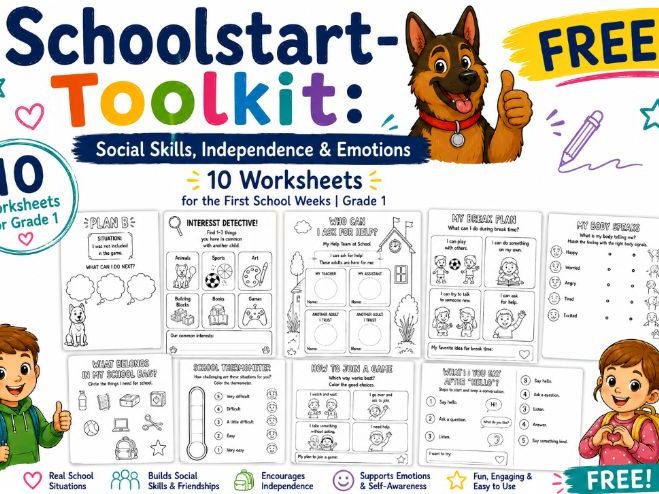
This set of 10 practical worksheets helps children prepare for the everyday situations they are likely to encounter at school.
Instead of abstract advice such as “be brave,” “make friends,” or “don’t worry,” children get a clear situation, a visual prompt, and a concrete action they can practice.
What’s Included- Plan B — what to do when I’m not included in a game
- Interest Detective — discover shared interests with another child
- My Help Team — identify trusted adults I can turn to at school
- My School Bag — figure out what I really need for school
- School Thermometer — rate how easy or challenging different school situations feel
- My School Map — learn important places and become more confident navigating school
- My Recess Plan — plan options for talking, playing, spending time independently, and asking for help
- My Body Speaks — notice emotions and body signals
- How to Join a Game — recognize helpful and unhelpful ways to join other children
- What Do I Say After “Hello”? — practice starting and keeping a conversation going step by step
Grade 1 • School Readiness • Back to School • First Weeks of School • School Adjustment • Social-Emotional Learning • Individual & Group Activities
The worksheets can be used in the classroom, during individual sessions, or at home with parents.
There is no need to complete everything at once. Teachers and parents can choose the worksheet that best matches the situation a child is currently facing.
The Main GoalThe goal is not simply to tell children how they should behave at school, but to give them an opportunity to see the situation, think about it, choose a response, and practice what they can do.
So when a real school situation happens, the child already has an answer to the question:
“What can I do now?”
Something went wrong, please try again later.
This resource hasn't been reviewed yet
To ensure quality for our reviews, only customers who have downloaded this resource can review it
Report this resourceto let us know if it violates our terms and conditions.
Our customer service team will review your report and will be in touch.
£0.00