


This PowerPoint resource provides an engaging and interactive lesson on understanding food webs, their construction, and their importance in representing feeding relationships within ecosystems. It is designed for middle school science classes and builds on foundational knowledge of food chains.
Key learning objectives:
- Defining food webs and explaining their importance in showing the complexity of feeding relationships.
- Constructing food webs by combining multiple food chains, including producers, primary consumers, secondary consumers, and tertiary consumers.
- Understanding why food webs give a more accurate representation of ecosystems than individual food chains.
- Exploring energy transfer and energy loss in ecosystems.
Resource features:
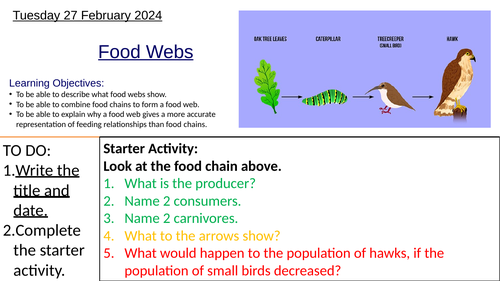
The lesson begins with a starter activity that revisits food chains. Students analyze a simple food chain to identify the producer, consumers, and carnivores, and predict the impact of population changes, such as a decrease in small birds on hawks.
Key topics include:
Food Chains vs. Food Webs:
A food chain shows a linear path of energy transfer, while food webs demonstrate interconnected feeding relationships.
Energy Loss:
Explains how energy is lost at each trophic level through movement, growth, and heat, using real-world examples like the Qatar food chain.
Constructing Food Webs:
Students combine multiple food chains into a food web, using producers as starting points and adding connections between consumers.
Interactive activities include:
- Drawing food webs based on provided organisms and scenarios.
- Answering questions to identify producers, primary consumers, secondary consumers, and top predators.
- Completing challenges like explaining energy loss along a food chain and analyzing which organism holds the most energy.
The plenary reinforces learning with review questions, encouraging students to articulate their understanding of food webs and energy flow.
File details:
This editable ‘.pptx’ file aligns with middle school science curricula and supports theoretical and practical learning. It includes clear visuals, guided activities, and interactive challenges, making it an essential resource for teaching food webs and their role in ecosystems.
Something went wrong, please try again later.
This resource hasn't been reviewed yet
To ensure quality for our reviews, only customers who have purchased this resource can review it
Report this resourceto let us know if it violates our terms and conditions.
Our customer service team will review your report and will be in touch.
£2.00