


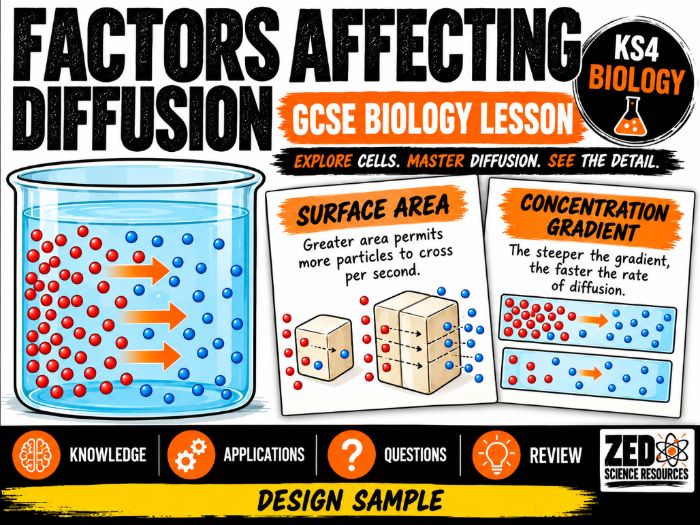
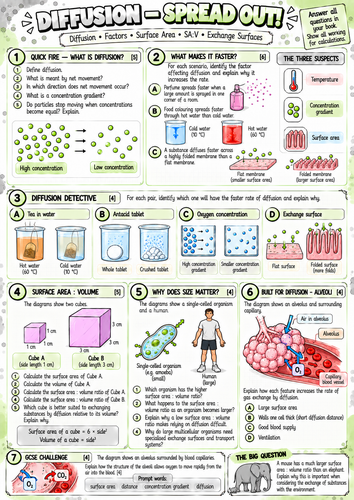
Develop students’ understanding of how different conditions affect the rate of diffusion, with particular attention to surface area. This lesson connects particle movement with the adaptations that enable efficient exchange in living organisms.
Learning Objectives
- Describe diffusion as the net movement of particles down a concentration gradient.
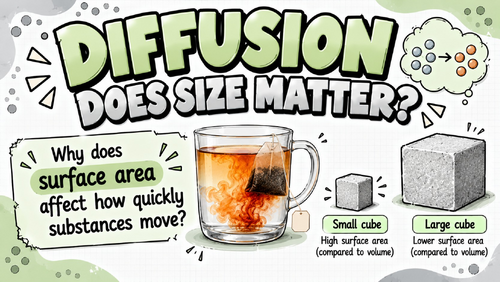
- Explain how increasing surface area increases the rate of diffusion.
- Explain the effects of temperature, concentration gradient and diffusion distance.
- Predict how changing conditions affects diffusion.
- Apply these principles to biological exchange surfaces.
Lesson Overview
Students explore the factors affecting diffusion through particle-model explanations and comparisons. Surface area is linked to the number of particles that can cross an exchange surface in a given time.
Prediction and explanation activities develop students’ ability to justify changes in rate. Biological applications connect large surface areas, short diffusion distances and maintained concentration gradients with efficient exchange.
Suitable For
KS4 GCSE Biology and Combined Science students.
What’s Included
- PowerPoint lesson presentation
- Particle-model explanations and diagrams
- Surface-area and diffusion-rate comparisons
- Prediction and explanation activities
- Biological application questions
Something went wrong, please try again later.
This resource hasn't been reviewed yet
To ensure quality for our reviews, only customers who have purchased this resource can review it
Report this resourceto let us know if it violates our terms and conditions.
Our customer service team will review your report and will be in touch.
£3.67