


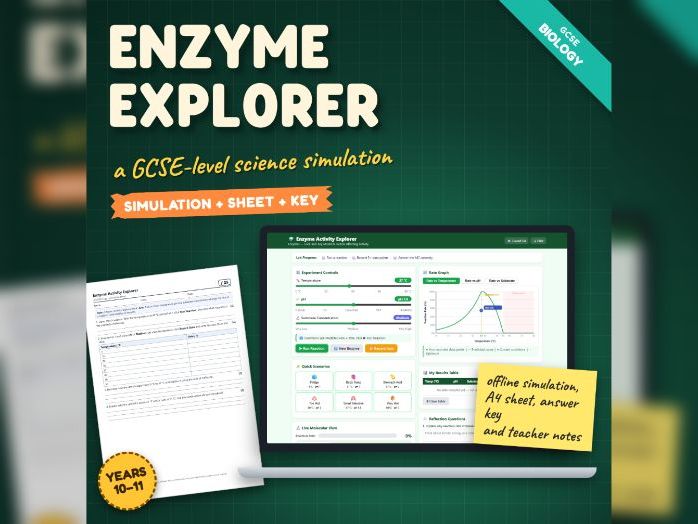

A complete biology simulation for GCSE-level science (ages 14 to 16): a lab-bench simulation of an enzyme-controlled reaction, with an A4 student sheet, an answer key and teacher notes. One offline file; no website, no login and nothing to install.
What is this?
Students set the temperature, the pH and the substrate concentration, run the reaction and watch enzyme and substrate molecules collide in a live molecular view. They record the rate in a results table and see it build into rate graphs against temperature, pH and substrate concentration, with the predicted curve for comparison.
It runs offline from a single file on any device, from a Chromebook to a projector. It comes with a two-page student sheet (25 marks) written for this simulation, with tables to fill in from the simulation’s own numbers, short explanations, calculations and an evaluation question. The answer key gives every number the simulation produces, so marking is quick.
What is in the zip
- The simulation (Enzyme-Activity-Explorer.html): one file for any modern browser. Works offline, sends nothing anywhere and uses no live AI at run time.
- Student sheet (PDF, 2 pages, 25 marks) for printing or sharing.
- Answer key (PDF) with a mark scheme and the numbers the simulation gives.
- Teacher notes (PDF): how to run a 50-minute lesson, how the simulation behaves, and its honest limits.
What the simulation includes
- Live molecular view of enzyme and substrate
- Rate graphs against temperature, pH and substrate concentration with a predicted curve
- Six quick scenarios (fridge, body temperature, stomach acid)
- Reflection questions with model answers and a quiz
- Denaturing is permanent: cooling does not restore the enzyme
What students learn
- The lock-and-key model: the substrate fits the active site.
- Rate rises with temperature up to an optimum because particles collide more often.
- Above the optimum the enzyme denatures and the rate falls to zero.
- Each enzyme has an optimum pH, and the rate falls either side of it.
- Rate rises with substrate concentration and then levels off.
Where it fits
GCSE Biology: enzymes, factors affecting enzyme activity, and the enzyme practicals. Use it as a starter, for prep, cover work, homework or revision.
What it does, and what it does not
The numbers come from a model, not from measurements, so real data will look messier. It does not replace working with real apparatus: use it to prepare, to practise reading and plotting data, or when the practical cannot be run. There is a free demo of this simulation on Tes with one fixed set-up and a one-page sheet, so you can try the format first.
Written by a British science and maths teacher who taught for more than 12 years in international schools, including a spell as Head of Science. An independent resource, not affiliated with or endorsed by any exam board. Every question and the simulation are original.
Something went wrong, please try again later.
This resource hasn't been reviewed yet
To ensure quality for our reviews, only customers who have purchased this resource can review it
Report this resourceto let us know if it violates our terms and conditions.
Our customer service team will review your report and will be in touch.
£3.95