


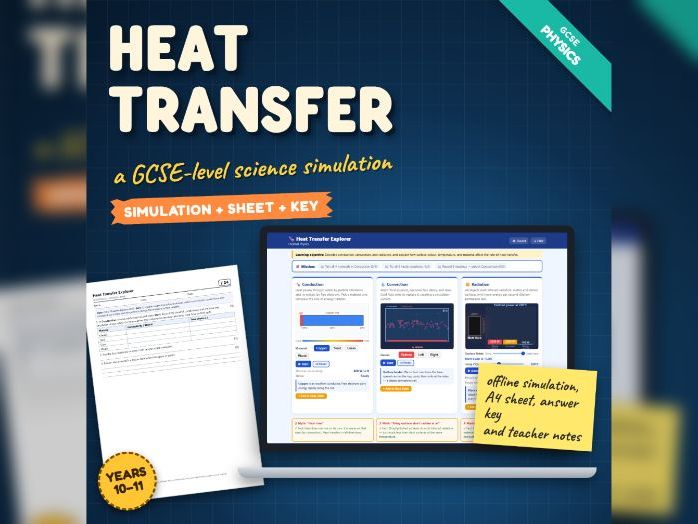

A complete physics simulation for GCSE-level science (ages 14 to 16): three experiments in one file: conduction, convection and radiation, with an A4 student sheet, an answer key and teacher notes. One offline file; no website, no login and nothing to install.
What is this?
In the conduction experiment students heat rods of copper, steel, glass and wood and compare how fast the energy travels. In the convection experiment they move a heater to the bottom, left or right of a tank and watch the current form. In the radiation experiment they change the surface finish and the temperature and read the power emitted.
It runs offline from a single file on any device, from a Chromebook to a projector. It comes with a two-page student sheet (24 marks) written for this simulation, with tables to fill in from the simulation’s own numbers, short explanations, calculations and an evaluation question. The answer key gives every number the simulation produces, so marking is quick.
What is in the zip
- The simulation (Heat-Transfer-Explorer.html): one file for any modern browser. Works offline, sends nothing anywhere and uses no live AI at run time.
- Student sheet (PDF, 2 pages, 24 marks) for printing or sharing.
- Answer key (PDF) with a mark scheme and the numbers the simulation gives.
- Teacher notes (PDF): how to run a 50-minute lesson, how the simulation behaves, and its honest limits.
What the simulation includes
- Four conduction rods with thermal conductivities from 400 to 0.15 W/m·K
- A convection tank with three heater positions
- A radiation panel: emissivity from shiny to matt black, temperature from 20 to 500 °C
- A mission checklist, a data table and a comparison summary
- A myths panel and challenge questions with explanations
What students learn
- Conduction in metals by free electrons and in other solids by vibrations.
- Convection currents: warm fluid expands, becomes less dense and rises.
- Radiation depends on surface and temperature: black surfaces emit and absorb more.
- How to compare data from three different methods.
Where it fits
GCSE Physics: energy transfers by heating, thermal insulation and the thermal energy practicals. Use it as a starter, for prep, cover work, homework or revision.
What it does, and what it does not
The numbers come from a model, not from measurements, so real data will look messier. It does not replace working with real apparatus: use it to prepare, to practise reading and plotting data, or when the practical cannot be run. There is a free demo of this simulation on Tes with one fixed set-up and a one-page sheet, so you can try the format first.
Written by a British science and maths teacher who taught for more than 12 years in international schools, including a spell as Head of Science. An independent resource, not affiliated with or endorsed by any exam board. Every question and the simulation are original.
Something went wrong, please try again later.
This resource hasn't been reviewed yet
To ensure quality for our reviews, only customers who have purchased this resource can review it
Report this resourceto let us know if it violates our terms and conditions.
Our customer service team will review your report and will be in touch.
£3.95