


Is Lady Macbeth really as powerful as she first appears?
This enquiry-led GCSE English Literature lesson explores how Shakespeare presents Lady Macbeth’s power and vulnerability across Macbeth.
Rather than treating Lady Macbeth simply as a powerful character who later becomes weak, students investigate a more challenging question: does Lady Macbeth lose her power, or was her power always more limited than it first appeared?
The lesson includes:
A low-stakes quotation register task introducing Lady Macbeth.
A central enquiry exploring power and vulnerability.
A What Would You Do? decision-making activity placing students in Lady Macbeth’s position after receiving Macbeth’s letter.
A follow-up revealing and examining Lady Macbeth’s actual choices.
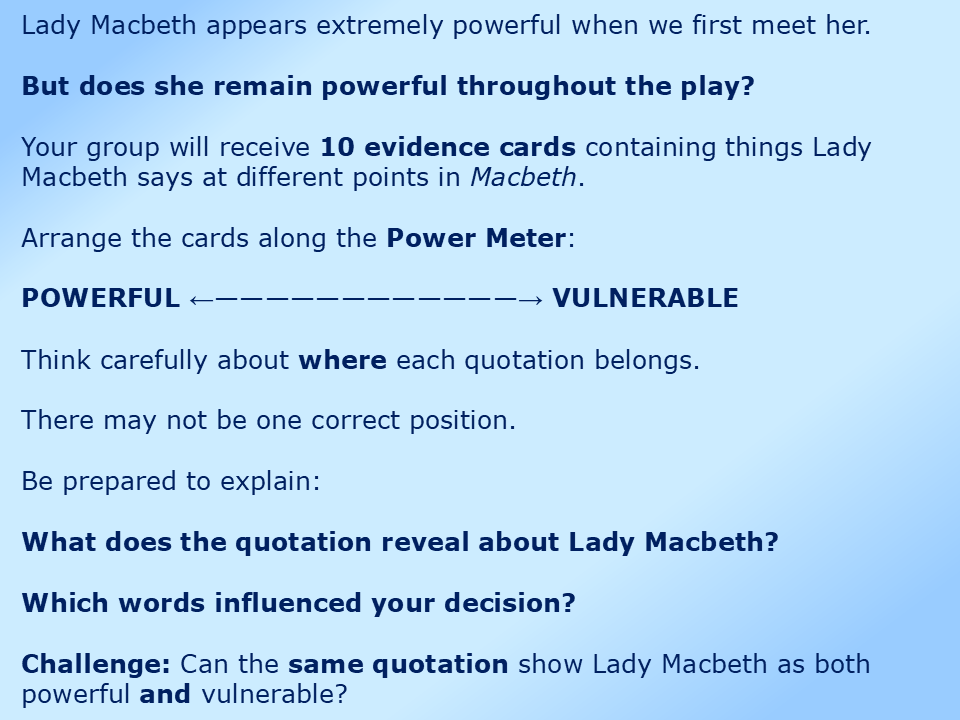
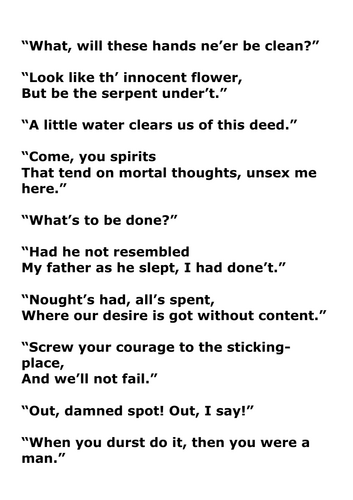
A 10-card Power Meter activity in which students arrange quotations from across the play from powerful to vulnerable.
Student and teacher versions of the quotation evidence cards.
Exploration of the changing power dynamic between Macbeth and Lady Macbeth.
Close comparison of “A little water clears us of this deed” and “What, will these hands ne’er be clean?”
Guided analysis of Shakespeare’s language, imagery and structural contrasts.
An extended Build Your Argument task using evidence from different points in the play.
A Final Verdict activity encouraging students to reach and defend their own interpretation.
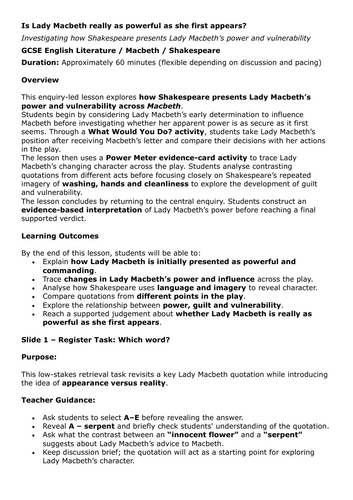
Detailed teacher guidance, contextual insight, differentiation and extension suggestions throughout.
The lesson is designed for GCSE English Literature students studying Shakespeare’s Macbeth and can be used with different exam boards. It is particularly suited to teaching or revising Lady Macbeth, power, guilt, vulnerability, ambition and character development.
The resource encourages students to move beyond simple character descriptions and develop evidence-based, alternative interpretations, while repeatedly returning to Shakespeare’s language and the central enquiry.
Approximate teaching time: 60 minutes, with flexibility depending on discussion and written work.
Something went wrong, please try again later.
This resource hasn't been reviewed yet
To ensure quality for our reviews, only customers who have purchased this resource can review it
Report this resourceto let us know if it violates our terms and conditions.
Our customer service team will review your report and will be in touch.
£4.50