


**Save 54% with the Complete Electricity Bundle! **
Get this lesson as part of our GCSE Electricity Bundle and enjoy a huge discount! Instead of buying lessons individually, grab the entire unit with 13 lessons, including required practicals, for just £12.00.
Click here to get the bundle now: https://www.tes.com/teaching-resource/resource-13199110
This “AC, DC, The National Grid & Transformers” PowerPoint lesson is designed for AQA GCSE Physics students. It covers the differences between alternating current (AC) and direct current (DC), the structure and function of the UK National Grid, and the role of transformers in electricity distribution. The lesson includes clear explanations, interactive activities, and real-world applications to help students understand how electricity is transmitted efficiently.
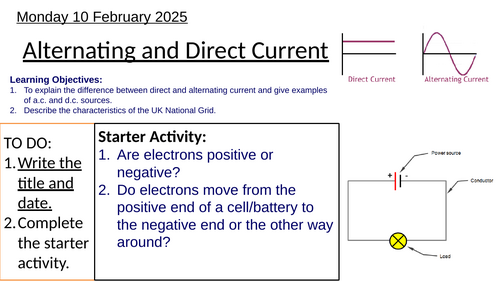
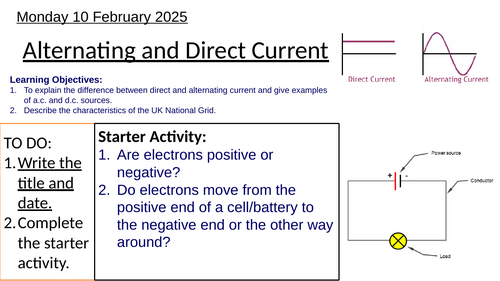
The lesson starts with a starter activity that prompts students to recall the movement of electrons in a circuit and the direction of current flow. This helps reinforce the concept that electrons move from the negative to the positive terminal, setting the foundation for understanding AC and DC electricity.
Students then explore the key differences between alternating and direct current, including how AC changes direction 50 times per second (50Hz) in the UK mains supply, while DC flows in one constant direction. A voltage-time graph comparison is provided to help students visualize how AC and DC behave differently.
Next, the lesson introduces the UK National Grid, explaining how electricity is generated, transmitted, and distributed across the country. Students learn why high-voltage transmission is necessary to reduce energy loss due to resistance in power lines. They analyze how transformers play a crucial role in the National Grid, stepping up voltage for transmission and stepping it down for safe use in homes.
The section on transformers explains their function using key equations and diagrams. Students explore the differences between step-up and step-down transformers, learning how the number of coil turns affects voltage and current. They then apply their knowledge by answering GCSE-style calculation questions, using the transformer equation to determine voltage changes.
Throughout the lesson, students engage in interactive activities, including identifying AC and DC sources, interpreting voltage-time graphs, and discussing the pros and cons of overhead vs. underground power cables. Review questions at the end assess understanding of key concepts such as National Grid efficiency, transformer function, and AC vs. DC behavior.
This editable PowerPoint (.pptx) file is designed specifically for AQA GCSE Physics students. Updated in February 2025, it provides structured explanations, problem-solving exercises, and real-world applications, making it an essential resource for mastering electricity transmission and transformer principles in GCSE Physics.
Something went wrong, please try again later.
I appreciate the way the information is chunked in this PowerPoint, with review questions allowing me to assess learning before moving on to the next chunk. The practice questions near the end are very helpful too. Thank you!
Report this resourceto let us know if it violates our terms and conditions.
Our customer service team will review your report and will be in touch.
£2.00