

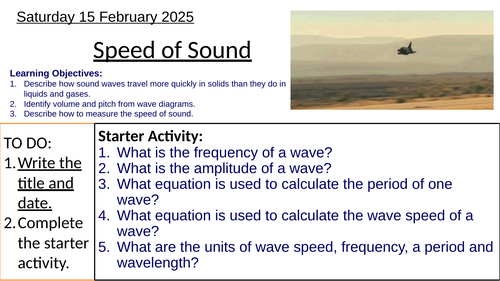

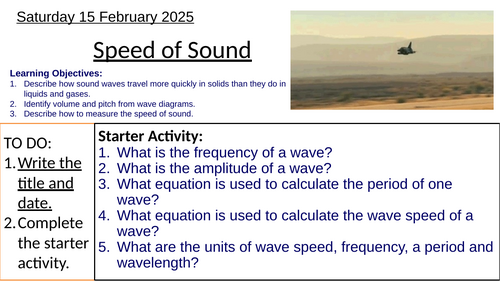
This “Speed of Sound” PowerPoint lesson is designed for GCSE Physics students, focusing on how sound waves travel through different media, how to measure the speed of sound, and how wave properties like pitch and volume are affected by frequency and amplitude. The lesson includes interactive demonstrations, real-world applications, and exam-style questions to help students grasp key concepts.
The lesson starts with a starter activity reviewing prior knowledge of wave properties, including frequency, amplitude, and wave speed equations. Students recall the relationships between wavelength, wave speed, and period, ensuring they have a strong foundation before diving into the topic.
Students then explore how sound waves require a medium to travel and why they cannot propagate in a vacuum. A key discussion point is whether an astronaut in space would hear a drum beating outside their suit. They learn that sound waves are mechanical waves, which require particles to transfer energy, making it impossible to hear sound in space.
The lesson introduces a practical demonstration using an alarm bell in a vacuum jar, which visually reinforces that as air is removed, the sound disappears because no particles remain to transfer the vibrations.
Students then see how sound speed differs in solids, liquids, and gases, understanding that:
- Sound travels fastest in solids due to closely packed particles allowing quicker energy transfer.
- Sound is slower in liquids since particles are further apart.
- Sound travels slowest in gases, where particles are widely spaced and less frequent collisions occur.
The lesson also covers how sound waves travel and reflect, leading into an explanation of how to measure the speed of sound using the echo method.
Students work through a step-by-step guide:
Generate a sound (e.g., a hand clap).
Time how long it takes for the sound to reflect off a surface (like a wall) and return.
Multiply the measured distance by 2 (since sound travels to the wall and back).
Use the formula: speed = distance/time
Repeat and calculate an average, removing any anomalous results.
Students apply this knowledge in practice calculations, solving problems like:
If a wall is 50m away and it takes 0.3 seconds to hear the echo, how fast was the sound traveling? 100m÷0.3s=333.33m/s
A section on oscilloscopes and sound waves helps students analyze how changes in frequency affect pitch and how amplitude affects loudness. Using interactive simulations or teacher demonstrations, students match waveforms to their corresponding pitch and volume characteristics.
The lesson concludes with GCSE-style exam questions.
This editable PowerPoint (.pptx) file is fully aligned with GCSE Physics specifications, offering clear explanations, real-world applications, and interactive problem-solving activities. Updated in Februa2024, this resource ensures a strong understanding of wave behavior, sound propagation, and practical measurement techniques for GCSE students.
Get this resource as part of a bundle and save up to 50%
A bundle is a package of resources grouped together to teach a particular topic, or a series of lessons, in one place.
Bundle
AQA GCSE Combined Science (Foundation) Physics: Waves and the Electromagnetic Spectrum Bundle
This GCSE Physics PowerPoint bundle provides a comprehensive series of lessons on waves and the electromagnetic spectrum, covering wave properties, speed of sound, refraction, the electromagnetic spectrum, its uses, dangers, and required practicals. Designed for AQA GCSE Combined Science (Foundation Tier) Physics, these presentations offer detailed explanations, real-world applications, required practicals, and exam-style questions to support student learning. Each lesson includes clear diagrams, structured activities, and revision tasks, making this bundle ideal for both classroom teaching and independent study. What’s Included in the Bundle? 1. Introduction to Waves Definition of waves and how they transfer energy. Identifying transverse and longitudinal waves with real-life examples. Key wave properties, including wavelength, amplitude, and frequency. 2. Properties of Waves Understanding wave frequency, speed, and period. The wave speed equation and how to apply it. Investigations using ripple tanks and oscilloscopes (simulation). 3. Speed of Sound How sound waves travel through solids, liquids, and gases. Factors affecting the speed of sound in different materials. Measuring sound speed using echo methods and timing experiments. 4. Required Practical – Measuring Wave Speed Investigating wave speed in solids (string) and water (ripple tanks). How to accurately measure wavelength, frequency, and speed. Understanding the relationship between wave properties and medium. 5. Refraction Explanation of light bending at material boundaries. Using ray diagrams to illustrate refraction. Required practical on measuring refraction using a glass block. 6. The Electromagnetic Spectrum Understanding the order of the electromagnetic spectrum based on wavelength, frequency, and energy. Explaining how all electromagnetic waves travel at the speed of light in a vacuum. Applying the wave speed equation to EM waves. 7. Uses of Electromagnetic Waves Exploring how radio waves, microwaves, infrared, visible light, ultraviolet, X-rays, and gamma rays are used. Real-world applications in communication, medicine, security, and industry. 8. Required Practical – Absorption and Radiation Investigating infrared radiation emission and absorption. Using Leslie cubes and boiling tubes to analyze heat transfer. Understanding how surface color and texture affect radiation. 9. Dangers of Electromagnetic Waves Identifying ionising vs. non-ionising radiation. Explaining the risks of X-rays, gamma rays, and ultraviolet radiation. Examining radiation safety, dose measurement, and protection methods. Each PowerPoint is fully editable (.pptx), allowing teachers to customize the content. The bundle includes exam-style questions, structured revision tasks, and guided practical investigations to enhance student understanding. Last updated: March 2025. This PowerPoint bundle is perfect for teachers, tutors, and students looking for a detailed and curriculum-aligned resource on waves and the electromagnetic spectrum. Download now to enhance your physics lessons!
£10.00
Bundle
AQA GCSE Physics Wave Properties Bundle: 4 PowerPoint Lessons
This AQA GCSE Physics Waves PowerPoint bundle provides a comprehensive series of lessons covering the key concepts of waves, including wave properties, wave speed, sound waves, and the required practical. Designed for AQA GCSE combined science, these presentations offer detailed explanations, practical investigations, worked examples, and exam-style questions to support student understanding and exam preparation. What’s Included in the Bundle? **Lesson 1: Introduction to Waves** * Definition of waves as energy transfer without matter movement. * Difference between mechanical and electromagnetic waves. * Explanation of transverse and longitudinal waves with real-world examples. * Identifying wavelength and amplitude from wave diagrams. **Lesson 2: Properties of Waves** * Definition and calculation of wave frequency. * Wave speed equation (v = fλ) and how to use it. * Understanding wave period and how it relates to frequency. * Wavefronts and their role in wave behavior. * Practical examples of wave properties using a ripple tank demonstration. **Lesson 3: Speed of Sound** * How sound waves travel through solids, liquids, and gases. * Why sound waves cannot travel through a vacuum. * Measuring the speed of sound using an echo method. * How frequency and amplitude affect pitch and loudness. * Oscilloscope simulation/demonstrations to visualize sound waves. **Lesson 4: Required Practical – Measuring Wave Speed** * Investigating wave speed in a solid (vibrating string method). * Investigating wave speed in water (ripple tank method). * Step-by-step practical methods, including improvements. * How to calculate wave speed from frequency and wavelength. * Analyzing errors and improving accuracy in wave measurements. Why Use This Resource? * Aligned with AQA GCSE combined science specification. * Fully editable PowerPoint (.pptx) files to suit different teaching styles. * Clear visuals, structured lessons, and engaging activities. * Supports practical investigations and experimental analysis. * Includes exam-style practice questions and problem-solving exercises. Last updated: March 2025. This PowerPoint bundle is ideal for teachers, tutors, and students looking for a curriculum-aligned resource on GCSE Physics Waves. Download now to enhance your physics lessons!
£4.00
Something went wrong, please try again later.
This resource hasn't been reviewed yet
To ensure quality for our reviews, only customers who have purchased this resource can review it
Report this resourceto let us know if it violates our terms and conditions.
Our customer service team will review your report and will be in touch.
£2.00