



Most compare-and-contrast resources stop at description: how two texts are similar or different. CCSS RL/RI.5.9 asks for more — comparing and contrasting how authors in the same genre or on the same topic differ in their approach. This unit builds toward synthesis: a new claim that emerges only from reading two texts together.
Students learn to distinguish topic from theme using the theme test, apply three comparison frameworks (Venn diagram, Claims Table, and Theme Web) and understand when to use each, identify what each author emphasises and omits and what those choices reveal about purpose, analyse how genre and format shape what an author can argue, and write a Synthesis Statement — a precise analytical sentence that goes beyond description to a new insight requiring both texts. Aligned to CCSS RL.5.9 and RI.5.9.
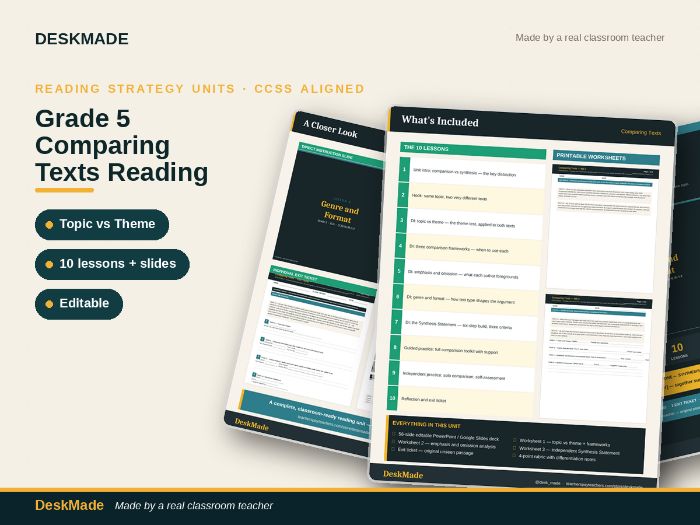
WHAT’S INCLUDED
63 PowerPoint slides across 10 structured lessons
3 worksheets (6 pages total) — text annotation and Claims Table, emphasis/omission and genre analysis, independent paired-text analysis with Synthesis Statement
1 exit ticket (L10) — topic and theme, emphasis/omission, genre analysis, complete Synthesis Statement
1 rubric — 4 criteria, 4-point scale with differentiation notes
Teacher speaker notes on every slide
Original text pairs throughout — news reports, personal essays, informational texts, and narrative non-fiction
LESSON OVERVIEW
L1 — Unit intro: comparison vs synthesis — the key distinction this unit builds toward
L2 — Hook: same topic (bees), two radically different texts — students feel the difference before they analyse it
L3 — Direct Instruction: topic vs theme — the theme test, applying it to both texts in a pair
L4 — Direct Instruction: three comparison frameworks — Venn, Claims Table, Theme Web — when to use each
L5 — Direct Instruction: emphasis and omission — four markers, four types, why omission is as revealing as inclusion
L6 — Direct Instruction: genre and format — how text type shapes what an author can argue
L7 — Direct Instruction: the Synthesis Statement — six-step build process, three quality criteria
L8 — Guided practice: full comparison toolkit applied to a library text pair with teacher support
L9 — Independent practice: solo text comparison, self-assessment, revise-and-strengthen exercise
L10 — Reflection and exit ticket
WORKSHEETS
Something went wrong, please try again later.
This resource hasn't been reviewed yet
To ensure quality for our reviews, only customers who have purchased this resource can review it
Report this resourceto let us know if it violates our terms and conditions.
Our customer service team will review your report and will be in touch.
£4.00