


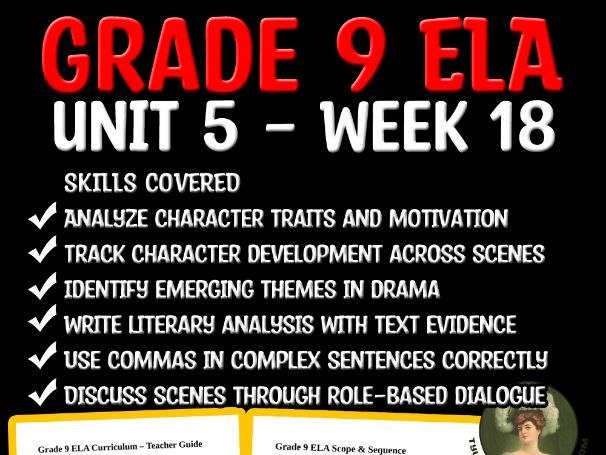
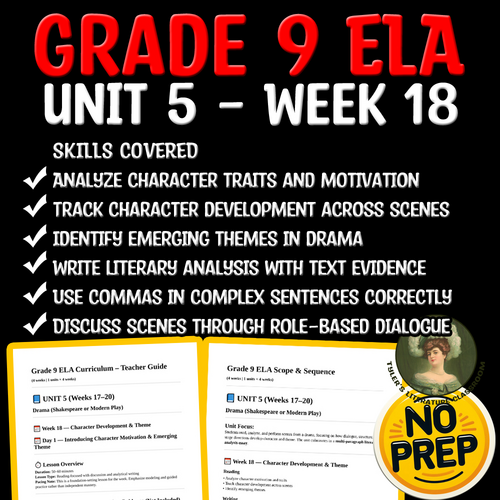
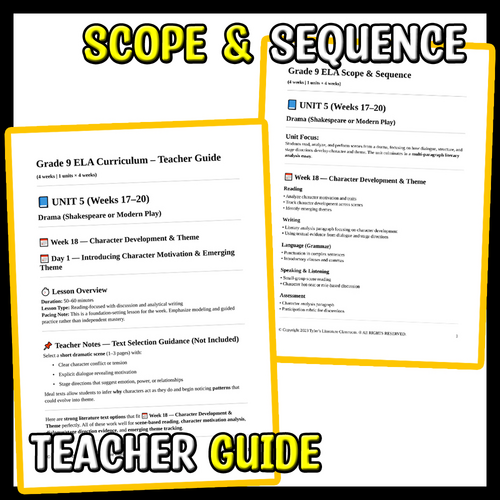
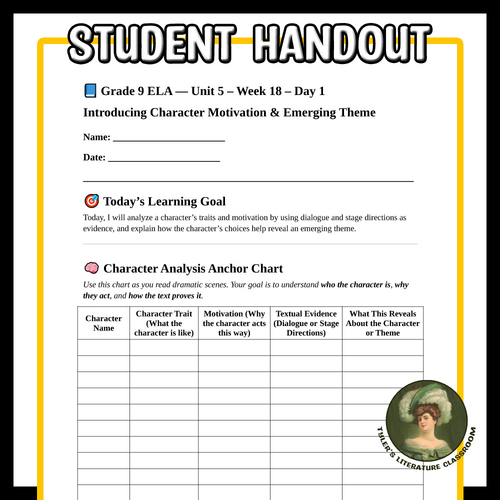
This print-and-teach Grade 9 ELA Unit 5 (Week 18) deepens students’ drama analysis by focusing on character development and emerging themes through close reading of scenes, evidence-based literary analysis writing, targeted grammar instruction on complex sentences, collaborative scene reading, role-based discussions, and summative assessments that measure character analysis and discussion skills.
** Week 18 Outcomes**
By the end of Week 18, students can:
✔ Analyze character motivation, traits, and decisions in a dramatic text
✔ Track how characters develop and change across scenes
✔ Identify and explain emerging themes in a play
✔ Write a focused literary analysis paragraph about character development
✔ Support analysis with textual evidence from dialogue and stage directions
✔ Use correct punctuation in complex sentences, including introductory clauses
✔ Participate effectively in collaborative discussions and role-based activities
What Students Learn
Day 1 — Introducing Character Motivation & Emerging Theme
Focus: Understanding why characters act as they do and how themes begin to form
Students learn to:
• Identify character traits revealed through dialogue and stage directions
• Explain a character’s motivation behind key actions or conflicts
• Recognize early ideas or messages (emerging themes) suggested in a scene
Day 2 — Tracking Character Development Across Scenes
Focus: How characters change or deepen over time
Students learn to:
• Compare a character’s traits and motivations across two scenes
• Explain how dialogue and stage directions reveal character development
• Describe how character changes contribute to an emerging theme
Day 3 — Turning Points: Character Decisions & Theme
Focus: How key decisions reveal character and theme
Students learn to:
• Identify a turning-point decision a character makes
• Explain the motivation behind that decision
• Use dialogue and stage directions as evidence
• Connect the decision to character development and theme
Day 4 — Synthesizing Character Development Across Scenes
Focus: How repeated choices show growth and reveal theme
Students learn to:
• Identify patterns in a character’s traits and motivations across multiple scenes
• Explain how repeated decisions show growth, consistency, or conflict
• Use dialogue and stage directions as evidence
• Connect character development to an emerging theme
Day 5 — Summative Character Analysis & Reflection
Focus: Demonstrating mastery of character development and theme
Students learn to:
• Write a polished literary analysis paragraph synthesizing character growth
• Use evidence from multiple scenes (dialogue and stage directions)
• Explain how character development contributes to an emerging theme
• Self-edit for punctuation, complex sentences, and clarity
• Participate in structured discussion or hot-seat reflection
Get this resource as part of a bundle and save up to 40%
A bundle is a package of resources grouped together to teach a particular topic, or a series of lessons, in one place.
Bundle
Grade 9 ELA Unit 2 & 4 & 5 | Literary Analysis Mastery Bundle
Build Literary Analysis Mastery through short stories, poetry, and drama with strong text-based literary analysis and interpretation skills. Guide students through a complete Literary Analysis Progression using fiction, poetry, and drama interpretation across multiple genres and formats. Strengthen Cross-Genre Literary Analysis and literary response writing through evidence-based discussion, analysis, and multi-genre writing workshops. 🧠 Unit 2 Progression at a Glance 📘 Week 5: Plot, Conflict & Theme Focus: Applying Close Reading to Literature Students learn to: • Identify elements of plot (exposition, rising action, climax, resolution) • Analyze internal vs. external conflict • Distinguish theme vs. topic • Track plot events using graphic organizers • Write analytical paragraphs connecting plot and conflict to theme 📘 Week 6: Characterization & Text Evidence Focus: Deepening Analysis Through Character Study Students learn to: • Analyze direct and indirect characterization • Examine character traits, motivations, and changes • Use dialogue, actions, and thoughts as textual evidence • Write paragraphs connecting characterization to story meaning 📘 Week 7: Setting, Mood & Author’s Choices Focus: Analyzing Craft and Purpose Students learn to: • Examine how setting creates mood and supports theme • Distinguish mood vs. tone • Analyze author’s choices and their effects on meaning • Revise commentary for depth, clarity, and stronger topic sentences 📘 Week 8: Literary Analysis Essay & Assessment Focus: From Paragraphs to Structured Writing Students learn to: • Independently analyze a short story for theme, character, and literary elements • Write a full literary analysis essay (introduction, body paragraphs, conclusion) • Revise essays using a literary analysis rubric • Edit for verb tense consistency, pronoun clarity, and sentence precision • Participate in discussions and reflect on their analytical growth 🧠 Unit 4 Progression at a Glance 📘 Week 13: Understanding Figurative Language in Poetry Focus: Interpreting Meaning Through Figurative Language Students learn to: • Identify and analyze simile, metaphor, personification, imagery, and symbolism • Closely read short poems for deeper meaning • Explain how figurative language contributes to tone and message • Write short poetry analysis paragraphs using claim, evidence, and commentary • Distinguish between denotation and connotation in poetic word choice 📘 Week 14: Sound Devices, Tone, and Mood Focus: How Sound and Language Shape Emotion Students learn to: • Analyze rhyme, rhythm, repetition, alliteration, assonance, and consonance • Identify tone and mood in poetry • Explain how sound devices support meaning and emotional impact • Write analytical paragraphs using textual evidence • Revise sentences for smoother flow using parallel structure 📘 Week 15: Writing About Poetry & Creative Imitation Focus: Analytical Depth and Poetic Craft Students learn to: • Compare poetic styles and structures • Identify patterns in language and form • Write an extended poetry analysis response • Create an original poem imitating a studied style • Revise sentences by correcting misplaced and dangling modifiers • Give and receive peer feedback on creative writing 📘 Week 16: Synthesis, Revision, and Assessment Focus: Independence, Mastery, and Reflection Students learn to: • Analyze a new poem independently using multiple strategies • Apply knowledge of figurative language, sound, tone, and mood • Write a polished poetry analysis paragraph or mini-essay • Revise a creative poem for clarity, structure, and effect • Edit writing using parallel structure and correct modifiers • Reflect on growth in poetry reading and writing 🧠 Unit 5 Progression at a Glance 📘 Week 17: Introduction to Drama & Plot Development Focus: Understanding How Plays Are Structured and Introduce Conflict Students learn to: • Identify elements of drama (acts, scenes, dialogue, stage directions) • Analyze dramatic structure (exposition, rising action, climax, falling action, resolution) • Understand context, setting, and character relationships in a play • Explain how exposition introduces conflict • Write short constructed responses analyzing dramatic elements • Combine sentences to improve clarity and variety • Participate in read-alouds and partner discussions to build initial interpretations 📘 Week 18: Character Development & Theme Focus: How Characters Change and Themes Emerge Across a Play Students learn to: • Analyze character motivation, traits, and decision-making • Track character development across multiple scenes • Identify and refine emerging themes • Write a literary analysis paragraph focused on character development • Use textual evidence from dialogue and stage directions • Apply correct punctuation in complex sentences • Engage in collaborative scene readings and role-based discussions 📘 Week 19: Dialogue, Conflict & Performance Focus: Interpreting Meaning Through Dialogue and Performance Choices Students learn to: • Analyze dialogue for tone, conflict, and subtext • Explain how dialogue advances plot and reveals theme • Examine how conflict drives character actions • Write short responses analyzing key scenes • Begin planning a multi-paragraph literary analysis essay • Use semicolons and commas correctly in compound and complex sentences • Participate in dramatic readings or short scene performances • Give and receive peer feedback on interpretation and expression 📘 Week 20: Literary Analysis Essay & Reflection Focus: Synthesis, Writing Independence, and Critical Reflection Students learn to: • Reread key scenes to gather strong textual evidence • Review character arcs and theme development across the play • Write a multi-paragraph literary analysis essay • Draft, revise, and edit for clarity, organization, and depth of analysis • Proofread for sentence structure and punctuation • Reflect on how performance and interpretation influence meaning • Participate in reflective discussion and optional presentation • Evaluate their growth as readers, writers, and collaborators ✅ Unit 2 Outcomes (Weeks 5–8) By the end of Unit 2, students can: ✔ Independently analyze short stories for plot, conflict, characterization, setting, and theme ✔ Identify and select strong textual evidence ✔ Explain evidence with analytical commentary ✔ Write multi-paragraph literary analysis essays ✔ Develop clear claims and structured body paragraphs ✔ Revise for clarity, coherence, and academic tone ✔ Apply literary vocabulary accurately ✔ Participate in academic discussions and reflections ✔ Demonstrate skills through summative assessment under rubric conditions ✅ Unit 4 Outcomes (Weeks 13–16) By the end of Unit 4, students can: ✔ Analyze poems using figurative language, sound, tone, and structure ✔ Write clear, evidence-based poetry analysis paragraphs and responses ✔ Revise creative poems for craft, clarity, and word choice ✔ Apply parallel structure and correct modifier use in writing ✔ Use connotation and denotation intentionally to shape meaning ✔ Read and analyze poetry independently ✔ Participate in discussion and peer feedback ✔ Reflect thoughtfully on growth as readers and writers of poetry ✔ Demonstrate mastery through a poetry analysis assessment ✅ Unit 5 Outcomes (Weeks 17–20) By the end of Unit 5, students can: ✔ Students analyze drama through dialogue, structure, and performance. ✔ They study plot development and how conflict is introduced. ✔ They study plot development and how conflict is introduced. ✔ Students track character motivation and growth across scenes. ✔ They examine how themes emerge and develop over a play. ✔ Students support ideas with evidence from dialogue and stage directions. ✔ Students support ideas with evidence from dialogue and stage directions. ✔ They write and refine analytical paragraphs and essays. ✔ Students engage in discussion, performance, and peer feedback. ✔ The unit ends with a polished literary analysis and reflection. ✍️ What’s Included in Unit 2 ✔ 20 full lesson plans (Weeks 5–8, Days 1–5) ✔ Short stories for analysis ✔ Text-dependent questions and reading trackers ✔ Literary analysis essay organizers ✔ Essay drafting and revision guides ✔ Editing practice (verb tense, pronouns, clarity) ✔ Literary analysis rubrics ✔ Discussion prompts and reflection tools ✔ Assessment tasks and model responses ✔ Differentiation and support for diverse learners ✍️ What’s Included in Unit 4 ✔ 20 full lesson plans (Weeks 13–16, Days 1–5) ✔ Short poems for close reading and analysis ✔ Poetry annotation guides and text-dependent questions ✔ Poetry analysis paragraph and extended response organizers ✔ Creative poetry writing and imitation prompts ✔ Revision and editing checklists ✔ Grammar practice (parallel structure & modifiers) ✔ Vocabulary activities (connotation & denotation) ✔ Poetry analysis assessment ✔ Reflection prompts and unit closure activities ✔ Differentiation and support for diverse learners ✍️ What’s Included in Unit 5 ✔ 20 full lesson plans (Weeks 17–20, Days 1–5) ✔ Anchor drama text study (Shakespeare or modern play) ✔ Close-reading activities for scenes, dialogue, and stage directions ✔ Character tracking charts and theme development organizers ✔ Dialogue and scene analysis prompts and short-response tasks ✔ Literary analysis paragraph and full essay planning tools ✔ Revision, editing, and proofreading checklists ✔ Grammar practice (complex sentences, commas, semicolons, clarity) ✔ Performance-based activities (dramatic reading, scene work) ✔ Summative literary analysis essay assessment ✔ Reflection prompts and unit closure activities ✔ Built-in differentiation and student support 🎯 Best For • Grade 9 ELA & high school English classrooms • Short story, poetry, and drama analysis units • Teaching literary elements, dialogue, conflict, character, and theme • Developing fiction, poetry, and drama interpretation skills • Scaffolding literary analysis paragraphs and multi-paragraph essays • Balancing analytical, creative, and performance-based learning • Building text-based literary response and discussion skills • Test prep, benchmark assessments, essay practice, and reflection • Blending reading, writing, grammar, speaking, and literary interpretation • ESL / ELL / inclusion settings • Core instruction or end-of-unit summative assessment 🧠 Teacher-Friendly Design ✔ No prep required with clear daily pacing and consistent lesson structure ✔ Built-in scaffolding from guided literary analysis → independent essay writing ✔ Gradual progression from paragraphs and scene analysis to full multi-paragraph essays ✔ Integrated grammar and vocabulary instruction connected directly to student writing ✔ Built-in assessment tools, formative checks, and rubric-based grading support ✔ Frequent peer feedback, discussion, and collaborative learning opportunities ✔ Strong alignment across reading, writing, language, and speaking standards ✔ Smooth progression across fiction, poetry, and drama analysis units ⭐ Why Teachers Love These Units ✔ Turns literary analysis skills into polished, grade-level essays ✔ Produces strong evidence-based analysis with clear commentary and structure ✔ Builds student confidence in fiction, poetry, and drama interpretation ✔ Balances analytical writing, creative expression, discussion, and performance ✔ Reinforces grammar, academic language, and word choice in authentic contexts ✔ Connects close reading and performance choices to literary interpretation ✔ Makes assessment meaningful, reflective, and growth-oriented ✔ Supports clear growth from guided practice to independent literary analysis mastery ✔ Culminates in polished, standards-aligned multi-paragraph literary essays Want free products? By writing a review for this product, you will receive credits (free money) to use for your next purchase! Follow me and be the first to know about my new discounts, freebies, and product launches. Tah-Dah! You will now receive email updates about this store. More in Grade 9 - ELA: Grade 9 ELA Unit 1 Week 1 | Close Reading & Writing with Text Evidence Bundle & Save: Grade 9 ELA Unit 1 Bundle | Close Reading to Polished Writing (Weeks 1–4) More (Best with these Units): The Raven by Edgar Allan Poe | Q&A Poetry Analysis Sub Plan Romeo and Juliet Q&A Play Analysis of Shakespeare Sub Plan The Crucible Learning Stations & Q&A Analysis of Arthur Miller Sub Plan Access All Studies: ..
£45.10
Bundle
Grade 9 ELA Unit 5 & 8 | Text-Based Analysis & Argument Development
Build strong Literary Analysis & Argument Writing skills through dialogue interpretation, text-based analysis, and structured response writing. Support the transition from Analytical to Argument Writing with argument development, counterclaim writing, and persuasive writing skills. Strengthen Academic Essay Writing through essay revision, editing practice, and advanced text-based writing skills. 🧠 Unit 5 Progression at a Glance 📘 Week 17: Introduction to Drama & Plot Development Focus: Understanding How Plays Are Structured and Introduce Conflict Students learn to: • Identify elements of drama (acts, scenes, dialogue, stage directions) • Analyze dramatic structure (exposition, rising action, climax, falling action, resolution) • Understand context, setting, and character relationships in a play • Explain how exposition introduces conflict • Write short constructed responses analyzing dramatic elements • Combine sentences to improve clarity and variety • Participate in read-alouds and partner discussions to build initial interpretations 📘 Week 18: Character Development & Theme Focus: How Characters Change and Themes Emerge Across a Play Students learn to: • Analyze character motivation, traits, and decision-making • Track character development across multiple scenes • Identify and refine emerging themes • Write a literary analysis paragraph focused on character development • Use textual evidence from dialogue and stage directions • Apply correct punctuation in complex sentences • Engage in collaborative scene readings and role-based discussions 📘 Week 19: Dialogue, Conflict & Performance Focus: Interpreting Meaning Through Dialogue and Performance Choices Students learn to: • Analyze dialogue for tone, conflict, and subtext • Explain how dialogue advances plot and reveals theme • Examine how conflict drives character actions • Write short responses analyzing key scenes • Begin planning a multi-paragraph literary analysis essay • Use semicolons and commas correctly in compound and complex sentences • Participate in dramatic readings or short scene performances • Give and receive peer feedback on interpretation and expression 📘 Week 20: Literary Analysis Essay & Reflection Focus: Synthesis, Writing Independence, and Critical Reflection Students learn to: • Reread key scenes to gather strong textual evidence • Review character arcs and theme development across the play • Write a multi-paragraph literary analysis essay • Draft, revise, and edit for clarity, organization, and depth of analysis • Proofread for sentence structure and punctuation • Reflect on how performance and interpretation influence meaning • Participate in reflective discussion and optional presentation • Evaluate their growth as readers, writers, and collaborators 🧠 Unit 8 Progression at a Glance 📘 Week 29: Understanding Argument & Claims Focus: Building a foundation in argumentative thinking and claim development Students learn to: • Understand the purpose and structure of argumentative writing • Identify claims, reasons, and evidence in texts • Distinguish between strong and weak arguments • Analyze how authors support their positions • Write clear, arguable thesis statements (claims) • Develop reasons that logically support a claim • Use formal academic language in argument writing • Participate in structured discussions to justify opinions • Submit a well-developed argument paragraph with claim and support 📘 Week 30: Evidence & Counterclaims Focus: Strengthening arguments with evidence and addressing opposing viewpoints Students learn to: • Evaluate the quality and relevance of evidence • Select appropriate evidence to support claims • Incorporate textual evidence effectively into writing • Understand and identify counterclaims in arguments • Write counterclaims and develop rebuttals • Use transitions to connect ideas and strengthen flow • Maintain a formal tone in argumentative writing • Engage in debates using claims and counterarguments • Submit a paragraph including claim, evidence, and counterclaim 📘 Week 31: Drafting the Argument Essay Focus: Developing a complete multi-paragraph argumentative essay Students learn to: • Analyze model argumentative essays for structure and organization • Understand essay components (introduction, body, conclusion) • Create organized outlines for a full essay • Write engaging introductions with clear thesis statements • Develop body paragraphs using claim, evidence, and reasoning (CER) • Write effective conclusions that reinforce the argument • Use sentence variety and maintain coherence • Apply academic vocabulary in writing and discussion • Submit a complete first draft of an argumentative essay 📘 Week 32: Revising, Editing & Final Assessment Focus: Improving, polishing, and publishing argumentative writing Students learn to: • Review peer essays to identify strengths and areas for improvement • Distinguish between revision (ideas, structure) and editing (grammar, mechanics) • Revise writing for clarity, organization, and argument strength • Edit for grammar, punctuation, and precise word choice • Eliminate wordiness and improve conciseness • Apply revision and editing vocabulary in context • Participate in peer review discussions and give constructive feedback • Present final arguments orally (optional) • Submit a polished final argumentative essay ✅ Unit 5 Outcomes (Weeks 17–20) By the end of Unit 5, students can: ✔ Students analyze drama through dialogue, structure, and performance. ✔ They study plot development and how conflict is introduced. ✔ They study plot development and how conflict is introduced. ✔ Students track character motivation and growth across scenes. ✔ They examine how themes emerge and develop over a play. ✔ Students support ideas with evidence from dialogue and stage directions. ✔ Students support ideas with evidence from dialogue and stage directions. ✔ They write and refine analytical paragraphs and essays. ✔ Students engage in discussion, performance, and peer feedback. ✔ The unit ends with a polished literary analysis and reflection. ✅ Unit 8 Outcomes (Weeks 29–32) By the end of Unit 8, students can: ✔ Students understand the purpose and structure of argumentative writing. ✔ They identify and analyze claims, reasons, and evidence in argumentative texts. ✔ Students write clear, arguable thesis statements to express a strong position. ✔ They develop logical arguments supported by relevant evidence and clear reasoning. ✔ Students evaluate and incorporate strong evidence to support their claims effectively. ✔ They write counterclaims and rebuttals to address opposing viewpoints. ✔ Students organize and write a structured argumentative essay (introduction, body, conclusion). ✔ They use transitions, sentence variety, and academic tone to improve coherence and flow. ✔ Students revise writing for clarity, organization, and argument strength. ✔ They edit for grammar, punctuation, and precise word choice. ✔ Students apply academic vocabulary related to argument and revision accurately. ✔ They participate in peer discussions, debates, and structured peer review. ✔ The unit concludes with a polished argumentative essay and optional presentation of their argument. ✍️ What’s Included in Unit 5 ✔ 20 full lesson plans (Weeks 17–20, Days 1–5) ✔ Anchor drama text study (Shakespeare or modern play) ✔ Close-reading activities for scenes, dialogue, and stage directions ✔ Character tracking charts and theme development organizers ✔ Dialogue and scene analysis prompts and short-response tasks ✔ Literary analysis paragraph and full essay planning tools ✔ Revision, editing, and proofreading checklists ✔ Grammar practice (complex sentences, commas, semicolons, clarity) ✔ Performance-based activities (dramatic reading, scene work) ✔ Summative literary analysis essay assessment ✔ Reflection prompts and unit closure activities ✔ Built-in differentiation and student support ✍️ What’s Included in Unit 8 ✔ 4 full weeks of lesson plans (Weeks 29–32) ✔ Step-by-step instruction for understanding argumentative writing (claims, reasons, evidence, and argument structure) ✔ Guided practice in writing clear, arguable thesis statements and supporting claims with logical reasoning ✔ Explicit instruction on evaluating and integrating strong, relevant evidence into writing ✔ Scaffolded support for writing counterclaims and rebuttals to strengthen arguments ✔ Structured progression from paragraph writing → full essay development (introduction, body, conclusion) ✔ Graphic organizers and outlines to support planning and organizing ideas effectively ✔ Step-by-step guidance for drafting a complete argumentative essay ✔ Revision and editing instruction focused on clarity, organization, and argument strength ✔ Grammar support targeting sentence variety, formal tone, transitions, and precision in language ✔ Vocabulary instruction covering key argument and revision terminology (claim, evidence, counterclaim, rebuttal, concise, precise) ✔ Speaking and listening activities including debates, peer discussions, and structured peer review ✔ Final assessment: polished argumentative essay demonstrating clear claims, evidence, reasoning, and effective organization 🎯 Best For • Grade 9 ELA & high school English classrooms • Drama, literary analysis, and argument writing units • Teaching dialogue, conflict, character, theme, and text-based interpretation • Moving students from literary analysis into structured academic argument writing • Developing evidence-based reasoning, counterclaim writing, and persuasive writing skills • Scaffolding multi-paragraph literary and argumentative essays • Supporting essay organization from introduction to conclusion • Strengthening critical thinking through debate, discussion, and argument evaluation • Blending reading, writing, grammar, speaking, and performance-based learning • Preparing students for formal writing assessments and standardized exams • ESL / ELL / inclusion settings • Core instruction or end-of-unit summative assessment 🧠 Teacher-Friendly Design ✔ Print-and-teach with minimal prep required ✔ Clear daily focus with consistent lesson structure and pacing ✔ Strong progression from scene analysis and text interpretation → full argumentative essays ✔ Step-by-step scaffolding from idea development → drafting → revising → publishing ✔ Model texts and structured analysis to support writing transfer and essay development ✔ Graphic organizers and checklists for planning, drafting, revising, and editing ✔ Integrated grammar instruction connected directly to student writing tasks ✔ Frequent formative checks, peer review, and discussion-based feedback routines ✔ Focus on academic tone, coherence, precision, and evidence-based reasoning ✔ Strong alignment across reading, writing, language, speaking, and argumentation standards ⭐ Why Teachers Love These Units ✔ Builds deep understanding of drama, dialogue, and literary interpretation ✔ Helps students move confidently from analysis to academic essay writing ✔ Guides students through the complete argument writing process from planning to publishing ✔ Reinforces evidence-based analysis, claim development, and logical reasoning ✔ Strengthens critical thinking through evaluation of arguments and counterarguments ✔ Connects close reading and performance choices to written interpretation and argumentation ✔ Improves writing quality through structured revision, editing, and feedback routines ✔ Balances close reading, writing workshops, discussion, and collaborative learning ✔ Produces polished literary analysis and argumentative essays ready for assessment or portfolios ✔ Prepares students for advanced academic writing across subjects and grade levels Want free products? By writing a review for this product, you will receive credits (free money) to use for your next purchase! Follow me and be the first to know about my new discounts, freebies, and product launches. Tah-Dah! You will now receive email updates about this store. More in Grade 9 - ELA: Grade 9 ELA Unit 1 Week 1 | Close Reading & Writing with Text Evidence Bundle & Save: Grade 9 ELA Unit 1 Bundle | Close Reading to Polished Writing (Weeks 1–4) More (Best with these Units): Romeo and Juliet Q&A Play Analysis of Shakespeare Sub Plan The Crucible Learning Stations & Q&A Analysis of Arthur Miller Sub Plan The Art of War Bundle : Leadership & Philosophy Q&A Analysis & Literary Elements Meditations Bundle Q&A Analysis & Literary Elements Sub Plan To Kill a Mockingbird Q&A Analysis & CER Analysis for Harper Lee Sub Plan Access All Studies: ..
£32.45
Bundle
Grade 9 ELA Unit 2 & 5 | Fiction and Drama Interpretation Bundle
Develop strong Fiction and Drama Interpretation skills through short stories, plays, and Shakespeare study. Practice Text-Based Literary Response writing with evidence, analysis, and structured multi-paragraph essays. Strengthen understanding of Drama and Fiction through focused interpretation, discussion, and response writing tasks. 🧠 Unit 2 Progression at a Glance 📘 Week 5: Plot, Conflict & Theme Focus: Applying Close Reading to Literature Students learn to: • Identify elements of plot (exposition, rising action, climax, resolution) • Analyze internal vs. external conflict • Distinguish theme vs. topic • Track plot events using graphic organizers • Write analytical paragraphs connecting plot and conflict to theme 📘 Week 6: Characterization & Text Evidence Focus: Deepening Analysis Through Character Study Students learn to: • Analyze direct and indirect characterization • Examine character traits, motivations, and changes • Use dialogue, actions, and thoughts as textual evidence • Write paragraphs connecting characterization to story meaning 📘 Week 7: Setting, Mood & Author’s Choices Focus: Analyzing Craft and Purpose Students learn to: • Examine how setting creates mood and supports theme • Distinguish mood vs. tone • Analyze author’s choices and their effects on meaning • Revise commentary for depth, clarity, and stronger topic sentences 📘 Week 8: Literary Analysis Essay & Assessment Focus: From Paragraphs to Structured Writing Students learn to: • Independently analyze a short story for theme, character, and literary elements • Write a full literary analysis essay (introduction, body paragraphs, conclusion) • Revise essays using a literary analysis rubric • Edit for verb tense consistency, pronoun clarity, and sentence precision • Participate in discussions and reflect on their analytical growth 🧠 Unit 5 Progression at a Glance 📘 Week 17: Introduction to Drama & Plot Development Focus: Understanding How Plays Are Structured and Introduce Conflict Students learn to: • Identify elements of drama (acts, scenes, dialogue, stage directions) • Analyze dramatic structure (exposition, rising action, climax, falling action, resolution) • Understand context, setting, and character relationships in a play • Explain how exposition introduces conflict • Write short constructed responses analyzing dramatic elements • Combine sentences to improve clarity and variety • Participate in read-alouds and partner discussions to build initial interpretations 📘 Week 18: Character Development & Theme Focus: How Characters Change and Themes Emerge Across a Play Students learn to: • Analyze character motivation, traits, and decision-making • Track character development across multiple scenes • Identify and refine emerging themes • Write a literary analysis paragraph focused on character development • Use textual evidence from dialogue and stage directions • Apply correct punctuation in complex sentences • Engage in collaborative scene readings and role-based discussions 📘 Week 19: Dialogue, Conflict & Performance Focus: Interpreting Meaning Through Dialogue and Performance Choices Students learn to: • Analyze dialogue for tone, conflict, and subtext • Explain how dialogue advances plot and reveals theme • Examine how conflict drives character actions • Write short responses analyzing key scenes • Begin planning a multi-paragraph literary analysis essay • Use semicolons and commas correctly in compound and complex sentences • Participate in dramatic readings or short scene performances • Give and receive peer feedback on interpretation and expression 📘 Week 20: Literary Analysis Essay & Reflection Focus: Synthesis, Writing Independence, and Critical Reflection Students learn to: • Reread key scenes to gather strong textual evidence • Review character arcs and theme development across the play • Write a multi-paragraph literary analysis essay • Draft, revise, and edit for clarity, organization, and depth of analysis • Proofread for sentence structure and punctuation • Reflect on how performance and interpretation influence meaning • Participate in reflective discussion and optional presentation • Evaluate their growth as readers, writers, and collaborators ✅ Unit 2 Outcomes (Weeks 5-8) By the end of Unit 2, students can: ✔ Independently analyze short stories for plot, conflict, characterization, setting, and theme ✔ Identify and select strong textual evidence ✔ Explain evidence with analytical commentary ✔ Write multi-paragraph literary analysis essays ✔ Develop clear claims and structured body paragraphs ✔ Revise for clarity, coherence, and academic tone ✔ Apply literary vocabulary accurately ✔ Participate in academic discussions and reflections ✔ Demonstrate skills through summative assessment under rubric conditions ✅ Unit 5 Outcomes (Weeks 17–20) By the end of Unit 4, students can: ✔ Students analyze drama through dialogue, structure, and performance. ✔ They study plot development and how conflict is introduced. ✔ They study plot development and how conflict is introduced. ✔ Students track character motivation and growth across scenes. ✔ They examine how themes emerge and develop over a play. ✔ Students support ideas with evidence from dialogue and stage directions. ✔ Students support ideas with evidence from dialogue and stage directions. ✔ They write and refine analytical paragraphs and essays. ✔ Students engage in discussion, performance, and peer feedback. ✔ The unit ends with a polished literary analysis and reflection. ✍️ What’s Included in Unit 2 ✔ 20 full lesson plans (Weeks 5–8, Days 1–5) ✔ Short stories for analysis ✔ Text-dependent questions and reading trackers ✔ Literary analysis essay organizers ✔ Essay drafting and revision guides ✔ Editing practice (verb tense, pronouns, clarity) ✔ Literary analysis rubrics ✔ Discussion prompts and reflection tools ✔ Assessment tasks and model responses ✔ Differentiation and support for diverse learners ✍️ What’s Included in Unit 5 ✔ 20 full lesson plans (Weeks 17–20, Days 1–5) ✔ Anchor drama text study (Shakespeare or modern play) ✔ Close-reading activities for scenes, dialogue, and stage directions ✔ Character tracking charts and theme development organizers ✔ Dialogue and scene analysis prompts and short-response tasks ✔ Literary analysis paragraph and full essay planning tools ✔ Revision, editing, and proofreading checklists ✔ Grammar practice (complex sentences, commas, semicolons, clarity) ✔ Performance-based activities (dramatic reading, scene work) ✔ Summative literary analysis essay assessment ✔ Reflection prompts and unit closure activities ✔ Built-in differentiation and student support 🎯 Best For • Grade 9 ELA & high school English classrooms • Short story, fiction, and drama-based literature units • Shakespeare or play study and drama interpretation lessons • Teaching character, conflict, theme, and literary elements across genres • Developing text-based literary response and multi-paragraph essay writing • Scaffolding literary analysis from paragraphs to full essays • Blending reading, writing, language, and performance-based discussion skills • Test prep, benchmark assessments, and literary essay practice • ESL / ELL / inclusion settings • Core instruction or end-of-unit summative assessment • Building confidence in interpreting fiction and dramatic texts with evidence-based writing 🧠 Teacher-Friendly Design ✔ No prep required / print-and-teach format ✔ Clear daily pacing with consistent lesson structure ✔ Gradual release from paragraphs and scene analysis → full essays ✔ Built-in scaffolding to support all learners in literary analysis writing ✔ Built-in assessment tools and rubric-based grading ✔ Integrated grammar instruction connected to student writing ✔ Frequent formative checks, peer feedback, and discussion opportunities ✔ Strong alignment to reading, writing, language, and speaking standards ✔ Smooth transition from Unit 1 foundations to Unit 3 and from text analysis to essay writing ⭐ Why Teachers Love These Units ✔ Builds deep understanding of fiction, drama, dialogue, and literary elements ✔ Turns analytical skills into real, grade-level literary analysis essays ✔ Produces polished writing with strong evidence, commentary, and interpretation ✔ Helps students move confidently from analysis to multi-paragraph essay writing ✔ Reinforces structure, evidence integration, and academic writing skills ✔ Connects performance choices and textual details to literary interpretation ✔ Balances close reading, writing workshops, and structured discussion ✔ Makes assessment meaningful, skill-based, and growth-oriented ✔ Shows clear student growth from paragraph responses to full essays ✔ Culminates in a polished, standards-aligned literary analysis essay Want free products? By writing a review for this product, you will receive credits (free money) to use for your next purchase! Follow me and be the first to know about my new discounts, freebies, and product launches. Tah-Dah! You will now receive email updates about this store. More in Grade 9 - ELA: Grade 9 ELA Unit 1 Week 1 | Close Reading & Writing with Text Evidence Bundle & Save: Grade 9 ELA Unit 1 Bundle | Close Reading to Polished Writing (Weeks 1–4) More (Best with these Units): The Cask of Amontillado Q&A Analysis & Bingo Game of Poe Sub Plan Romeo and Juliet Q&A Play Analysis of Shakespeare Sub Plan The Crucible Learning Stations & Q&A Analysis of Arthur Miller Sub Plan Access All Studies: ..
£33.27
Bundle
Grade 9 ELA Unit 5 Bundle | Drama Analysis, Dialogue & Literary Essay
This print-and-teach Grade 9 ELA Unit 5 (Weeks 17–20) guides students through reading, analyzing, performing, and writing about drama as they study dramatic structure, dialogue, conflict, characterization, and theme. Students build from understanding the elements of drama and plot development to analyzing character motivation, interpreting dialogue for subtext and performance choices, and planning, drafting, and revising a multi-paragraph literary analysis essay. Along the way, students apply grammar and academic vocabulary in context, engage in text-based discussion and dramatic reading, and receive structured feedback. The unit culminates in a polished summative literary analysis essay and reflective assessment that emphasizes critical thinking, evidence-based writing, and readiness for advanced literary study. 🧠 Unit Progression at a Glance 📘 Week 17: Introduction to Drama & Plot Development Focus: Understanding How Plays Are Structured and Introduce Conflict Students learn to: • Identify elements of drama (acts, scenes, dialogue, stage directions) • Analyze dramatic structure (exposition, rising action, climax, falling action, resolution) • Understand context, setting, and character relationships in a play • Explain how exposition introduces conflict • Write short constructed responses analyzing dramatic elements • Combine sentences to improve clarity and variety • Participate in read-alouds and partner discussions to build initial interpretations 📘 Week 18: Character Development & Theme Focus: How Characters Change and Themes Emerge Across a Play Students learn to: • Analyze character motivation, traits, and decision-making • Track character development across multiple scenes • Identify and refine emerging themes • Write a literary analysis paragraph focused on character development • Use textual evidence from dialogue and stage directions • Apply correct punctuation in complex sentences • Engage in collaborative scene readings and role-based discussions 📘 Week 19: Dialogue, Conflict & Performance Focus: Interpreting Meaning Through Dialogue and Performance Choices Students learn to: • Analyze dialogue for tone, conflict, and subtext • Explain how dialogue advances plot and reveals theme • Examine how conflict drives character actions • Write short responses analyzing key scenes • Begin planning a multi-paragraph literary analysis essay • Use semicolons and commas correctly in compound and complex sentences • Participate in dramatic readings or short scene performances • Give and receive peer feedback on interpretation and expression 📘 Week 20: Literary Analysis Essay & Reflection Focus: Synthesis, Writing Independence, and Critical Reflection Students learn to: • Reread key scenes to gather strong textual evidence • Review character arcs and theme development across the play • Write a multi-paragraph literary analysis essay • Draft, revise, and edit for clarity, organization, and depth of analysis • Proofread for sentence structure and punctuation • Reflect on how performance and interpretation influence meaning • Participate in reflective discussion and optional presentation • Evaluate their growth as readers, writers, and collaborators ✅ Unit Outcomes (Weeks 17–20) By the end of Unit 4, students can: ✔ Students analyze drama through dialogue, structure, and performance. ✔ They study plot development and how conflict is introduced. ✔ They study plot development and how conflict is introduced. ✔ Students track character motivation and growth across scenes. ✔ They examine how themes emerge and develop over a play. ✔ Students support ideas with evidence from dialogue and stage directions. ✔ Students support ideas with evidence from dialogue and stage directions. ✔ They write and refine analytical paragraphs and essays. ✔ Students engage in discussion, performance, and peer feedback. ✔ The unit ends with a polished literary analysis and reflection. ✍️ What’s Included in the Bundle ✔ 20 full lesson plans (Weeks 17–20, Days 1–5) ✔ Anchor drama text study (Shakespeare or modern play) ✔ Close-reading activities for scenes, dialogue, and stage directions ✔ Character tracking charts and theme development organizers ✔ Dialogue and scene analysis prompts and short-response tasks ✔ Literary analysis paragraph and full essay planning tools ✔ Revision, editing, and proofreading checklists ✔ Grammar practice (complex sentences, commas, semicolons, clarity) ✔ Performance-based activities (dramatic reading, scene work) ✔ Summative literary analysis essay assessment ✔ Reflection prompts and unit closure activities ✔ Built-in differentiation and student support 🎯 Best For Grade 9 ELA & high school English classrooms Drama and play-based literature units Teaching dialogue, conflict, character, and theme Scaffolding multi-paragraph literary analysis essays Blending reading, writing, grammar, and performance ESL / ELL / inclusion settings Core instruction or end-of-unit summative assessment 🧠 Teacher-Friendly Design ✔ Print-and-teach, minimal prep required ✔ Clear daily focus with consistent lesson structure ✔ Gradual progression from scene analysis to full essay writing ✔ Integrated grammar instruction tied to student drafts ✔ Frequent formative checks and peer feedback opportunities ✔ Strong alignment to reading, writing, language, and speaking standards ⭐ Why Teachers Love This Unit Bundle ✔ Builds deep understanding of drama and dialogue ✔ Helps students move confidently from analysis to essay writing ✔ Connects performance choices to literary interpretation ✔ Reinforces evidence-based analysis and academic language ✔ Balances close reading, writing workshops, and discussion ✔ Culminates in a polished, standards-aligned literary analysis essay Want free products? By writing a review for this product, you will receive credits (free money) to use for your next purchase! Follow me and be the first to know about my new discounts, freebies, and product launches. Tah-Dah! You will now receive email updates about this store. More in Grade 9 - ELA: Grade 9 ELA Unit 1 Week 1 | Close Reading & Writing with Text Evidence Bundle & Save: Grade 9 ELA Unit 2 Bundle | Short Stories to Literary Analysis Essays Weeks 5–8 More in World Literature (Best with this Unit): Romeo and Juliet Q&A Play Analysis of Shakespeare Sub Plan Access All Studies: ..
£18.01
Something went wrong, please try again later.
This resource hasn't been reviewed yet
To ensure quality for our reviews, only customers who have purchased this resource can review it
Report this resourceto let us know if it violates our terms and conditions.
Our customer service team will review your report and will be in touch.
£6.60