



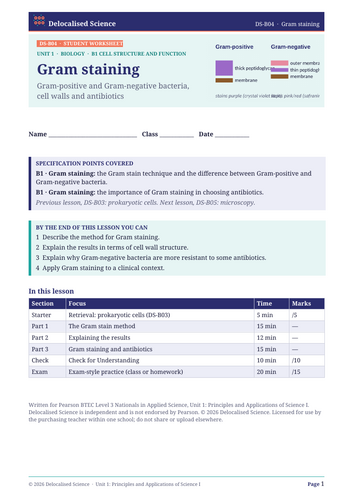
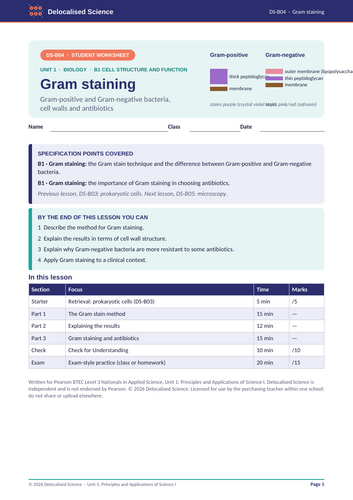
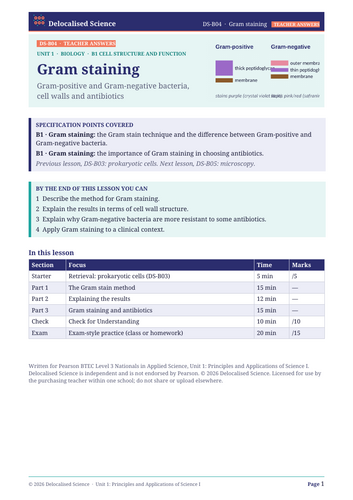
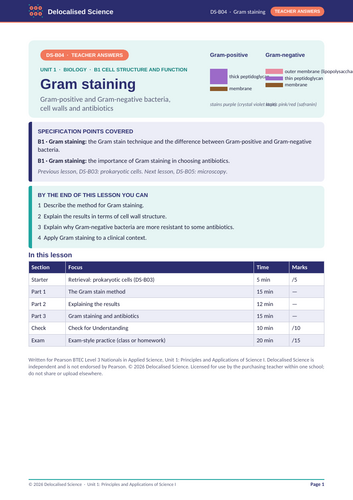
A complete, ready-to-teach lesson for Unit 1 (Principles and Applications of Science I), biology section: Gram-positive and Gram-negative bacteria, cell walls and antibiotics.
Learning objectives:
- Describe the method for Gram staining.
- Explain the results in terms of cell wall structure.
- Explain why Gram-negative bacteria are more resistant to some antibiotics.
- Apply Gram staining to a clinical context.
What’s included:
- Student worksheet (PDF and editable Word)
- Teacher version with model answers and mark schemes (PDF and editable Word)
- Teacher notes: lesson flow, common misconceptions and practical/safety notes
- Retrieval starter (5 marks)
- Structured tasks with key-idea boxes and clear diagrams
- Check for Understanding quiz (10 marks) with a confidence self-assessment
- Exam-style practice (15 marks), ending with a levels-marked 6-mark question with indicative content
Specification coverage:
- B1 · Gram staining: the Gram stain technique and the difference between Gram-positive and Gram-negative bacteria.
- B1 · Gram staining: the importance of Gram staining in choosing antibiotics.
About 60 minutes of teaching; the exam-style section works in class or as homework. All questions are original.
Written for the Pearson BTEC Level 3 Nationals in Applied Science. Not endorsed by Pearson. Single-school licence.
Something went wrong, please try again later.
This resource hasn't been reviewed yet
To ensure quality for our reviews, only customers who have purchased this resource can review it
Report this resourceto let us know if it violates our terms and conditions.
Our customer service team will review your report and will be in touch.
£3.00