


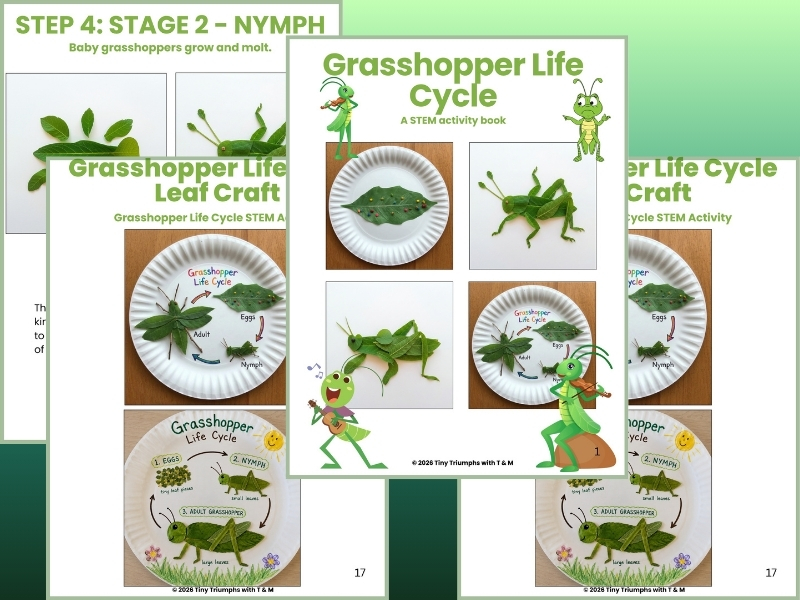
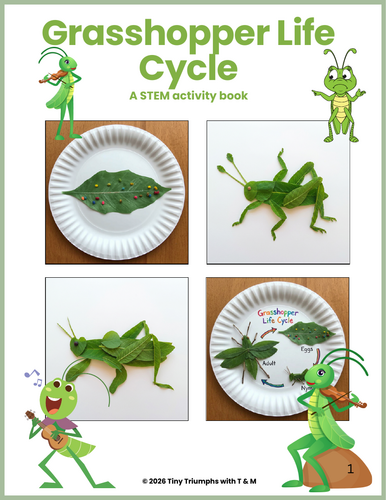
Grasshopper Life Cycle: A STEM Activity Book
Grasshopper Life Cycle is an immersive STEM activity book designed for young explorers (Ages 3–8) to discover the fascinating world of entomology. The book focuses on the concept of incomplete metamorphosis, guiding children through the three distinct stages of a grasshopper’s life: Egg, Nymph, and Adult.
Rather than just reading about science, children become active participants by using the “Nature Collage” method. By collecting real leaves and natural materials, students build physical models that illustrate how a grasshopper grows, changes, and eventually gains wings. This resource bridges the gap between outdoor exploration and classroom learning, making complex biological cycles easy to visualize and understand.
What’s Included
Life Cycle Lessons: Simple, illustrated explanations of the three growth stages (Egg, Nymph, and Adult).
Step-by-Step Nature Craft: A guided engineering project where children use different leaf sizes (tiny, small, and large) to build a grasshopper model.
Teacher Talk Prompts: Specific scripts and questions for educators and parents to use to deepen the child’s understanding during the activity.
STEM Learning Skills Checklist: A breakdown of how the book covers Science, Engineering, Art, and Math.
Observation & Reflection: Sections that encourage children to compare their leaf models to real insects found in nature.
Extension Activities: Ideas for “Bug Safaris” and further insect research to keep the learning going beyond the pages.
Primary Subject Areas
Life Science (Biology): The core curriculum focuses on life cycles, growth, and development. Specifically, it covers incomplete metamorphosis and the biological transition from egg to nymph to adult.
STEM (Science & Engineering): Students engage in scientific observation and engineering by constructing physical 3D models of insects using varied natural materials.
Mathematics (Measurement & Data): The resource requires students to categorize, compare, and select materials based on size (e.g., distinguishing between tiny, small, and large leaves).
Integrated Learning Skills
Environmental Education: By conducting a “Nature Walk” and a “Bug Safari,” students build a direct connection to their local ecosystem and learn to identify natural habitats.
Fine Motor Skills & Art: The creation of a “Nature Collage” develops hand-eye coordination through the precise application of glue, leaf placement, and drawing anatomical details like antennae and eyes.
Scientific Vocabulary: Early learners are introduced to domain-specific terms such as incomplete metamorphosis, nymph, molting, and organism.
© 2026 Tiny Triumphs with T & M
Something went wrong, please try again later.
This resource hasn't been reviewed yet
To ensure quality for our reviews, only customers who have purchased this resource can review it
Report this resourceto let us know if it violates our terms and conditions.
Our customer service team will review your report and will be in touch.
£2.99