




Book Snapshot
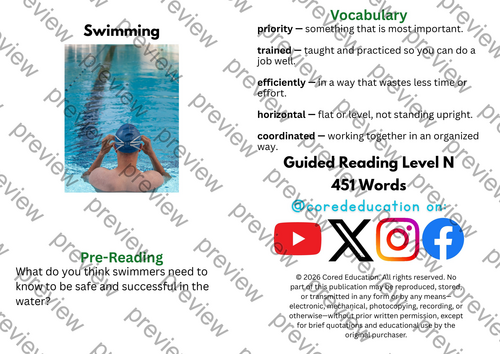
• Title: Swimming
• Genre: Nonfiction (informational)
• Subject: Physical Education / Health
• Primary Topic: Swimming safety, gear, strokes, and racing
• Estimated Guided Reading Level (A–Z): N
What This Book Teaches Best
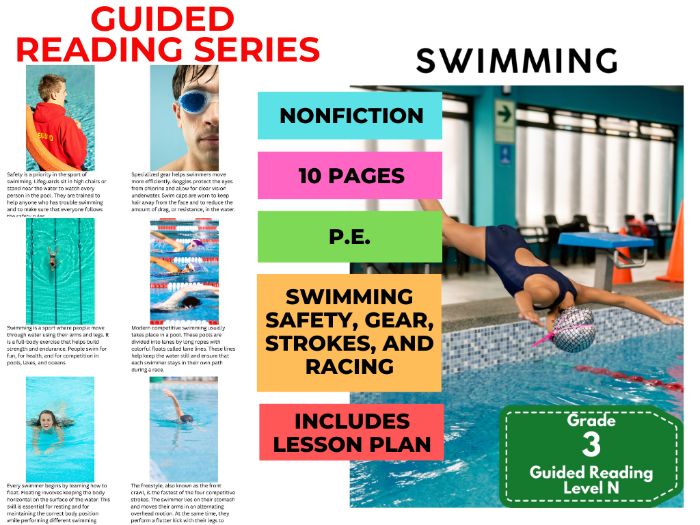
• How swimming uses arms and legs as a full-body exercise that builds strength and endurance.
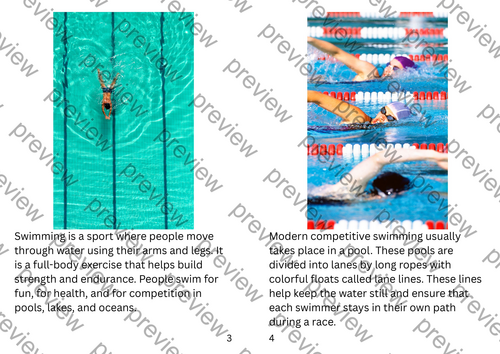
• How competitive swimming pools are organized with lanes and lane lines to help swimmers stay in their own path.
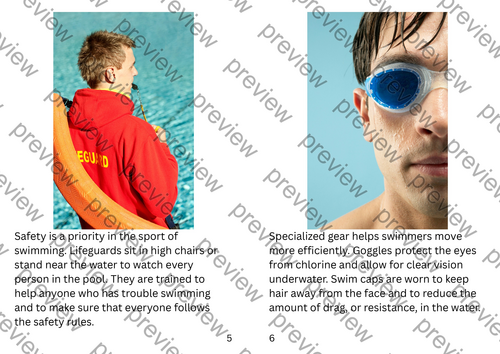
• Why safety matters in swimming and what lifeguards do to keep swimmers safe.
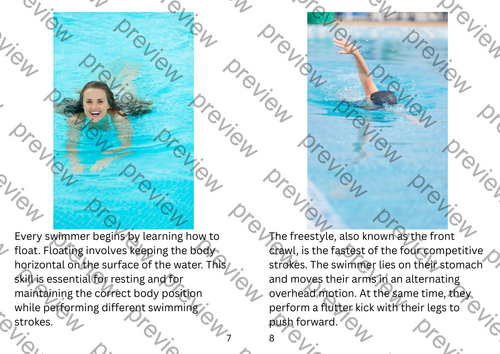
• How gear (goggles and swim caps) helps swimmers see clearly and reduce drag/resistance in the water.
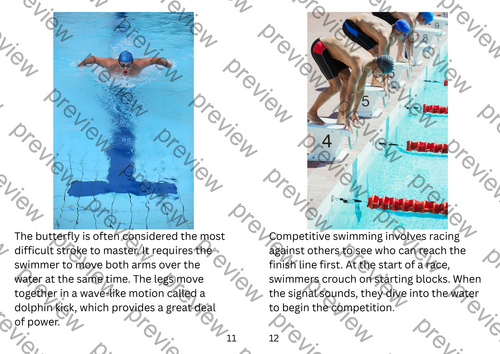
• Key features of the four competitive strokes (freestyle, backstroke, breaststroke, butterfly) and how races begin.
Learning Goals
• Students will describe where people can swim and why people swim (fun, health, competition).
• Students will explain how lane lines help swimmers during a race.
• Students will describe how lifeguards help keep swimmers safe and support swimmers who have trouble.
• Students will explain how goggles and swim caps help swimmers in the water.
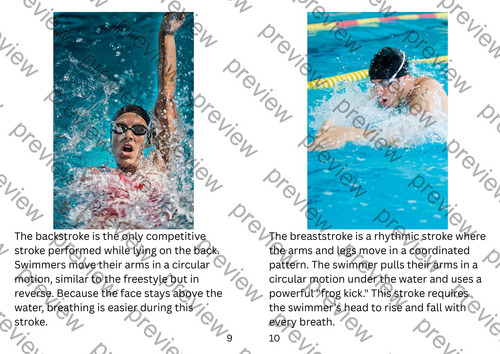
• Students will describe what “floating” is and why it is an essential beginner skill.
• Students will compare the four competitive strokes by identifying a key movement for each.
Key Vocabulary From the Text
• endurance — being able to keep going for a long time.
• competitive — about contests where people try to win.
• priority — something that is most important.
• efficiently — using less time or effort to do something.
• horizontal — flat and level, not standing upright.
Discussion Prompts
• Pre-reading question: What do you think swimmers must do to stay safe in the water?
• Comprehension questions: How do lane lines help swimmers during a race in a pool?
• Comprehension questions: What two jobs does the text say lifeguards do at the pool?
• Comprehension questions: Why is floating an essential skill for swimmers, according to the text?
Printing Tips
-
Best Printing Method (Recommended)
“Booklet” Printing (Best if Available)
If your printer or PDF viewer supports Booklet Printing, use this.
Settings to use:
• Print mode: Booklet
• Paper size: Letter or A4 (either works)
• Orientation: Landscape
• Print on both sides: Yes
• Flip on: Short edge
• Scaling: Fit to printable area
• Booklet subset:
o First test: Front sides only
o Then: Back sides only
This will automatically:
• Pair pages correctly
• Put the cover on the outside
• Align everything for folding
After printing, fold in half and staple along the spine. -
If “Booklet” Printing Is NOT Available
You can still print this correctly with manual duplex printing.
Step-by-step: -
Open the PDF.
-
Choose Print.
-
Set:
o Orientation: Landscape
o Pages per sheet: 1
o Print on both sides: Yes
o Flip on: Short edge -
Print all pages.
Because each PDF page already contains two facing book pages, the result will still fold cleanly into a book.
Something went wrong, please try again later.
This resource hasn't been reviewed yet
To ensure quality for our reviews, only customers who have purchased this resource can review it
Report this resourceto let us know if it violates our terms and conditions.
Our customer service team will review your report and will be in touch.
£1.25