


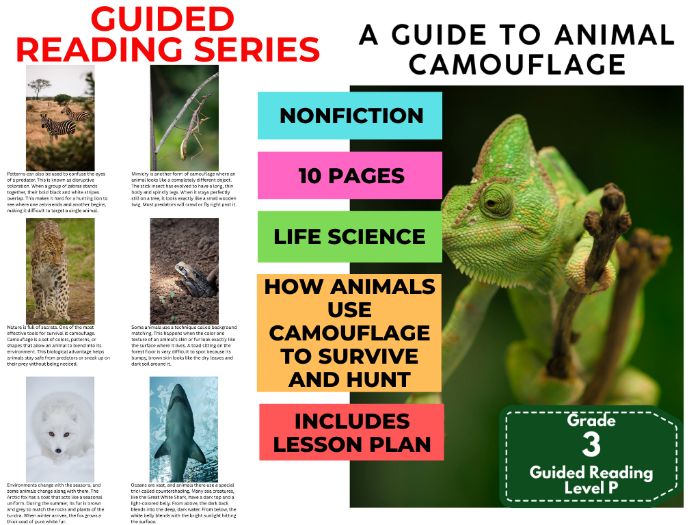

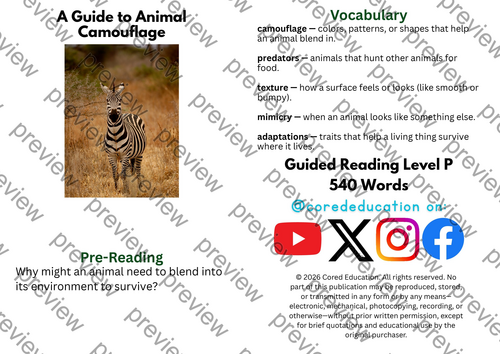
Book Snapshot
• Title: A Guide to Animal Camouflage
• Genre: Nonfiction (informational text)
• Subject: Life Science / Reading (Informational Text)
• Primary Topic: How animals use camouflage to survive and hunt
• Estimated Guided Reading Level (A–Z): P
What This Book Teaches Best
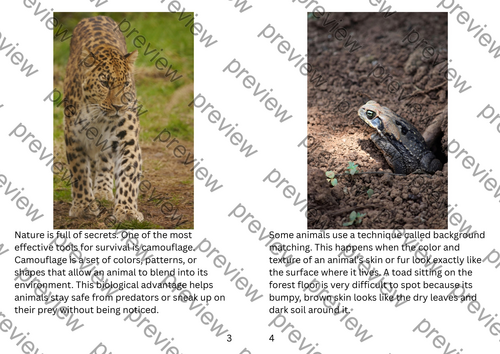
• What camouflage is and why it matters: Camouflage helps animals blend into their environment to stay safe from predators or sneak up on prey.
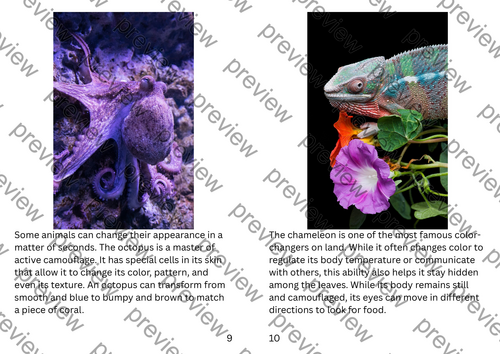
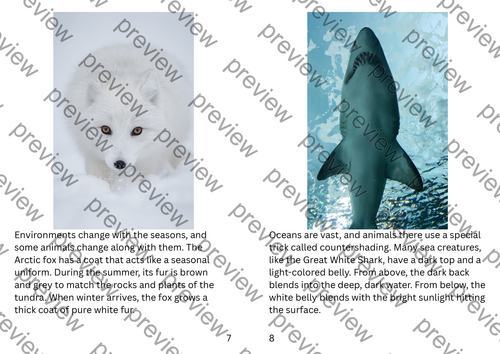
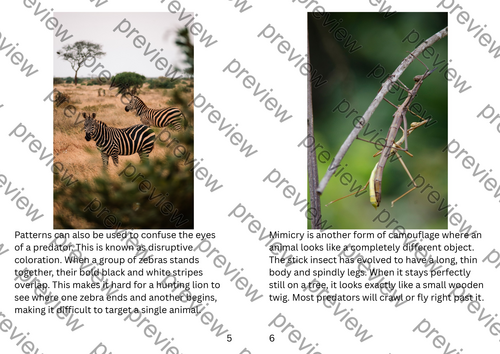
• Types of camouflage with clear examples: Background matching (toad), disruptive coloration (zebras), mimicry (stick insect), countershading (sea animals), and active camouflage (octopus).
• How animals change to match conditions: Seasonal changes in the Arctic fox’s coat and rapid changes in the octopus’s appearance.
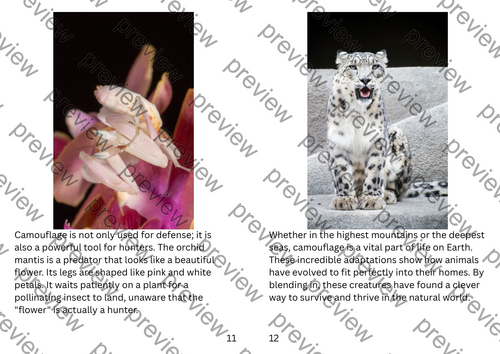
• Camouflage for defense and hunting: The text shows camouflage protecting animals and helping hunters like the orchid mantis.
• Adaptations and survival: Camouflage is presented as an adaptation that helps animals survive and thrive in their homes.
Learning Goals
• Students will explain what camouflage is and how it helps animals survive.
• Students will describe background matching and use the toad example from the text.
• Students will explain how disruptive coloration in zebra stripes can confuse a predator.
• Students will describe mimicry using details about the stick insect.
• Students will compare seasonal camouflage in the Arctic fox with countershading in sea animals.
• Students will describe how active camouflage works in the octopus and how the chameleon’s color-changing can help it stay hidden.
Key Vocabulary From the Text
• camouflage — colors, patterns, or shapes that help an animal blend in.
• predators — animals that hunt other animals for food.
• texture — how a surface feels or looks.
• mimicry — when an animal looks like a different object.
• countershading — dark top and light belly that help hide in water.
Discussion Prompts
• Pre-reading question: Why might an animal need to blend into its environment to survive?
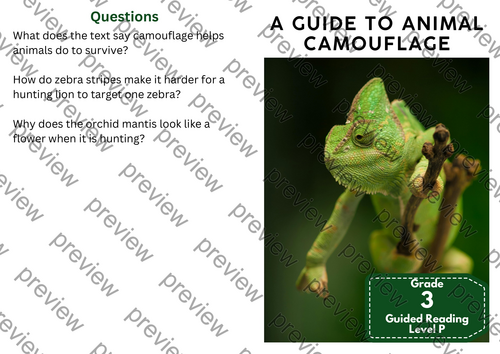
• Comprehension questions: What does the text say camouflage helps animals do?
• Comprehension questions: How do zebra stripes make it difficult for a hunting lion to target one zebra?
• Comprehension questions: How does countershading help sea animals blend in from above and from below?
- If “Booklet” Printing Is NOT Available
You can still print this correctly with manual duplex printing.
Step-by-step: - Open the PDF.
- Choose Print.
- Set:
o Orientation: Landscape
o Pages per sheet: 1
o Print on both sides: Yes
o Flip on: Short edge - Print all pages.
Because each PDF page already contains two facing book pages, the result will still fold cleanly into a book.
Something went wrong, please try again later.
This resource hasn't been reviewed yet
To ensure quality for our reviews, only customers who have purchased this resource can review it
Report this resourceto let us know if it violates our terms and conditions.
Our customer service team will review your report and will be in touch.
£1.25