


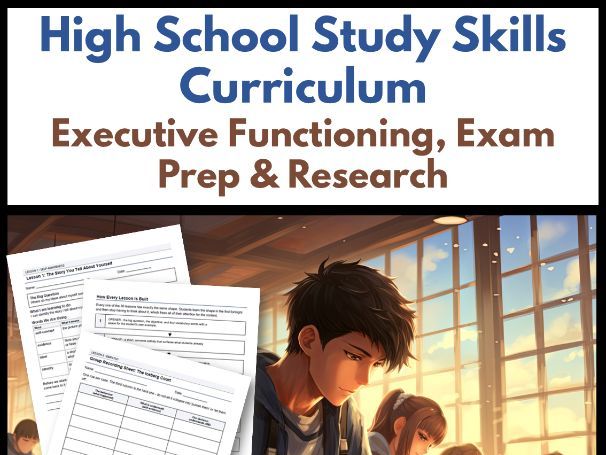
High School Study Skills Curriculum for Grades 9–12 is a comprehensive 10-unit program designed to help students manage the increasing academic demands of high school and become strategic, independent learners. Rather than focusing only on planners and reminders, the curriculum teaches students how to manage workload, study effectively, read complex texts, prepare for cumulative assessments, complete research-based assignments, and make responsible academic decisions.
The resource includes a Facilitator Guide, flexible Scope and Sequence, Student Self-Inventory, 10 complete study skills units, printable planners and trackers, a 30-prompt Reflection Journal, Family Guide, and assessment and progress-monitoring materials. Units cover Self-Regulated Learning; Systems and Workload Management; Time and Competing Commitments; Attention, Energy and Sustainability; Reading Complex Texts; Notes and Knowledge Capture; Deep Study Strategies; Exam Strategy; Research and Academic Writing; and Self-Advocacy and Independence.
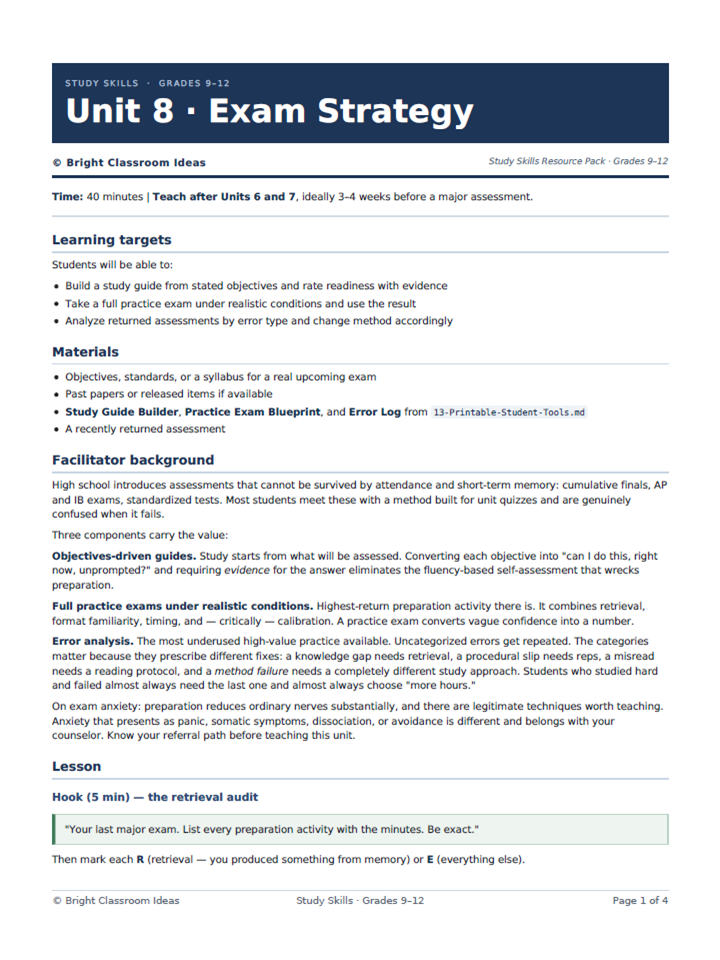
Each unit follows a consistent 40-minute structure: Hook, Model, Guided Practice, Transfer Task, and Close and Reflection. Students learn strategies explicitly, practice them with support, and then apply them to authentic academic situations. The transfer task is central, requiring students to use strategies with their actual assignments, current course content, upcoming assessments, and long-term projects.
The curriculum can be used in advisory, homeroom, study-skills electives, academic intervention, tutoring, student support programs, college and career readiness programs, homeschool, or independent instruction.
Students develop executive-function and academic skills including metacognition, workload management, prioritization, long-term planning, attention management, sustainable work habits, complex reading, note-taking, knowledge capture, retrieval practice, spaced studying, interleaving, elaboration, practice testing, error analysis, research, academic writing, source evaluation, citation management, and self-advocacy.
A major strength is its focus on evidence-based learning strategies rather than relying on rereading, highlighting, or motivational advice. Students learn to plan across an entire semester, identify deadline conflicts, work backward from major assessments, manage research and writing projects, and understand academic integrity and responsible AI-tool use.
The curriculum also prepares students for post-secondary independence by teaching appropriate communication, help-seeking, and self-assessment. A four-point developmental rubric tracks strategy use, growth, self-assessment, and transfer rather than compliance. The Family Guide encourages adults to coach independence instead of managing students’ schoolwork.
Overall, this resource gives Grades 9–12 students practical systems for planning, studying, reading, writing, testing, communicating, and managing their academic lives beyond high school.
Something went wrong, please try again later.
This resource hasn't been reviewed yet
To ensure quality for our reviews, only customers who have purchased this resource can review it
Report this resourceto let us know if it violates our terms and conditions.
Our customer service team will review your report and will be in touch.
$15.00